
Creator marketing is beginning to absorb a new metric: visibility inside AI-generated answers.
Digiday reported on September 18 that creators and agencies are starting to include AI citations and LLM discoverability in creator pitches.
The change is still early.
There is no standardized “AI citation rate.” There is no accepted pricing model. And appearing in an answer does not prove that a creator caused a recommendation or sale.
But the direction matters.
Creator value is expanding from:
- reach;
- engagement;
- clicks;
- affiliate sales;
toward a more difficult question:
Does this creator’s content influence what AI systems know, cite or recommend?
The pitch is changing before the measurement system is ready
Digiday reports that some creators are already telling brands when their content appears in AI search or assistant results.
Agencies are also being asked to identify creators with existing AI visibility.
That creates a familiar marketing pattern.
The market begins selling a signal before measurement is fully mature.
Years ago, creator campaigns relied heavily on follower count.
Then marketers added:
- views;
- engagement;
- clicks;
- affiliate revenue;
- conversion.
AI visibility could become another layer.
But it needs stronger measurement discipline than a screenshot showing one citation.
Why creators can matter to AI systems
Creators produce content with characteristics AI systems can find useful:
- first-person experience;
- product demonstrations;
- reviews;
- comparisons;
- niche expertise;
- video transcripts.
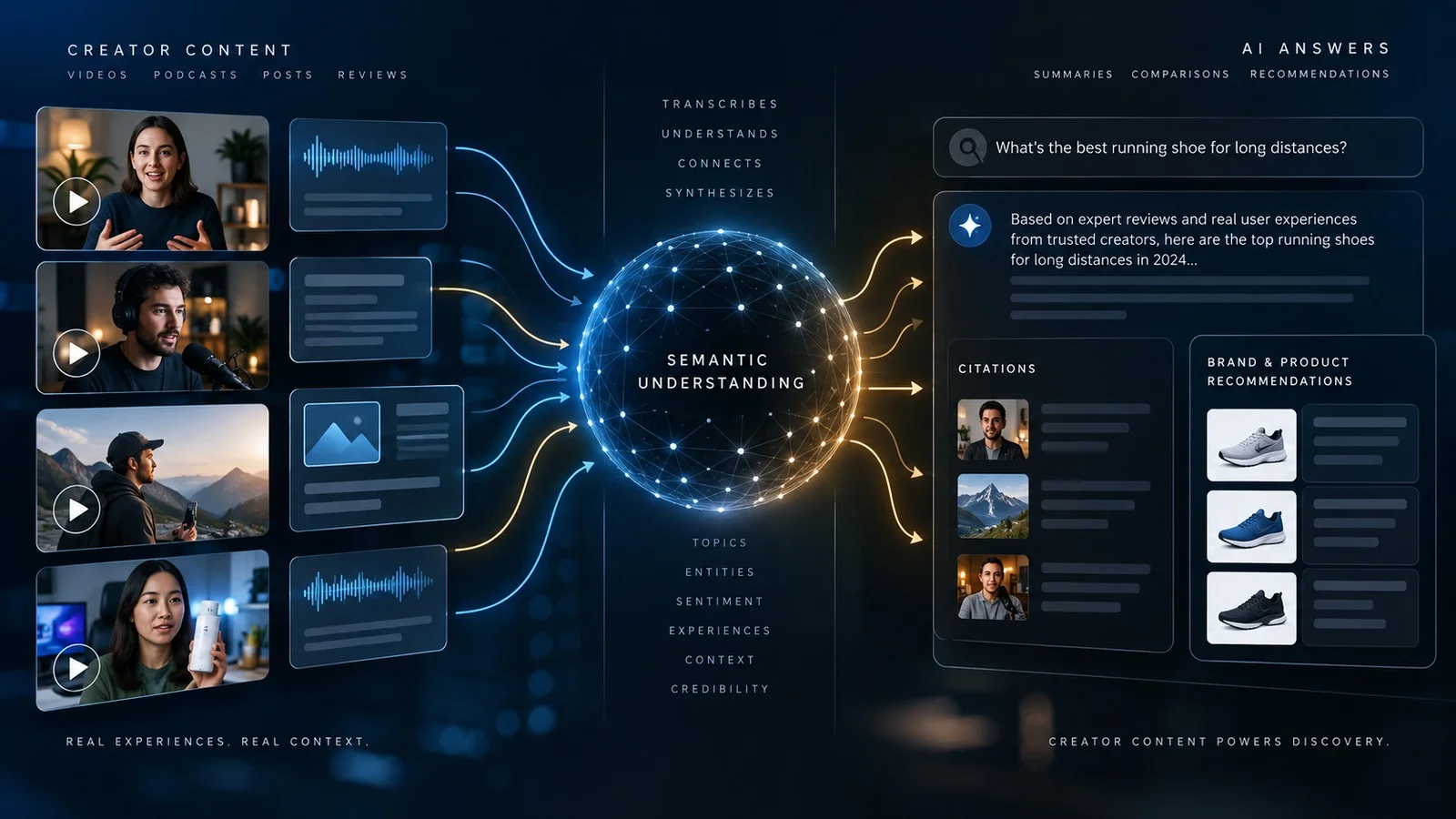
Some AI products retrieve web and video sources when answering questions.
That means creator content can become part of the information layer used to construct an answer.
A product review can influence:
- what attributes are discussed;
- which products are compared;
- which sources are cited.
This does not mean every creator post directly changes a model.
The mechanism differs by platform and query.
Marketers should avoid simplistic claims about “training the AI.”
The practical issue is discoverability and retrieval.
YouTube is particularly important
Digiday’s reporting points to YouTube as an important source surface for AI systems.
That makes sense operationally because YouTube content can contain:
- product demonstration;
- expert explanation;
- transcript text;
- audience validation;
- long-form context.
A creator video can function as both media and searchable evidence.
That is different from a short social post whose value disappears after the feed cycle.
The new creator brief may need AEO fields
A future creator brief could include traditional deliverables:
- number of videos;
- platform;
- usage rights;
- CTA;
- tracking link.
And new AI-discovery fields:
- target questions;
- brand entities;
- category terminology;
- product attributes;
- citation monitoring;
- query set.
Example:
Brand: running shoe company.
Target question: “best long-distance running shoes for flat feet.”
Creator deliverable: long-form review and comparison.
AI-discovery objective: increase the probability that the brand’s product is represented accurately when the category is summarized.
That is a more specific strategy than simply asking the creator to “mention the brand.”
Citation is not causation
This is the biggest measurement risk.
A creator can appear in an AI answer because:
- their content is authoritative;
- many other sites cite them;
- the brand is already popular;
- the query happens to match their wording.
Seeing the citation does not prove the creator changed buyer behavior.
A useful measurement model should separate:
Presence
Did the creator appear?
Frequency
How often across a stable query set?
Position
How prominently?
Brand outcome
Was the brand mentioned or recommended?
Commercial outcome
Did search, traffic, consideration or sales change?
Only the last layers move toward business impact.
Create a fixed query set
AI visibility measurement becomes meaningless if marketers check random prompts.
Define a recurring set.
Example:
- best CRM for small agencies;
- CRM with WhatsApp integration;
- HubSpot alternatives for agencies;
- easiest CRM to implement.
Then track:
- answer presence;
- citation source;
- brand mention;
- competitor mention;
- changes over time.
Use the same queries, geography and account conditions where possible.
AI answers can vary.
The objective is to create a directional monitoring system.
Creator selection may change
Traditional creator selection evaluates:
- audience fit;
- reach;
- engagement;
- content quality;
- historical conversion.
AI-era selection may add:
- topical authority;
- search visibility;
- long-form content;
- citation frequency;
- structured expertise.
A smaller specialist may become more valuable than a larger general creator if their content is repeatedly used as a trusted source.
That would be a meaningful shift.
It changes creator marketing from pure distribution toward information authority.
The commercial model is not ready yet
Digiday’s reporting is explicit that the market is early.
Creator AI visibility is currently closer to a sales point than a standardized metric.
That should make buyers cautious.
Do not pay a premium simply because a creator says:
“I get cited by AI.”
Ask:
- Which systems?
- Which queries?
- How often?
- Over what period?
- Compared with whom?
- Does it produce brand visibility?
- Does that visibility connect to demand?
Without this structure, AI citations risk becoming a new vanity metric.
Brands need to optimize the source content itself
If creator content is meant to support AI discovery, quality matters.
Useful content tends to have:
- clear subject;
- explicit entities;
- product names;
- concrete claims;
- experience;
- comparisons;
- structured language.
That should not produce robotic content.
The creator still needs to make something humans value.
The strongest content may be content that works for both:
- human audiences;
- retrieval systems.
Usage rights become more complicated
If creator content becomes a long-lived discovery asset, brands may want:
- reposting rights;
- site embedding;
- transcript reuse;
- paid amplification.
That increases the economic importance of usage rights.
A one-week social post and a two-year searchable review have different value profiles.
Creator contracts may need to account for that.
What marketers should do now
Add AI visibility to research, not compensation
Track it first.
Do not build a pricing model around immature signals.
Monitor fixed queries
Create a category query set.
Compare creator types
Test:
- specialist;
- celebrity;
- reviewer;
- practitioner.
Connect AI visibility to other demand signals
Watch:
- branded search;
- direct traffic;
- assisted conversion;
- referral traffic.
Preserve source credibility
Do not script creators into making unsupported claims simply to influence AI answers.
The strategic implication
Creator marketing is becoming part of the information layer of the internet.
A creator can:
- reach an audience directly;
- produce affiliate sales;
- create searchable content;
- become a cited source.
That makes creator strategy increasingly overlap with:
- SEO;
- AEO;
- PR;
- affiliate;
- content marketing.
The important change is not that AI citations are now a proven KPI.
They are not.
The change is that marketers are starting to ask whether creator content influences machine-mediated discovery at all.
Once that question enters the brief, measurement infrastructure usually follows.
Build an AI-discovery measurement sheet
A simple measurement system can begin without buying specialized software.
For every target query, record:
- date;
- AI product;
- prompt;
- creator cited;
- brand mentioned;
- competitors mentioned;
- recommendation position;
- linked source.
Repeat the same query set on a recurring cadence.
The result will be noisy.
That is expected.
The purpose is to establish a baseline.
Over time, marketers can ask:
- Which creators appear repeatedly?
- Which content formats are cited?
- Which topics produce brand mentions?
- Do citations persist?
Measure at three levels
Creator visibility
How often is the creator used as a source?
Brand visibility
How often does the creator's content lead to accurate brand representation?
Business impact
Do changes coincide with:
- branded search;
- referral traffic;
- affiliate sales;
- assisted conversion?
The third level is the hardest and most important.
Avoid AEO theater
The emergence of AI citations will inevitably create vendors promising guaranteed visibility.
Marketers should be skeptical of:
- one-off screenshots;
- unverifiable prompt sets;
- claims of direct causal influence;
- opaque proprietary scores.
AI discovery should be treated like early SEO measurement:
useful, changing quickly and easy to oversell.
Creators who genuinely have authority in a category may become more valuable.
But the market needs evidence before “AI visibility” becomes a pricing multiplier.
For now, the smart move is to measure it alongside established creator outcomes rather than replace them.