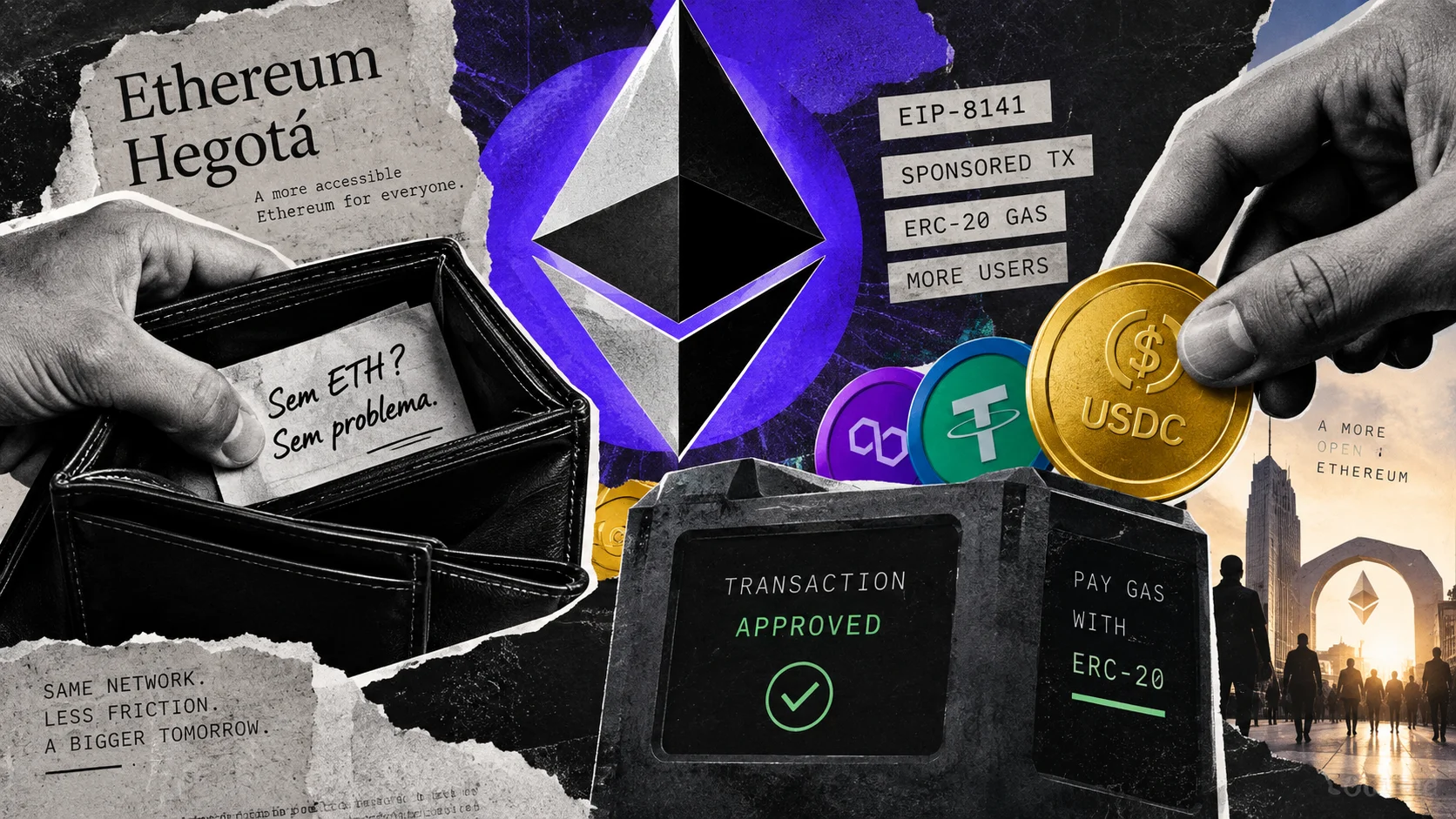
The Ethereum Foundation confirmed on Monday (7) that the EIP-8141, known as Frame Transactions, will be one of the main changes in the execution layer of the Hegotá upgrade. The proposal will allow users to make transactions without needing to keep ETH in their own wallet just to pay gas fees.
The change attacks a recurring friction in the use of the network. Today, a wallet may have stablecoins or other tokens, but still needs to obtain ETH before moving them if it does not have enough balance for the transaction fee.
With EIP-8141, gas payment can be sponsored by another account or offset with ERC-20 tokens. The specification provides, for example, that a sponsor pays the fee required by the network while receiving from the user the corresponding amount in another token.
This does not mean that ETH will stop participating in the settlement of Ethereum fees. What changes is the experience for the user: the wallet that initiates the operation will not necessarily need to hold ETH, because another account can assume the payment to the protocol.
A new structure for transactions
EIP-8141 creates a new type of transaction called Frame Transaction. Instead of treating authorization, gas payment and execution as a single rigid step, the operation is divided into different “frames,” which can separately define who authorizes the transaction, who pays for it and which actions will be executed.
The specification itself cites among the intended uses sponsored transactions, gas payment with ERC-20 tokens and batch operations. It will also be possible to maintain a dedicated account with ETH to pay the fees of other wallets that hold only stablecoins, NFTs or other assets.
The change is part of a broader effort of account abstraction, a model that seeks to transform Ethereum accounts into programmable structures. In addition to simplifying fee payment, Frame Transactions allows separating the account from current ECDSA keys and paves the way for new authentication systems, including methods resistant to quantum computers.
The Ethereum Foundation's protocol cluster classified EIP-8141 as S-tier, a level reserved for changes considered mandatory to define Hegotá, and described it as the main item in the execution layer of the upgrade. The foundation said that if a proposal in this category faces problems, the preference is to adjust the schedule before removing it from scope.
Despite that commitment, the technical specification of EIP-8141 still formally appears as Draft. The code will need to go through implementation stages, test networks and validation before reaching mainnet.