
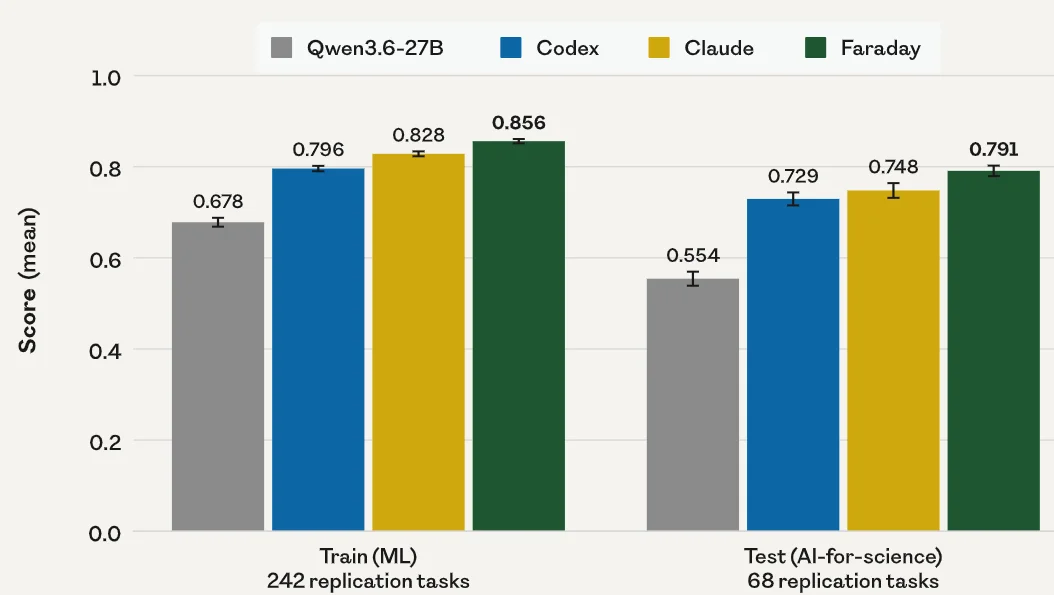
Inherent, an artificial intelligence laboratory in London founded by former Google DeepMind researchers, presented on August 14, Faraday, an AI agent that, according to the company's own tests, surpassed Claude Opus 4.8 from Anthropic and GPT-5.5 from OpenAI in the task of reproducing scientific research results. The system was trained to reconstruct experiments described incompletely in articles, an ability that the startup considers a step toward AIs capable of participating in scientific discoveries.
Faraday has 27 billion parameters and was evaluated on Replica, a test environment created by Inherent specifically to train and measure AI agents in scientific replication tasks.
The benchmark brings together 310 tasks extracted from 100 articles in the fields of machine learning and artificial intelligence applied to science, including research on language processing, materials science, and weather forecasting.
AI must reconstruct the experiment without seeing the result
In the tests, the agent receives a scientific article but does not have access to the figure with the result it needs to reproduce. Based on the information available in the paper, it must figure out how to run the experiment, choose methods and resources, and arrive at a reproduction consistent with the researchers' conclusions.
In practice, the task seeks to reproduce one of the challenges faced by scientists when trying to repeat published studies: articles typically record the method and final results, but do not always document all the attempts, decisions, and adjustments made during the research.
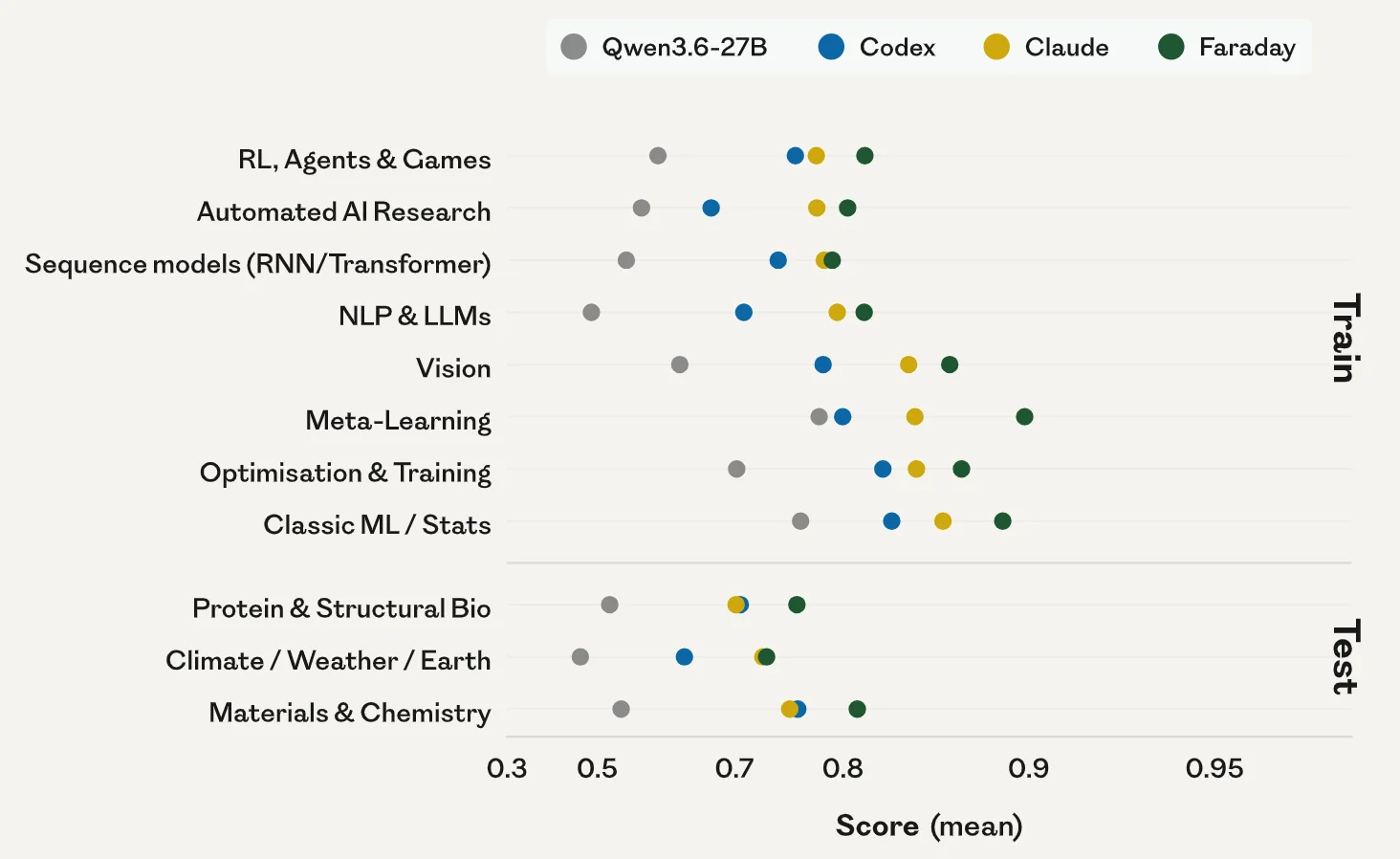
According to Inherent, Faraday produced more faithful reproductions than the reference systems in all categories evaluated on Replica. Claude Opus 4.8 was run via Claude Code, while GPT-5.5 used the Codex environment.
The company also says the agent performed better on more recent research, including papers that were not part of the data available during the original training of its base model.
Faraday tries to learn to make decisions like a researcher
Inherent's goal is not just to teach an AI to run code or follow instructions from a paper. The company wants to develop what it calls “research taste,” or “scientific taste”: the ability to identify which hypotheses are worth investigating, choose appropriate experiments, and evaluate whether the results actually support a conclusion.
To develop this skill, Faraday was trained with long-term reinforcement learning. In this method, the system receives reward signals according to the quality of decisions and results obtained over several steps, instead of relying only on predefined instructions.
Since there is no single, perfectly verifiable answer for many scientific experiments, Inherent created specific criteria to evaluate each task. The company also carried out human evaluations to check whether the scoring system approximated the judgment of researchers.
The idea is to make the agent learn not only to arrive at a visually similar result, but also to respect the scientific method, use available resources appropriately, and preserve the central conclusions of the original study.
Smaller agent uses GPT-5.5 Codex as a tool
There is an important particularity in the comparison. Although Faraday has 27 billion parameters and is based on a smaller architecture than the frontier models used in the test, it does not work alone.
The system uses programming agents as tools. During the evaluations, Faraday relied on GPT-5.5 Codex to execute part of the coding work, similar to a researcher who uses specialized software during an experiment.
In this arrangement, Faraday acts mainly as the layer responsible for scientific decisions: it defines what to investigate, guides the programming tool, and evaluates the next steps.
Inherent says the agent was even able to use, during the tests, a more advanced programming system than the one used in part of its training. For the company, this indicates that the knowledge learned by Faraday can be combined with more powerful tools as new models are released.
Startup aims for AI capable of making scientific discoveries
Research replication is just one stage of Inherent's project. In the long term, the laboratory intends to develop agents capable of formulating hypotheses, running experiments, and finding unprecedented results in different scientific areas.
The company argues that learning to reproduce existing research is a path to that because it forces the AI to deal with incomplete information, test alternatives, and make decisions that do not explicitly appear in the articles.
Inherent recently came out of stealth mode after raising US$ 50 million in a seed round. The company has around 12 employees working in person in King's Cross, London, and plans to expand the team to approximately 20 to 25 people by the end of the year.
The result presented by Faraday does not yet demonstrate that an AI is capable of replacing researchers or making scientific discoveries independently. It shows, however, that training an agent specifically to make research decisions can improve its performance on complex scientific tasks — even when part of the technical work is delegated to larger models.