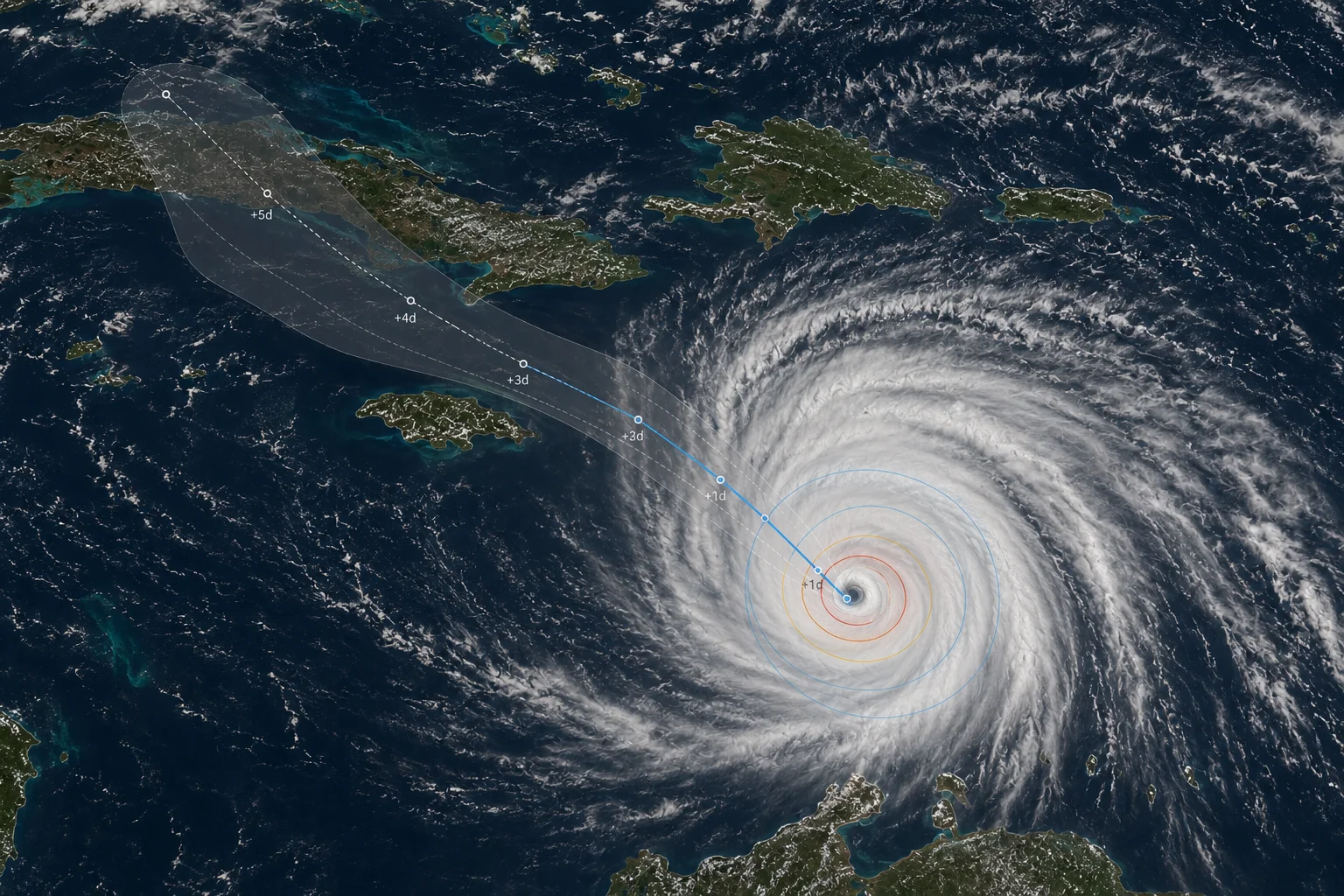
Google DeepMind has reported developing WeatherNext Cyclones (WN-C), an artificial intelligence model that simultaneously predicts the track and intensity of tropical cyclones. In a study published in Nature, the system demonstrates the ability to see about one day ahead of the main operational models, a gain equivalent to advances in traditional methods over the past decade.
The model was built in partnership with the National Hurricane Center (NHC), the Cooperative Institute for Research in the Atmosphere (CIRA), and the UK Met Office. Since June 2025, forecasts have run live on Google's Weather Lab. During Hurricane Melissa, which hit Jamaica in 2025, WN-C helped the NHC predict the storm's rapid intensification in time, according to DeepMind. Rapid intensification occurs when a cyclone gains at least 30 knots in wind speed within 24 hours.
End of a decades-old dilemma
Tropical cyclone forecasting has always run into a dilemma. Global models, such as the ECMWF's ensemble system (ENS), are strong on track but coarse on intensity. Specialized regional models, such as NOAA's Hurricane Analysis and Forecast System (HAFS), deliver more accurate intensity readings but lose accuracy on track. WN-C combines both functions in a single system.
For a five-day forecast, the mean error in the estimated position of the storm center is 230 km, compared with 370 km for ENS and 335 km for GenCast, DeepMind's previous model. For three-day intensity forecasts, WN-C is 3.75 knots more accurate than HAFS.
WN-C also scores more than double that of ENS and GenCast in probabilistic intensity forecasts across several lead times. For the probability of 64-knot winds, the threshold at which a storm reaches hurricane strength, the model delivers greater practical value for decision-making, according to DeepMind.
Coarse data, accurate forecasts
WN-C operates on a data grid in which each point covers about 28 km, roughly one hundred times coarser than that of specialized regional models. Even a compact variant, with 111 km per point, produces competitive results, according to DeepMind. "High resolution is not a strict prerequisite for state-of-the-art intensity forecasting," the authors write. The reason the model generates such accurate forecasts at this resolution remains an open question.
Technique and training
Instead of the diffusion used in GenCast, WN-C uses Functional Generative Networks (FGN). GenCast requires dozens of passes through the neural network at each forecast step; FGN requires a single pass and is eight times faster. To represent uncertainty, the system injects noise into the network's control layers, rather than adding noise to individual pixels, producing different but physically consistent scenarios.
The training combined nearly 20 terabytes of global atmospheric data from ECMWF analyses with a database of about 5,000 historical cyclones. Tabular storm data – position, intensity, and extent – were projected onto the same geographic grid as the weather data, allowing the network to learn from both sources together. Ablation studies in the paper show that this joint training is what drives the improvements.
Forecasts at scale
A 15-day forecast runs in less than a minute on a Google AI chip, which allowed DeepMind to increase the number of parallel runs per storm from 50 to 1,000. Large ensembles like this can help capture rare extreme events more reliably. The Critical Success Index, which weighs correct warnings against false alarms and missed events, jumps from below 0.3 to 0.5.
Complement, not substitute
Traditional numerical models remain relevant, DeepMind says. The NHC typically combines results from several physics-based models into a weighted average for its official advisories, split between track (TVCN) and intensity (IVCN). In a simulation that added WN-C to these consensus forecasts, the model improved track forecasts by an average of 28% and intensity forecasts by about 6%. The smaller gain in intensity suggests that traditional models still carry relevant weight in this area.
The code and weights for WeatherNext 2 and WeatherNext Cyclones have been made publicly available on GitHub. The mini variant runs on a single TPU in a free Colab notebook. For official advisories, the authors recommend national meteorological services; WN-C is a tool to support forecasters, not a substitute.
WN-C is the latest evolution of an open lineage from DeepMind: GenCast, released in late 2024, was the first probabilistic model to beat the ECMWF ensemble; WeatherNext 2 was presented last year; and Weather Lab, Google's platform for cyclone forecasting, went live in June 2025 with the experimental model that now becomes WeatherNext Cyclones.