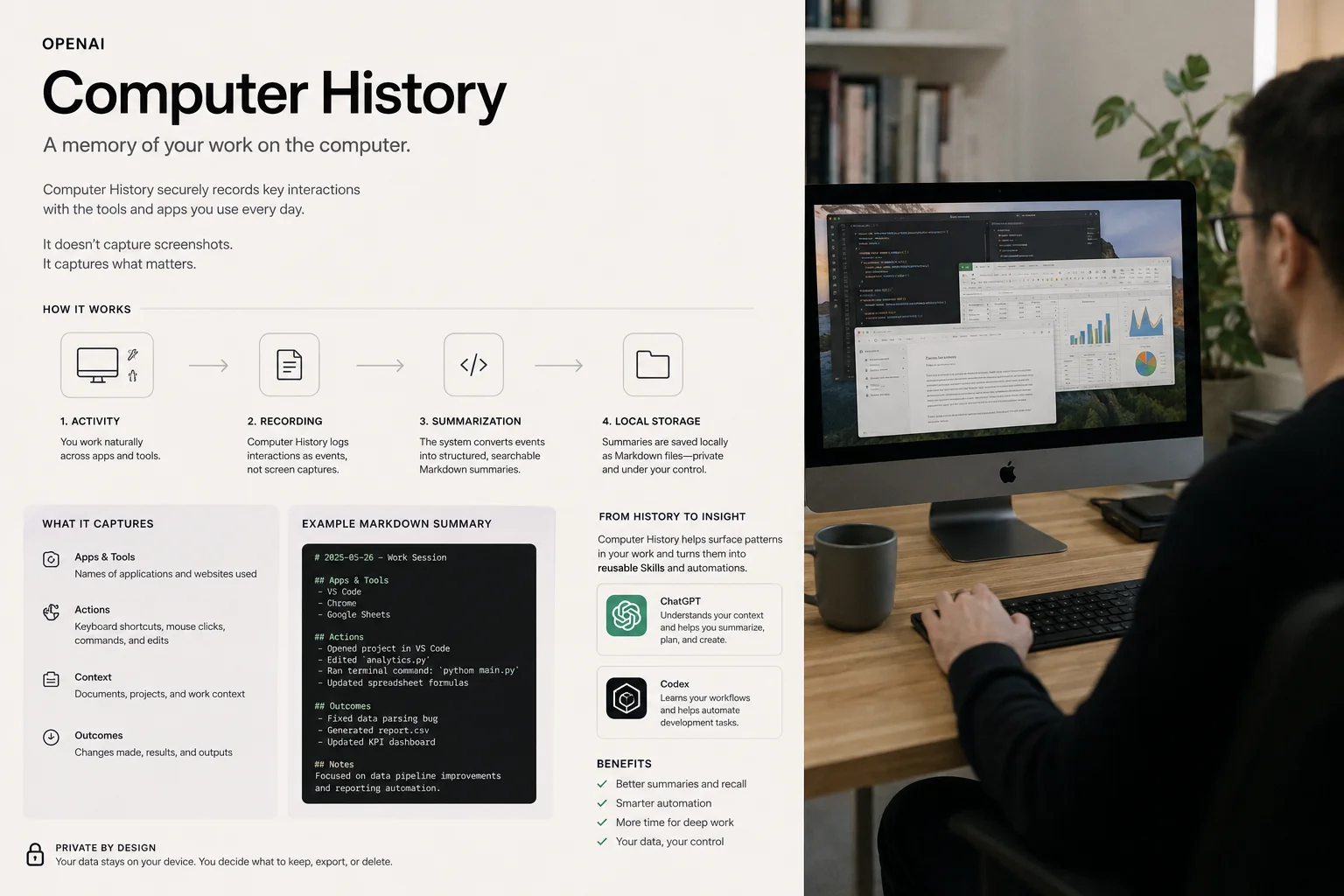
OpenAI unveiled Computer History, a feature that records clicks, keystrokes, and app switches on macOS to create a searchable timeline of memories used as context by ChatGPT and Codex.
The feature replaces the Chronicle research preview, which relied on screenshots. Instead of recording the screen, Computer History records interaction events such as clicks, keystrokes, keyboard shortcuts, and app changes, read by macOS's accessibility system. There is no capture of images, microphone audio, or system sound, and private browsing is excluded.
The captured events are periodically converted into text summaries and stored locally as Markdown files. The timeline groups the summaries by day and time and indicates which apps were used.
Repeated flows turn into automations
When ChatGPT identifies recurring patterns in activities, Computer History suggests a Skill or automation. The user can ask Codex to create a reusable model from the recorded flow. OpenAI cites finding recently edited documents and generating standup summaries as examples.
Permissions and availability
On Business and Enterprise accounts, the administrator must enable the feature, and each user must give individual consent. The feature also requires the Memories feature to be turned on. Users control which sites and apps contribute data through allow and block lists, and can pause or resume recording from the macOS menu bar. Computer History is not available in the European Economic Area, Switzerland, or the United Kingdom.
Local storage and risks
The temporary event files are stored in the ChatGPT app group on the Mac and are deleted after 48 hours. The memory files generated from them remain as plain-text Markdown on the local system, without encryption, until the user deletes them. As a result, any program running under the same macOS user could read them. OpenAI processes the temporary files on its servers but says it does not keep them after processing, except when required by law.
OpenAI says the files are not used to train models. However, when memories appear as context in subsequent conversations, the content of those conversations can become training data depending on the user's data control settings.
OpenAI's documentation warns of a high risk of prompt injection. Because Computer History captures content from apps and websites, malicious instructions embedded in a web page could trick ChatGPT or Codex. The company recommends not using the feature with communication apps without explicit consent from all participants and suggests pausing or excluding apps that handle sensitive health, financial, or personal data.