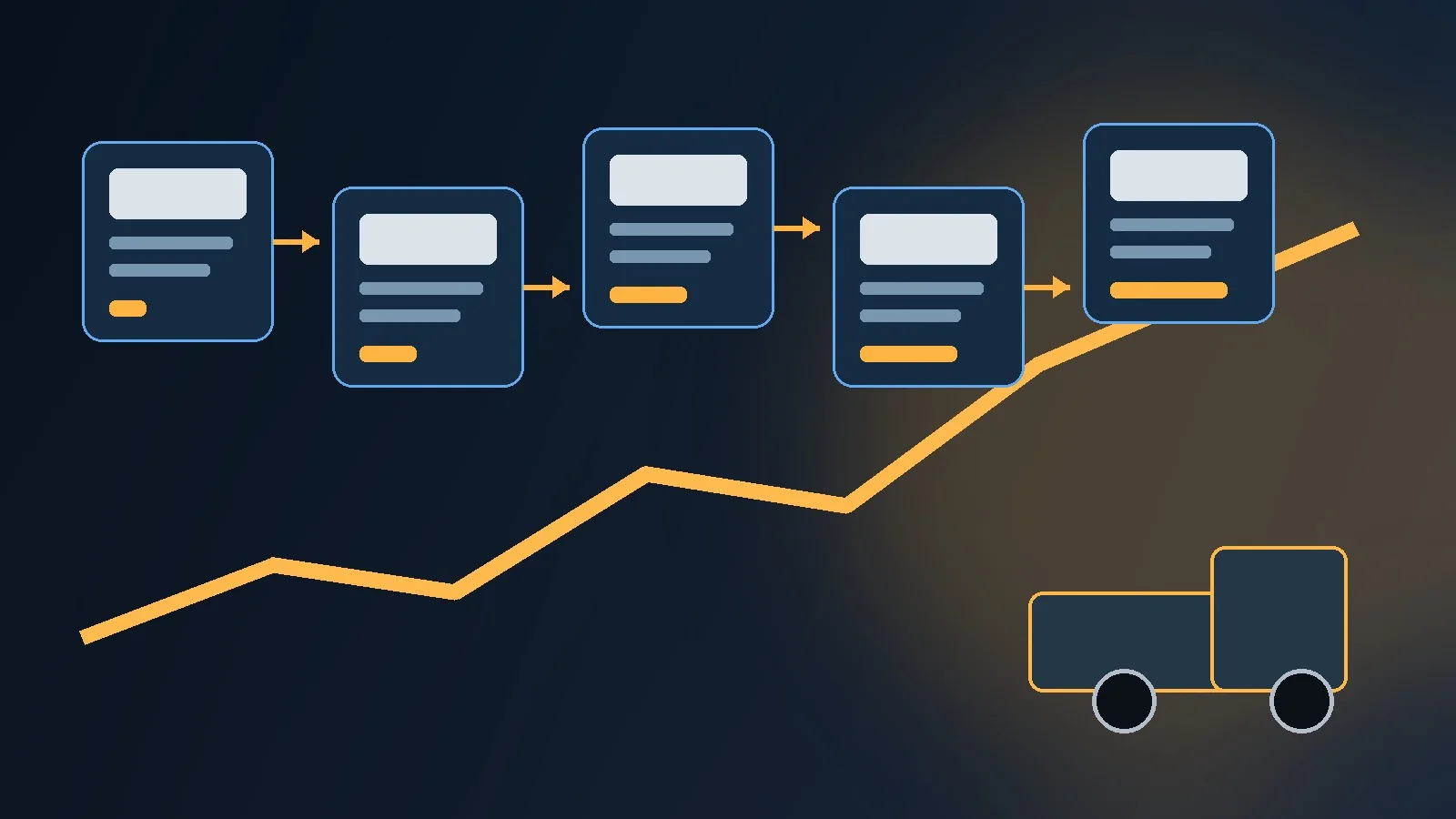
TruckersReport’s landing-page case is valuable because the final 79.3% lift did not come from one clever redesign.
It came from six rounds of testing, including several ideas that lost.
CXL founder Peep Laja originally documented the case in 2013 and later republished it. TruckersReport was a large professional-driver community with more than one million monthly visits at the time of the case.
One service helped drivers find better jobs.
Users entered through a landing page, provided information and continued into a multi-step resume-building funnel.
The initial landing page converted 12.1% of visitors into email opt-ins.
After iterative research and testing, the final tested version reached a 21.7% conversion rate — 79.3% higher than the initial baseline.
The important lesson is not the percentage.
It is the process that produced it.
Start with research, not redesign
The CXL team did not begin by changing colors.
It analyzed Google Analytics, click behavior, scroll behavior, attention heatmaps, session recordings and customer survey responses.
The research identified several issues.
About half of traffic came from mobile devices. The headline lacked a clear benefit. The imagery felt generic. The page lacked credibility. The audience cared strongly about pay, benefits, home time and respect.
This created specific hypotheses.
Research did not tell the team exactly which design would win.
It reduced the number of arbitrary guesses.
The first test lost
One common CRO heuristic says fewer form fields create less friction and therefore increase conversion.
The team tested that.
The control won by 13.56%.
That result matters.
The team did not decide that CRO was useless.
It learned that fewer fields were not automatically better for this audience and funnel.
The fields may have contributed credibility, relevance, commitment or context.
This is the same broader lesson seen in the Smartlook case: friction is not universally negative.
A stronger promise hurt downstream quality
The second test used language based on customer research.
The variation emphasized the problems drivers said they cared about.
That sounds like textbook conversion practice.
But the result was mixed.
CXL reports no material improvement in landing-page opt-ins.
More importantly, the original version produced 21.7% better bottom-of-funnel conversion.
The more aggressive promise attracted people into the top of the funnel who were less likely to finish the full process.
This is one of the strongest parts of the case.
A message can improve attention while weakening intent quality.
The correct metric depends on the business objective.
The new design improved the full funnel
In the third test, the team compared the new landing page with the original.
The new page produced:
- 21.7% more opt-ins;
- 24% more full-funnel signups;
- 99.7% confidence on the reported opt-in result.
The team also tested a “job match” progress page.
Analytics had shown a 10.8% drop-off at that step.
Removing it did not hurt bottom-of-funnel conversion, so it was eliminated.
That is another useful lesson.
Progress screens, confirmation screens and intermediate steps should earn their place.
If a step creates abandonment without improving downstream quality, remove it.
The obvious headline ideas lost
The fourth test evaluated several headline variants.
The control was simple: “Get a truck driving job with better pay.”
Variations included a question, a three-benefit formulation and an autonomy-oriented formulation.
The simple original headline beat the second-best variation by 16.2%, according to CXL.
This reinforces a recurring CRO principle:
clarity often beats persuasion tactics.
The customer research had identified many benefits.
That did not mean all of them belonged in the headline.
Simplicity won when tested in the right place
The fifth test used a shorter page with less copy.
This variation produced 21.5% more opt-ins than the control at a reported 99.6% confidence level.
Notice the difference from the earlier failed test.
Reducing form fields lost.
Reducing page complexity won.
“Less friction” is too broad a principle.
Different kinds of friction behave differently.
A shorter page can reduce cognitive load while still preserving useful qualification fields.
The sixth test produced the largest result
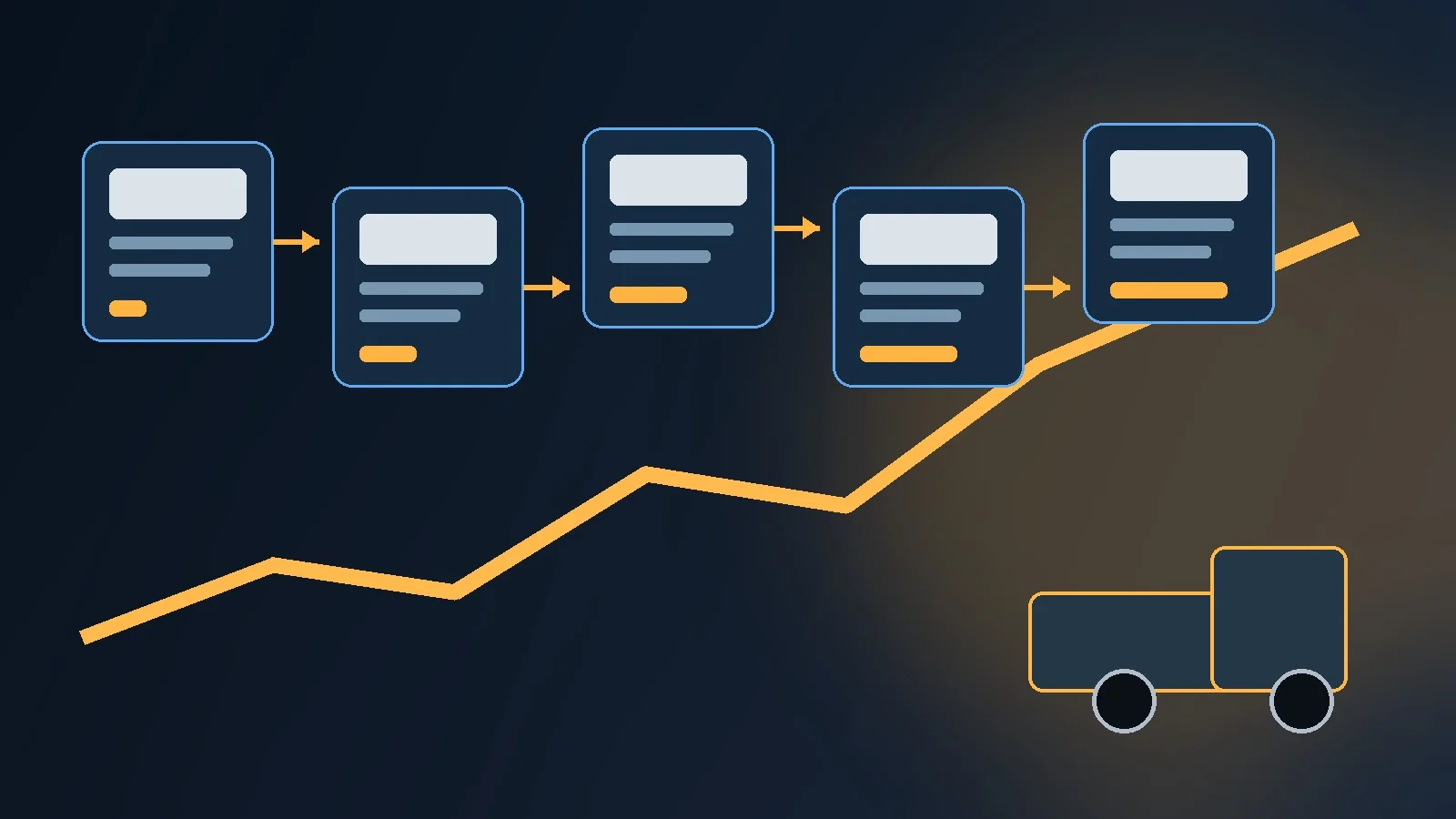
The final round tested additional simplification.
The winning variation removed the name field and placed email later in the sequence, after easier selections.
CXL reports:
- 44.7% more opt-ins than the control;
- 99.9% confidence;
- final conversion rate of 21.7%.
Compared with the initial 12.1% landing-page conversion rate, that represented a 79.3% lift.
The sequence matters.
The team did not start with this exact configuration.
It arrived there using insights from earlier tests.
Why iterative CRO compounds learning
A one-off A/B test asks whether variation B beat A.
A testing program asks what the result taught the team about user behavior and what should be tested next.
TruckersReport’s sequence produced several lessons:
- fewer fields were not always better;
- big promises could reduce downstream quality;
- the new design improved both opt-ins and final conversion;
- simple headlines beat clever alternatives;
- shorter content helped;
- form sequence mattered.
Each result narrowed the next search space.
That is why the final lift cannot be attributed to one best practice.
It was a cumulative research process.
The full funnel matters
The case repeatedly distinguishes between landing-page opt-in and full-funnel completion.
That is essential.
A top-of-funnel experiment can create more leads, worse leads, more abandoned downstream sessions and higher operational load.
For a recruiting funnel, the value is not an email address.
The value is a qualified driver completing enough information to be matched with employers.
This changes the scorecard.
Primary metric:
- completed funnel.
Secondary metric:
- landing opt-in.
Guardrails:
- quality;
- downstream completion;
- recruiter outcomes.
What operators can copy
1. Instrument before redesigning
Use quantitative and qualitative evidence.
2. Ask customers
Use their language to generate hypotheses, but still test it.
3. Measure the full funnel
Do not let a local lift hide downstream damage.
4. Store learnings
Every test should produce a record containing hypothesis, variant, result, segment and interpretation.
5. Build the next test from the previous one
This is where experimentation becomes a system.
6. Preserve control variants long enough to learn
Do not declare victory from early movement.
What not to copy
Do not assume short pages always win, email should always come last, simple headlines always beat questions or fewer form fields are bad.
The case itself disproves several universal rules.
The right move depends on audience, funnel, intent, product and traffic source.
Why this old case still matters
The interfaces in this case are dated, but the operating logic remains current. Modern teams still face the same temptation to copy “best practices,” optimize a local metric and move on after one test. TruckersReport shows why that is weaker than a sequence of connected experiments.
The case also demonstrates the value of preserving negative results. The failed shorter-form test and the weaker benefit-heavy headline were not wasted work. They changed what the team tested next. In a mature experimentation program, that accumulated knowledge reduces future uncertainty.
The relevant modern equivalent is an experiment repository that connects research evidence, variants, results, guardrails and follow-up hypotheses. The tooling has improved; the need to learn systematically has not.
Limitations of the case
This is a historical case.
CXL notes that it originally appeared in 2013.
That means devices and traffic behavior have changed, testing platforms have changed, statistical practices have evolved and the recruiting market is different.
The reported percentages are valuable as case evidence but should not be treated as modern benchmarks.
The enduring value lies in the testing process.
The operating lesson
TruckersReport improved landing-page conversion from 12.1% to 21.7% after six rounds of tests.
But the deeper lesson is that several “best practices” lost along the way.
The team improved performance because it tested hypotheses against real behavior and carried the learning forward.
For operators, CRO should therefore be managed as a learning system:
research → hypothesis → experiment → downstream measurement → learning → next experiment.
The 79.3% lift was the visible result.
The reusable asset was the process that produced it.