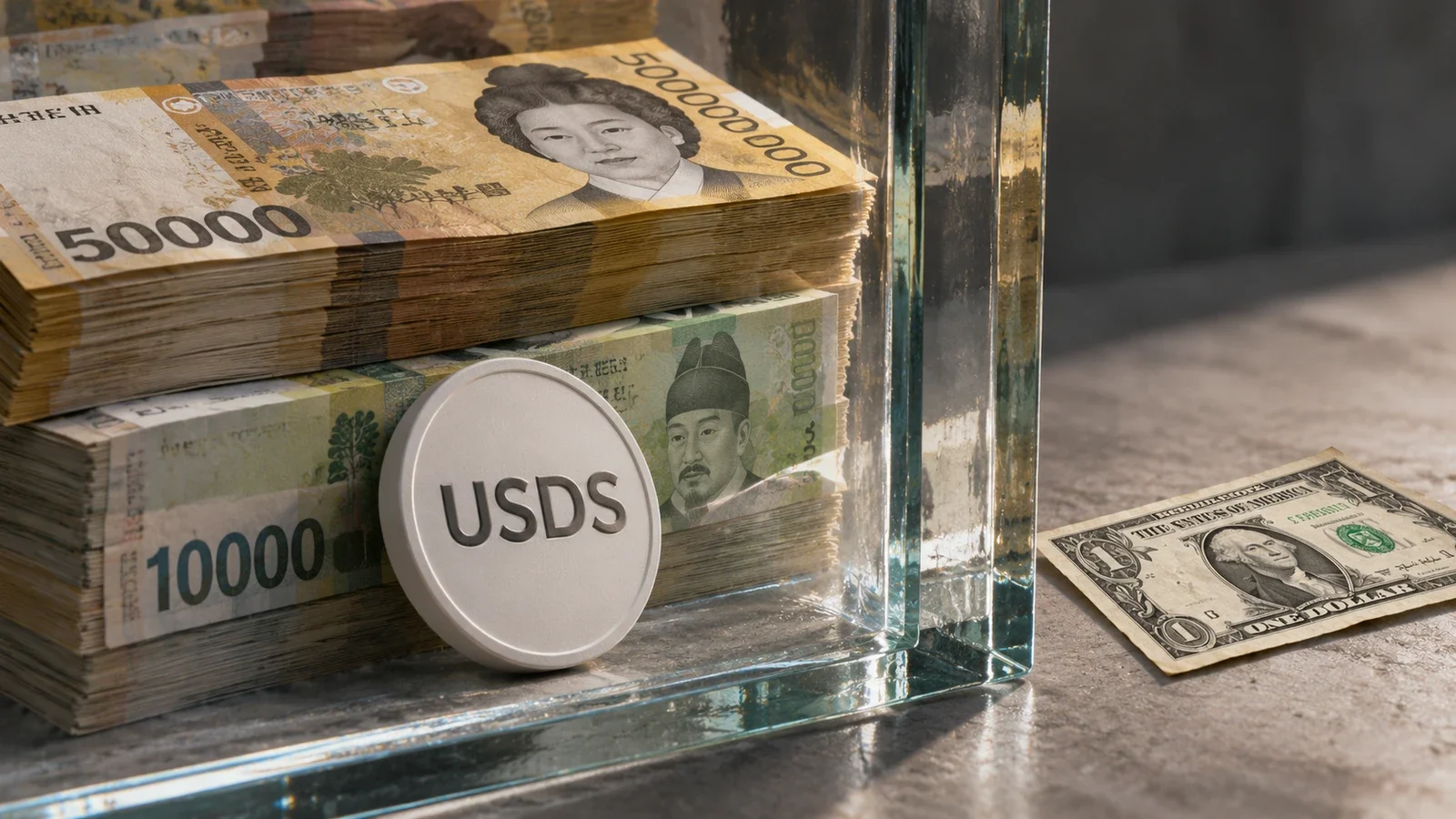
The USDS stablecoin, designed to track the value of the dollar, was traded at 7,835 won on Upbit, one of the largest cryptocurrency exchanges in South Korea, on Tuesday (24). The price represented a premium of approximately 480% over the international quote, after the suspension of deposits at the country's main exchanges interrupted the inflow of tokens bought abroad.
The move occurred even though USDS remained close to parity at US$ 1 in international markets. At 1:15 p.m. on Tuesday, the coin was still trading at 5,970 won on Upbit, while it cost 1.0012 USDT on Binance. At that moment, the premium had already retreated to about 334%, according to the comparison published at the time, with variations depending on the exchange rate used.
The gap continued to shrink on Wednesday (25). At 3 p.m. South Korean time, USDS was trading at 3,630 won on Upbit, against approximately 1,341 won on the international market, according to data published by the South Korean newspaper Herald Economy. Even after the drop, the domestic price remained more than twice the global reference.
Why the deposit block triggered the surge
On November 23, Upbit, Bithumb and Coinone classified USDS and SKY, the governance token of Sky Protocol, as assets that require caution and suspended their deposits. Trading of the tokens, however, remained available.
The restriction temporarily eliminated an essential mechanism for keeping prices aligned across markets: arbitrage. Normally, when a cryptocurrency becomes more expensive on an exchange, traders can buy it where it costs less, transfer it and sell it on the more expensive market.
Without the possibility of depositing USDS on South Korean exchanges, this operation stopped working. Buyers began competing for the units already available on the platforms, allowing the local price to drift away from the international quote.
The result was a practically isolated market. The 480% premium did not mean that each USDS had come to be worth nearly six dollars globally, but that buyers on Upbit were paying that amount in an environment with limited supply and without the usual inflow of new tokens.
Upbit justified the risk designation by the possibility of losses to users, considering factors related to the operation and the reliability of the entities responsible for the assets. The exchange did not attribute the decision to a specific technical failure.
Sky co-founder holds 48% of the debts of a pool without liquidity
The restriction on the exchanges occurred amid a liquidity crisis in stUSDS, a Sky product in which users deposit USDS to finance loans backed by SKY tokens and receive yields.
Unlike the stablecoin itself, stUSDS involves exposure to credit risk and to the availability of funds for redemption. Since November 10, the pool had faced a lack of liquidity for withdrawals, with practically all deposits committed to loans.
On November 23, the protocol's dashboard showed approximately US$ 159 million in the pool, 99.99% utilization and US$ 0 available for withdrawal. The annualized rate offered to depositors had risen to about 50%, without being able to resolve the shortage of funds.
An on-chain investigation published by Bitquery identified that a wallet associated with Rune Christensen, co-founder of Sky, had accumulated 77.1 million USDS in debt on November 19. Of that total, 66.7 million corresponded to loans and 10.4 million to accrued interest.
The amount represented approximately 48% of the 161.6 million USDS lent in that survey. The five largest borrowers concentrated about 90% of the debts, increasing depositors' dependence on a small group of debtors.
On November 23, Christensen publicly acknowledged his responsibility for the situation. He stated that he had underestimated the risks of the borrowing and admitted:
"It was a big mistake, and it is part of the reason why stUSDS cannot allow withdrawals today. I apologize."
The co-founder said he had paid 3 million USDS and still owed approximately 77 million. According to Bloomingbit, the 3 million returned were withdrawn by other users in just 24 seconds, leaving the balance available for withdrawals close to zero again.
Another risk factor is the deactivation of the automatic liquidation mechanism for loans backed by SKY, documented by Bitquery. Without this mechanism, drops in the value of collateral can increase depositors' exposure to losses if the loans are not fully recovered.
Christensen said he was studying selling part of his SKY tokens directly to institutional investors to reduce the debt. Governance participants also submitted proposals to restrict new loans, reduce interest and buy back stUSDS, but these measures still depended on implementation.
Meanwhile, USDS buyers on South Korean exchanges face a different risk from that of stUSDS depositors: the local premium can disappear even if the stablecoin continues to be worth US$ 1 internationally.
The resumption of deposits would again allow the inflow of tokens bought in cheaper markets. An expansion of sell orders could also accelerate the drop. In addition, the exchanges may remove the alerts, extend the review or end support for trading the assets.