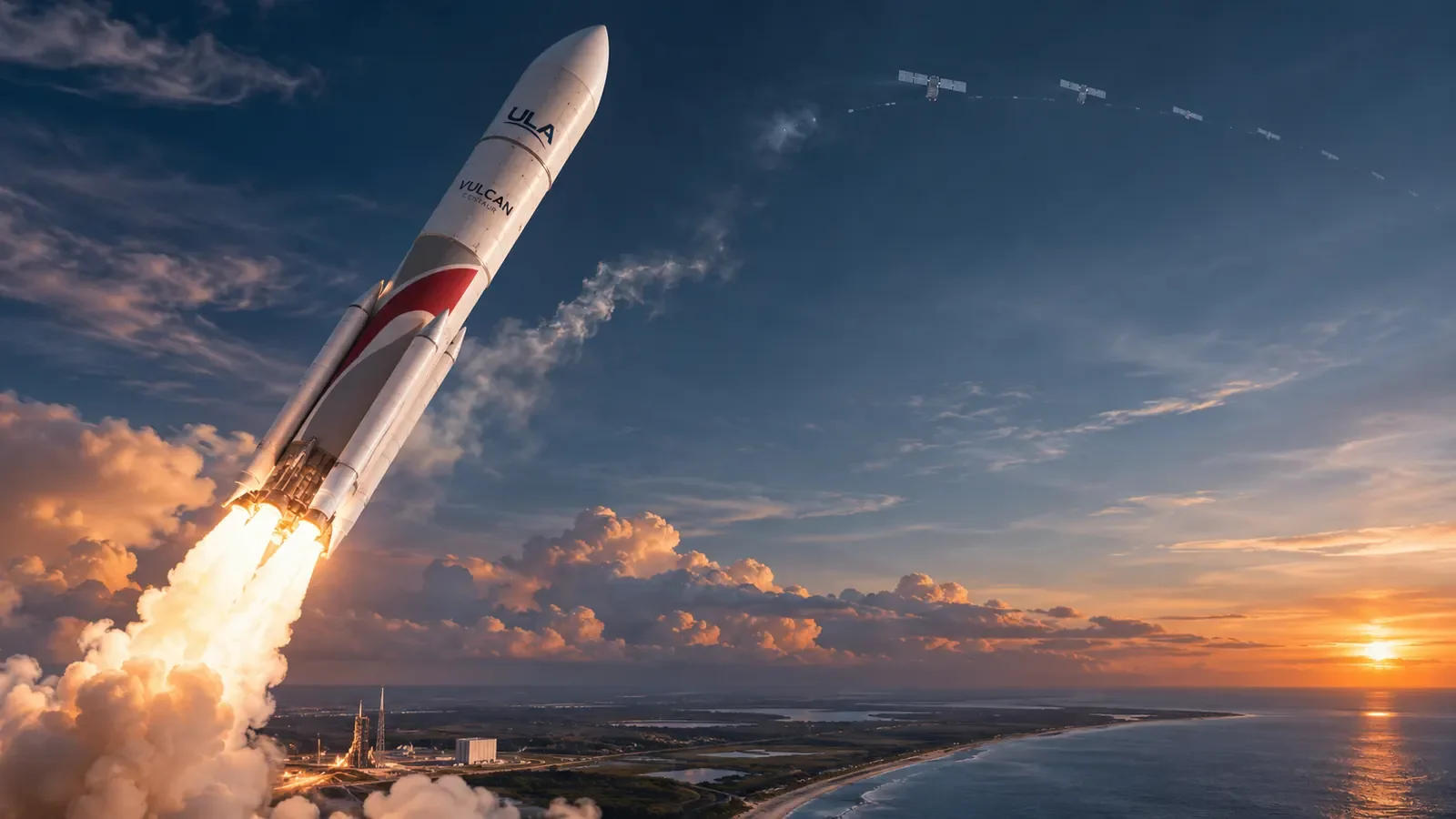
The Vulcan rocket, from United Launch Alliance (ULA), suffered a failure about ten minutes after lifting off from Cape Canaveral, Florida, on Sunday (15), causing the loss of 40 satellites from the Amazon Leo constellation. The mission failed to place the payload in orbit, in an accident that marked the first complete failure of a ULA launch since its founding, in 2006.
The launch took place at 17:40 UTC (12:40 local time), from the Cape Canaveral Space Force Station. ULA confirmed the anomaly shortly after liftoff, but did not identify its cause. Amazon also officially acknowledged the loss of the payload.
The mission, named LV-01 (Leo Vulcan 1), represented Vulcan's debut in carrying Amazon satellites. It was the rocket's fifth flight, which had returned to operations after nine months without launches.
The accident interrupted an important mission for the expansion of Amazon Leo, a low-orbit satellite network developed to provide high-speed internet. Before the attempt, the company had placed 398 satellites in orbit, distributed across 14 successful launches.
The partnership with ULA plays a central role in this project. Amazon contracted 38 Vulcan launches to carry approximately 1,500 satellites, in addition to using other vehicles to build its constellation.
In a statement, Amazon acknowledged the risks involved in space launches and reaffirmed its confidence in ULA, which had already carried out eight missions for the constellation with the Atlas V rocket.
The manufacturer reported that it will work with Amazon and other organizations to determine the cause of the failure, establish corrective measures and resume launches. There is, so far, no officially confirmed technical cause, nor an announced schedule for Vulcan's next flight.
The loss of the 40 satellites does not represent the interruption of the entire constellation, which remains in deployment with contracted launches from different providers.