Zuckerberg called out Dario: the essay that reignited the labs war
 ▶ Watch on YouTube
Zuckerberg's essay defends open AI for everyone and attacks power concentration — but Matthew Berman shows where the argument breaks: compute is finite, and whoever has capital wins.
Highlights
- Zuckerberg published an essay arguing superintelligence should be distributed to everyone — and jabbed Dario Amodei, quoted for the 'white collar blood bath' line
- Berman agrees with the critique of power concentration but spots the central contradiction: compute is finite, and whoever has the most capital always wins
- The superintelligent lawyer thought experiment shows the hole: even with the same model, the side with more compute thinks deeper and dominates
- Zuckerberg calls for legalizing distillation — a direct provocation to Anthropic, which tries to frame it as harmful
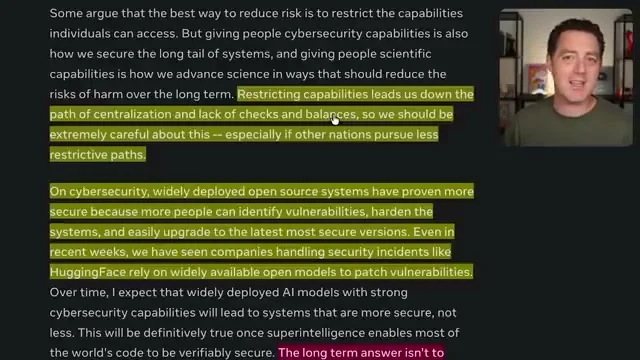
Mark Zuckerberg published an essay on the future of AI — 'The Future is for Everyone' — arguing that superintelligence should be distributed to everyone, not concentrated in a few labs. Matthew Berman read the whole thing and found contradictions in the argument.
The 37-minute video is an exercise in critical reading: what the essay gets right, where it breaks down, and why Meta's 'open AI' vision clashes with Anthropic's — even while sharing the same dream.
Zuckerberg's essay
The essay proposes three pillars: individual empowerment as the source of prosperity, invention as superintelligence's primary purpose (not job automation), and balance of power as the foundation of safety.
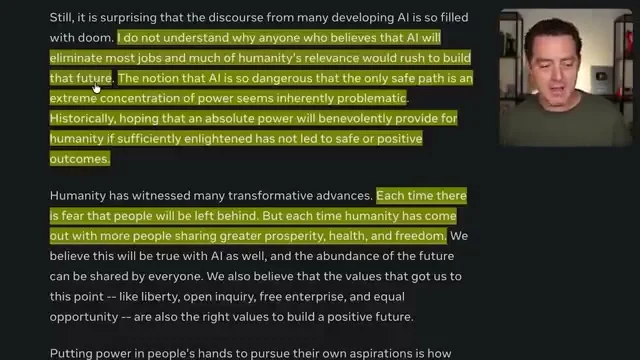
The target is clear: 'I don't understand why anyone who believes AI will eliminate most jobs would rush to build that future' — a direct jab at Dario Amodei, quoted for the 'white collar blood bath' line.
Berman agrees with much of it: the critique of power concentration is correct, and 'absolute power corrupts absolutely' applies to any lab that thinks it alone can decide what's safe.
Where the argument breaks down
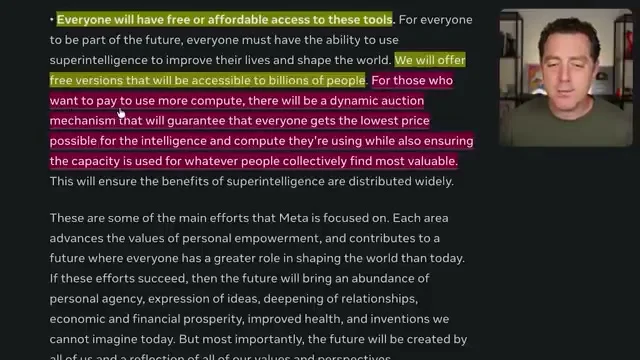
The core problem: Zuckerberg says everyone will have superintelligence, but admits compute is finite and there will be a 'dynamic auction' for whoever pays more. If intelligence depends on compute, whoever has the most capital wins — always.
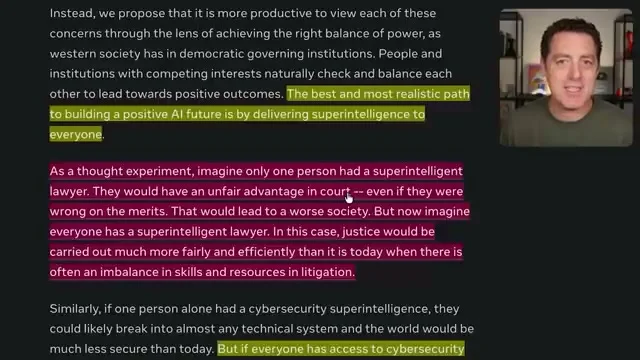
The superintelligent lawyer thought experiment: if only one side has the perfect lawyer, justice gets worse; if everyone has one, it improves. But Berman spots the hole: if both sides have the same model, the side with more compute thinks deeper and wins.
It's the 'permanent underclass': once superintelligence arrives, your socioeconomic position at that moment is where you stay forever — because everything is relative and compute is the contested resource.
The jabs at Anthropic
Zuckerberg calls for legalizing distillation (models learning from other models) — and whoever tries to frame it as harmful, he says, is 'some' (read: Anthropic). For open source, distillation is a boon; for closed source, a threat.
On biological risks: Berman agrees with Zuck — knowing how to build a weapon isn't enough; the physical components, facilities and expertise are the real bottleneck, and that's where regulation should act.
The final critique of Anthropic's alignment view: there's no technological solution that can align everyone's opposing interests at once. Any single superintelligence would have to prioritize some values over others.
Why it matters
The video captures the defining debate of the industry: open source vs. concentration, distribution vs. control, and the role of compute — which may be the true power factor, above the models themselves.
Berman ends optimistic about the vision but skeptical of the execution: 'I'm struggling to see how this doesn't come down to whoever has the most compute and energy wins'. An essential read on the narrative splitting Meta and Anthropic.