Sam Altman: AGI is very close — and the biggest risk is concentration of power
Sam Altman · CEO da OpenAI
 ▶ Listen / Watch
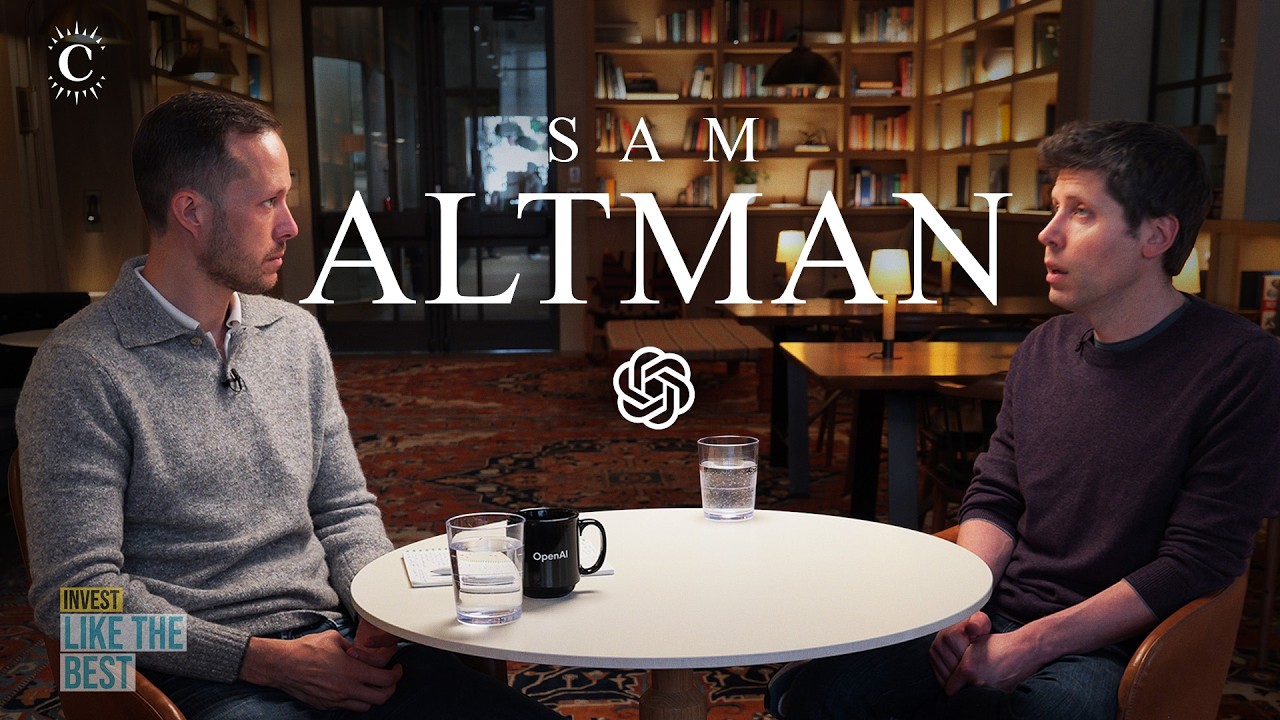
In a conversation with Invest Like The Best, the OpenAI CEO talks about the 'wish-granting genie', why AGI is not a single model, the compute race with China, and defending human agency in an AI world.
Who they are
Sam Altman é CEO da OpenAI, o laboratório por trás do ChatGPT e da família GPT. Antes, presidiu a Y Combinator. É uma das vozes mais influentes — e polarizadoras — do debate sobre AGI, segurança e política de IA.
Highlights
- AGI is not a single model: it's the machinery that makes the models — and the new science that emerges between them.
- The 'wish-granting genie' is coming: the world's first wishes need to benefit the world as a whole.
- Concentration of power with AI is 'terrifying': nobody should want to live with AI overlords.
- Altman is not a jobs doomer: there will be tons of jobs, and people will be busier, not less.
- GPT-5.6 already feels 'very AGI-like', but it still can't learn continuously or cure cancer on demand.
In a nearly hour-long conversation with the Invest Like The Best podcast, OpenAI CEO Sam Altman drew one of the most direct portraits of the current AI moment: AGI is very close, today's model already feels 'very AGI-like', and the debate that matters is not technical but political — who holds the power.
A wish-granting genie
The interview opens with an image Altman has repeated all year: AI as a 'genie that can grant any wish'. But he immediately qualifies why that matters.
This will be the greatest thus far technological achievement of human history. But the only way that it really matters is if it makes people's lives like much better than they otherwise would have been. We are about to create a genie that can grant any wish.
For Altman, the problem is not AI capability but the distribution of wishes: 'it is very important that the first wishes the world asks this genie to do benefit the world as a whole'.
What separates GPT-5.6 from AGI
Asked how far the present is from AGI, Altman was surprisingly concrete: GPT-5.6, released two weeks ago, already makes him hesitate.
GPT-5.6 has been out for me 2 weeks. I'm like, 'Okay, this is very AGI-like. It's very hard for me to say what I want from this model that it can't do.' But there are clearly some things: you can't yet go say cure cancer and get cancer cured.
What's missing, in his view, is a specific set of capabilities — not a single milestone:
- Learning continuously while operating (today's model still doesn't);
- Acting reliably in the physical world (robots executing complex tasks);
- Solving open scientific problems on demand (like curing diseases).
But he argues against himself: 'you can make a case that AGI is not actually about any single model. It's the model, it's the machinery that makes the models. And from model to model, we actually are learning new things. We're figuring out new science.' That's why he has 'a lot of sympathy' for people who say we're already there.
Compute, China and the frontier
On the infrastructure race, Altman recalls that 18 months ago the question was whether OpenAI could monetize so much compute. Today the game has shifted to geopolitics.
The most interesting thing happening this week is this Kimmy release. Back to this idea of the frontier and all the returns being at the frontier, and distillation and China versus America.
OpenAI's answer to the pressure of open models is offering the optimal price-intelligence point: 'our goal is to offer at every point along the Pareto optimal frontier the best option for intelligence and price. And that includes open source'.
Jobs: not a doomer
Altman pushes back on labor market pessimism with a creativity argument: people will ask the genie for such new things that demand for human work won't shrink.
I'm actually not a jobs doomer at all. I think we're going to have tons of jobs. I think we'll be busier than we want, not the opposite of that, because people will have such creative wishes.
The real risk: concentration of power
The most striking moment of the interview comes when Altman talks about what truly worries him — not technical capability, but who rules.
Concentration of power with AI is a terrifying thing. I don't think anyone should want to live in a world of AI overlords or a company that is the rough equivalent of that.
The way out, for him, is twofold: material abundance for everyone and preserving human agency. 'It's critical we preserve that spirit with AI, and that we all collectively have the ability to self-determine our future.'
Why it matters
The interview matters because it defines the vocabulary of the next cycle: 'wish-granting genie', 'AGI as a scientific discovery machine', and the warning that concentration of power is the central risk. For anyone following the sector, it's the CEO of the world's most valuable lab mapping his own future — and ours.