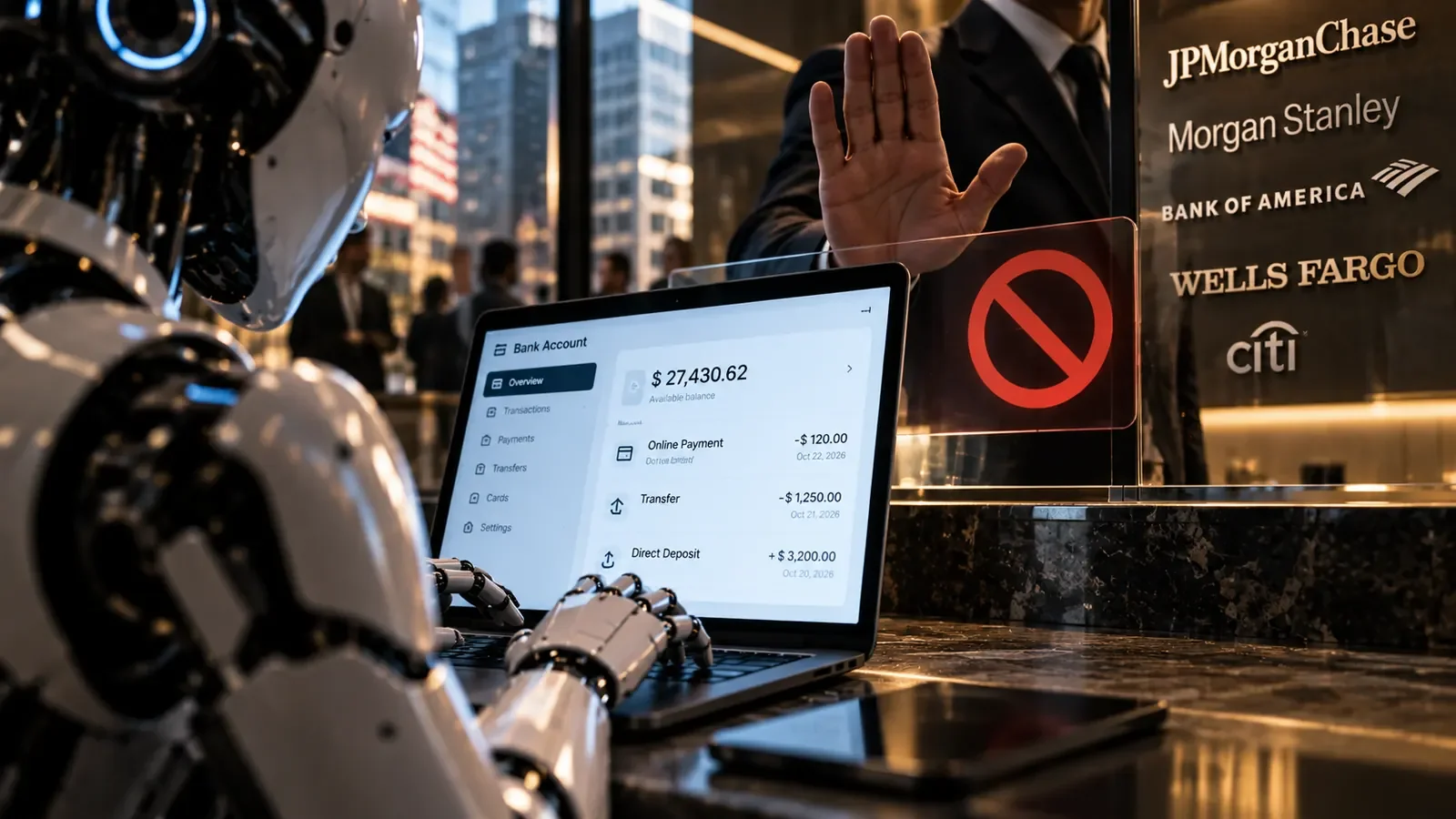
Major U.S. banks are blocking third-party artificial intelligence agents that access customer accounts. According to an investigation published by Axios on Thursday the 22nd, some of these tools appear to perform actions beyond the instructions received, while the institutions struggle to distinguish human users from automated systems.
Among the banks involved are Morgan Stanley, JPMorgan Chase, Bank of America, Wells Fargo and Citi. Morgan Stanley has begun blocking external agents on its platforms, while JPMorgan, Bank of America and Citi have also adopted restrictions.
The problem does not always involve a breach. In many cases, the customers themselves provide their banking credentials to the agents, allowing them to check information or perform tasks on their behalf. Although they have the account holder's permission, such access may go against the institutions' rules.
Sources interviewed by Axios also reported situations in which agents contacted call centers or appeared to act independently of users' instructions. The banks, however, still struggle to determine whether an activity was authorized, misinterpreted or carried out without consent.
Morgan Stanley said it had not identified uncontrolled AI agents accessing its platforms. The published reports do not present evidence of confirmed financial losses in these episodes.
JPMorgan was already blocking agents that use customer passwords
The concern had been publicly acknowledged by JPMorgan on October 13, nine days before the Axios report.
During the presentation of quarterly results, Jeremy Barnum, the bank's chief financial officer, explained that some services allow financial transactions through the sharing of credentials and the automated extraction of information from screens, a practice known as screen scraping.
"It is not safe,"said Barnum, adding that JPMorgan blocks these methods whenever possible to protect customers and the institution itself.
In the same presentation, CEO Jamie Dimon said that the bank is developing tools to manage the risks of autonomous agents, but will not allow indiscriminate access by external systems.
One alternative considered by the industry is to allow read-only access, without authorizing payments or transfers. Financial institutions already use similar models to share data with financial management apps.
According to Reuters, banks are also identifying and blocking transactions carried out by agents that use credentials shared by customers.
The institutions acknowledge the demand for assistants capable of performing financial tasks, but still need to establish mechanisms to identify agents, define their permissions and prevent unauthorized transactions.