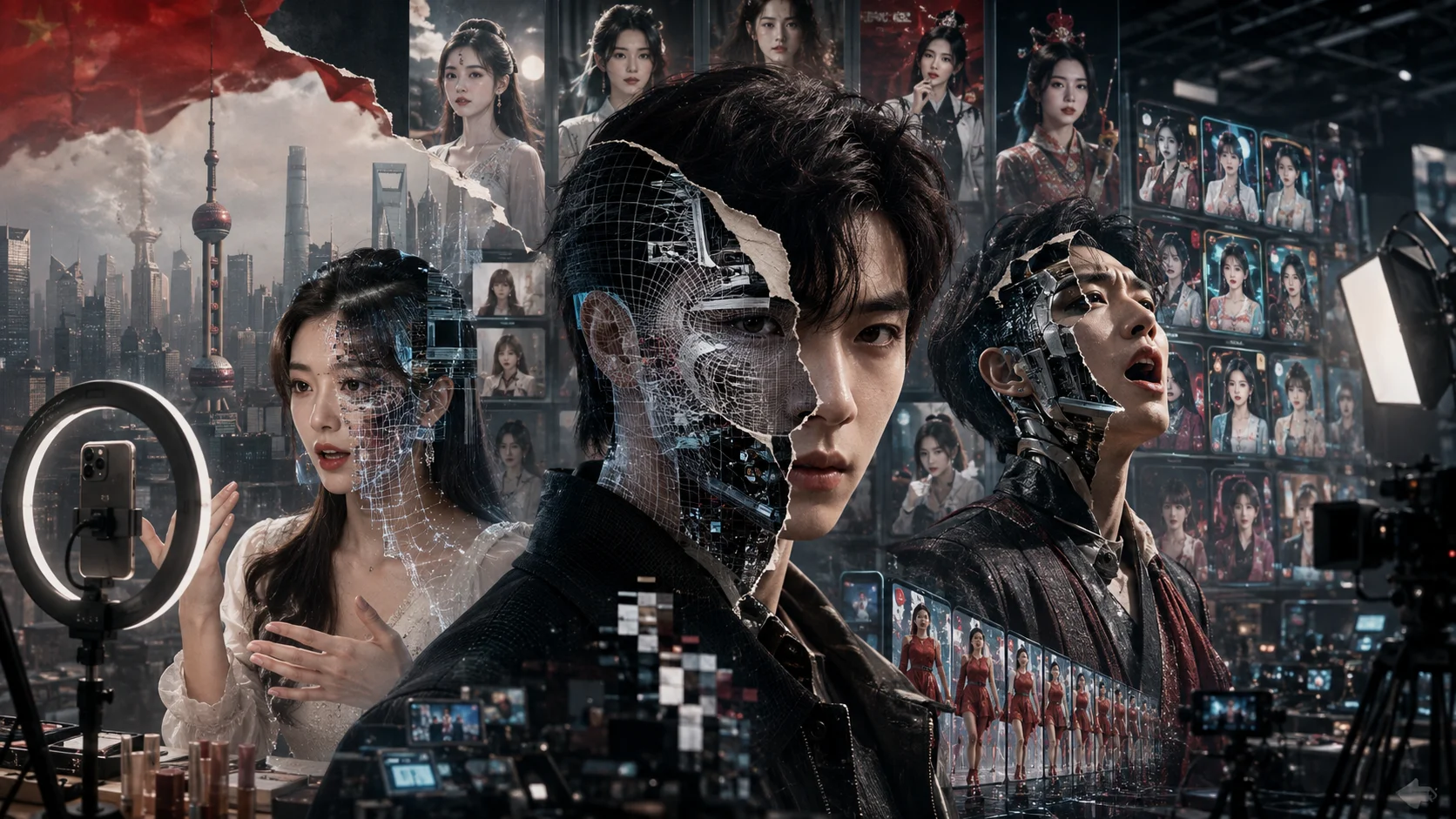
Artificial intelligence is already beginning to replace actors and livestreamers in China's entertainment industry. The advance of more realistic and cheaper video models is leading production companies to reduce the participation of human professionals in some productions.
The change was documented by the Financial Times in a report published on Saturday (29). The investigation reports cases of actors who had their face and voice digitized for later use in AI-generated content.
The movement gained scale mainly in microdramas, a short-video format popular on Chinese platforms. In the first quarter of 2026, about 128,000 productions were published in the country, and more than 95% used AI generation, according to data from the China Netcasting Services Association (CNSA).
AI videos cost about 90% less
The cost reduction helps explain the speed of adoption. Shen Yang, a professor at Tsinghua University, told the Financial Times that producing a minute of AI video costs between US$ 90 and US$ 120, approximately 10% of the value of an equivalent production with actors.
The use of digital characters also reduces expenses with recording, makeup, travel and cast availability. These models can be reused in different scenes and productions, which favors formats based on high volume and short cycles.
The evolution of tools such as Seedance 2.0, from ByteDance, has expanded the quality of synthetic videos and made the use of digital characters in content aimed at the general public more viable.
Face and voice become material for AI models
The change is also beginning to affect work contracts. Actors reported processes of capturing face, voice and performance for the creation of digital versions capable of appearing later in new videos.
In some cases, this digitization occurred before the professionals stepped away from productions. The result is that the actor's image can continue to be used even without their direct participation in recordings.
The practice has opened disputes over consent, compensation and control of digital identity. Lawyers heard in the investigation stated that labor conflicts related to the use of AI have grown in China over the last two or three years.
Livestreamers enter the same dispute
The impact also reaches live-streaming commerce. About 15 million people have livestreaming as their main occupation in China, while approximately 690,000 work directly in the microdrama industry.
Virtual presenters are already used to demonstrate products and maintain broadcasts for prolonged periods without depending on human teams. In some tests cited in the investigation, digital hosts achieved sales results comparable to or better than those of real presenters.
For companies that operate broadcasts for many hours a day, the cost difference makes automation especially attractive.
AI dominates volume, but humans still attract more audience
The presence of artificial intelligence grew rapidly among Chinese microdramas. After surpassing 95% of releases in the first quarter, the share remained above 60% in the second quarter, according to CNSA.
In the first half, about 367,000 microdramas reached Chinese platforms. The association reported that the share of AI-generated productions remained above 74% in the period.
The volume, however, does not automatically translate into audience.
Data released by CNSA itself shows that productions with real actors continued to concentrate a disproportionate share of views in certain periods, even representing a much smaller fraction of releases.
The difference suggests that AI already offers clear advantages in cost, speed and scale, but it still does not fully replace the ability of human productions to attract and retain audiences.
China prepares new rules for AI-generated content
The growth of this market has also led to regulatory changes. Starting September 1st, 2026, microdramas produced with artificial intelligence must include identification informing the use of the technology.
The rule arrives at a time when the discussion is no longer only about the quality of artificially generated videos and starts to directly reach image rights, compensation and labor relations.
For actors and creators, the central question becomes who can use a digital identity after face, voice and performance are transformed into data capable of generating new content.