Alibaba expanded its offensive in open artificial intelligence models with the launch of the Qwen3.8-27B and the release of the weights of the Qwen3.8-2.4T-A95B, its most advanced model to date. The company said the two versions are available to developers, with distribution via Hugging Face and, in the case of the main model, also through ModelScope.
The move places under the Apache 2.0 license everything from a 27-billion-parameter model capable of running on consumer hardware to a Mixture of Experts (MoE) architecture with 2.4 trillion total parameters.
Qwen3.8-27B drew attention soon after the launch.
27B model can run locally
The Qwen3.8-27B is a dense multimodal model, capable of processing text, images, and videos. Alibaba positions the version as an alternative for applications that need to balance performance, infrastructure, and cost.
With quantization, a technique used to reduce models' memory consumption, the company says the Qwen3.8-27B can be run even on a laptop. Without this optimization, the model was still designed to operate on consumer-level devices.
Despite having 27 billion parameters, the Qwen3.8-27B achieves performance comparable to the Qwen3.7-plus in different tasks evaluated by the company. The previous model uses MoE architecture and has approximately ten times more total parameters.
The new version was also developed for programming, research, professional activities, and operations performed by AI agents during longer sequences of actions.
The native context reaches 262,000 tokens and can be extended to up to 1 million. This allows the system to process large document bases, extensive interaction histories, or prolonged workflows without splitting the material into so many steps.
Alibaba also opens its 2.4-trillion-parameter model
The company went beyond the compact version and released the weights of the Qwen3.8-2.4T-A95B, presented as the flagship model of the current Qwen generation.
The architecture has2.4 trillion parameters in total, but uses about95 billion active parametersduring execution. This is one of the characteristics of the MoE model: only a portion of the network is activated for each processing.
The Qwen3.8-2.4T-A95B also supports context of up to 1 million tokens.
According to Alibaba, this is the first time that a model from the Qwen-Max class — the tier reserved for the company's highest-capacity systems — receives an open version.
The weights can be downloaded from Hugging Face and ModelScope, a model platform started by Alibaba itself.
The license allows companies and developers to modify, redistribute, and use the model commercially, subject to the conditions of Apache 2.0.
Model appears among leaders in programming and agents
The Qwen3.8-2.4T-A95B has also begun to appear in top positions in independent evaluations.
On CodeArena, the Arena AI ranking aimed at front-end web development, the model achieved third place globally.
It also placed third on the Agentic Index from Artificial Analysis, a benchmark focused on models' ability to execute tasks autonomously and coordinate multiple steps.
The results reinforce one of the main areas of dispute among AI labs in 2026: models capable not only of answering questions, but of planning, using tools, and completing more extensive workflows.
Qwen surpasses 3 billion downloads
The new releases arrive at a time of rapid expansion of the Qwen ecosystem.
Considering Hugging Face and ModelScope, Alibaba says it has already made availablemore than 460 open models. They have given rise to more than300,000 derivative modelsand have accumulatedmore than 3 billion downloads globally.
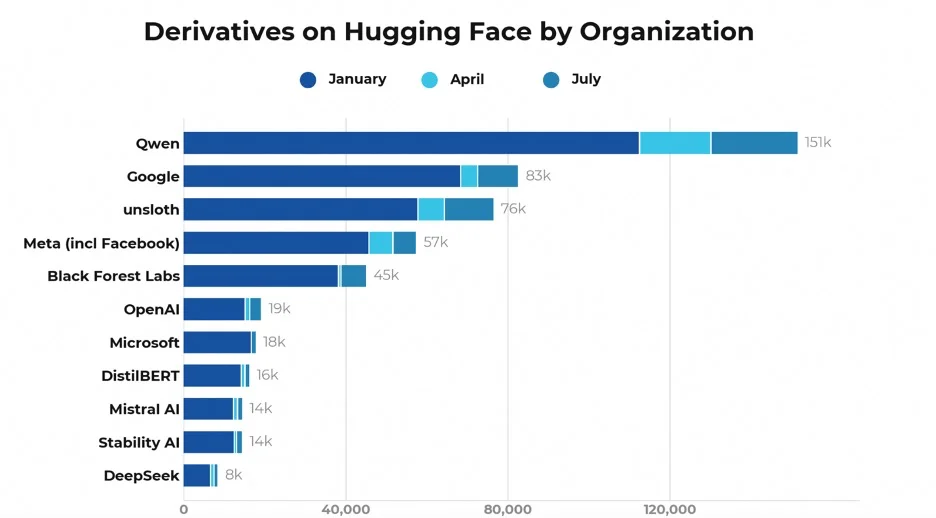
Data published by Hugging Face in the reportState of Open Models: Summer 2026 Observationsalso show the scale of the ecosystem.
The Hub registered151,448 models derived from Qwen, a number equivalent to approximately 2.6 times the entire presence of models derived from Meta on the platform and 4.7 times the number specifically associated with Llama repositories, according to the survey.
Between January and July 2026, Qwen-based repositories with a declared parameter count accumulated around2.045 billion downloadson Hugging Face.
Hugging Face itself pointed to Qwen as one of the main bases used by the community to create, adapt, and deploy new models.
The combination of different sizes, frequent release cycles, and a permissive license has expanded the family's use both in experiments and in systems intended for production.
Ecosystem also advances on multimodal agents
Alibaba's open strategy is not limited to models.
The company also recently made available Qwen-MM-Plugins, a library created to incorporate multimodal features into agent frameworks.
The project offers components for image and video processing, multimodal memory, support for variable resolutions, and use of tools based on visual information.
With the new generation Qwen3.8, Alibaba now offers in the same ecosystem everything from models that can be run locally to a 2.4-trillion-parameter architecture.
The breadth of this offering increases competitive pressure in the open model market, where technical capacity, execution cost, and developer convenience have come to contest space alongside raw performance.