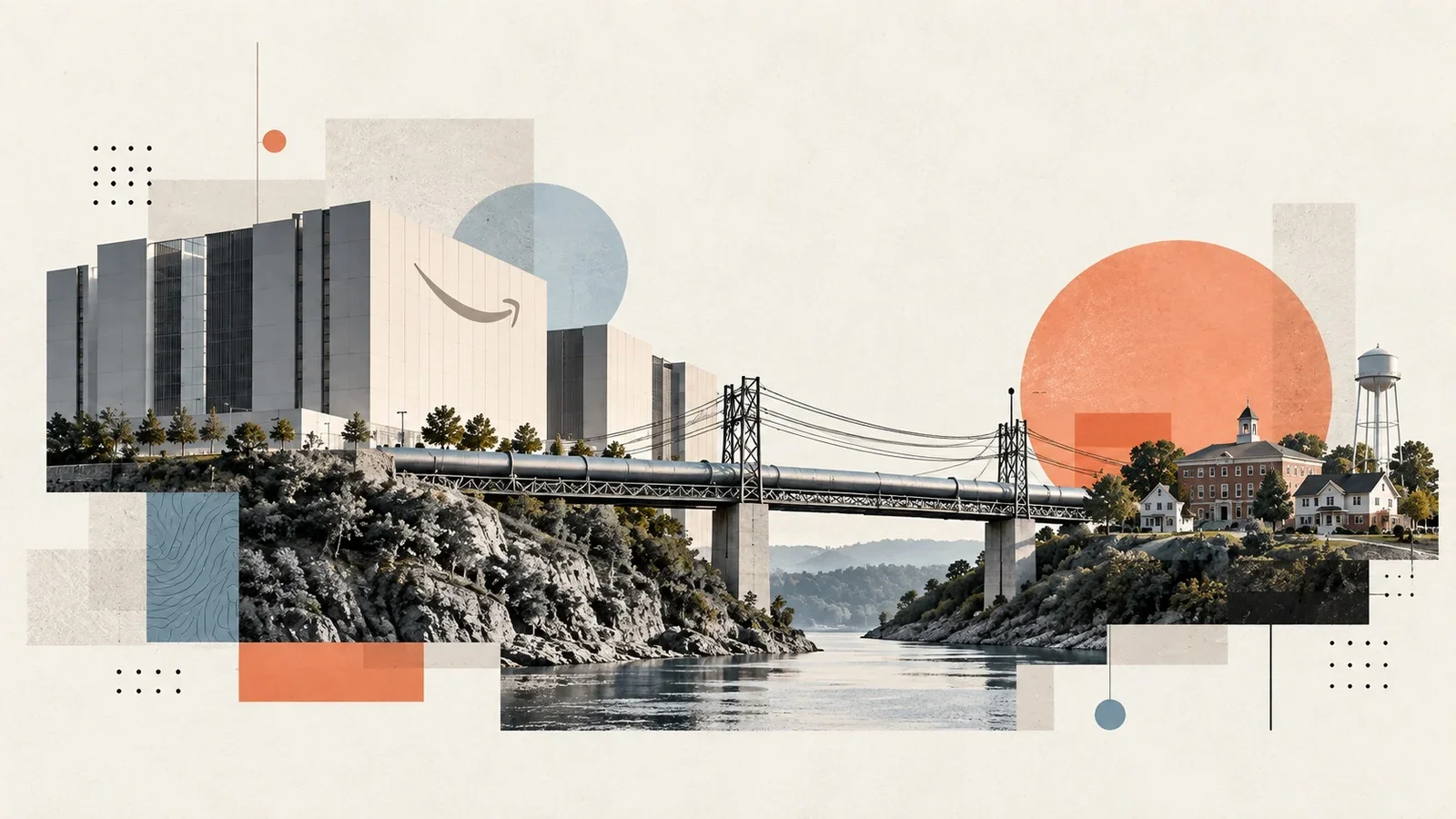
Amazon announced on Friday (2) that it will invest more than an additional US$ 1 billion over five years in the American communities where it operates data centers. The program, called Built Together, will direct resources to education, workforce training, energy efficiency, water conservation, and locally chosen priorities.
The program's financial size is small compared with the capital mobilized by the artificial intelligence race. Amazon itself forecasts US$ 220 billion in capital expenditures in 2026, including data centers and other technology investments. The strategic signal, however, lies less in the absolute value and more in the problem the company is trying to solve: building computing capacity no longer depends only on securing chips, energy, land, and capital. It increasingly depends on getting communities to accept the infrastructure.
Amazon put this problem at the center of the announcement. In addition to the investments, AWS formalized a set of commitments for its data centers, including early dialogue with residents, annual disclosure of energy and water data, and an end to the use of confidentiality agreements with government agencies involved in the projects.
The change matters because the approval process is emerging as a variable capable of altering where, when, and at what cost AI capacity can be built.
The capital exists, but permission is not automatic
The sector has already demonstrated the ability to mobilize volumes of money that few markets can match. Amazon, Alphabet, Meta, and other large technology groups are expected to jointly exceed US$ 700 billion in capital expenditures in 2026, driven by AI expansion, according to estimates cited by Reuters.
The problem is that capital does not automatically eliminate local restrictions.
According to Data Center Watch, an organization that tracks opposition movements against data centers, at least 75 projects valued at about US$ 130 billion were blocked or delayed in the first quarter of 2026 amid community disputes. The organization counted 833 active opposition groups spread across 49 states in the period. In the second quarter, at least 45 projects, valued at about US$ 68 billion, were blocked or postponed. These amounts include delays and do not represent only permanent cancellations.
Objections vary by region, but they focus on quite concrete issues: electricity consumption, transmission infrastructure, water availability, noise, tax incentives, changes in land use, and the risk of additional costs being passed on to local consumers.
This is where Built Together gains meaning beyond philanthropy. Amazon is directing money precisely to some of the areas that most fuel resistance to projects.
The company intends to offer free access to short-term higher education courses to more than 300,000 students, expand professional training centers, and fund energy efficiency improvements in more than 30,000 homes and 300 schools and community buildings. It also states that it will work with local foundations so that part of the funds is directed to priorities defined by the communities themselves.
Energy turns a local discussion into a problem of national scale
Pressure tends to increase because the growth in data center electricity demand requires reinforcements in the infrastructure that must serve them.
An update published in June by Lawrence Berkeley National Laboratory estimates that data centers could account for 11.8% of U.S. electricity consumption in 2030, with scenarios ranging between 9.5% and 15.3%.
This means that decisions made in small towns can affect a computing expansion on a national scale.
For a company, a rejected project does not necessarily mean abandoning the investment. It can mean seeking another municipality, redesigning the facility, negotiating new terms with the utility, funding additional infrastructure, or spending more time in the approval process. These paths can add time or cost.
Amazon states that it works with utilities and regulators so that the prices paid by its data centers cover both the energy consumed and the necessary infrastructure improvements. It also maintains that its centers are more efficient in water use than the industry average. These positions are part of the company's response to criticism, but they do not eliminate the need to convince authorities and residents that costs and benefits will be distributed in an acceptable way.
This is the central point of social license: a facility can be technically possible, financially viable, and still face enough resistance to delay or prevent its construction.
For the AI race, this creates a category of risk different from the scarcity of GPUs or the lack of electricity generation. Chips can be secured. Energy can be financed, and new lines can be built. A community's acceptance involves local politics, trust, perception of benefit, and willingness to coexist for decades with infrastructure that consumes resources on a large scale.
Amazon's US$ 1 billion commitment does not prove that community resistance has already become a bottleneck as large as chips or electricity. But it shows that one of the largest builders of AI infrastructure has started treating it as a component that needs to be financed and managed from the beginning of the project.
If this approach spreads across the industry, investments in schools, power grids, water, workforce training, and municipal infrastructure will no longer appear merely as social offsets.
They may, in practice, enter the structural cost of putting new megawatts of compute into operation.