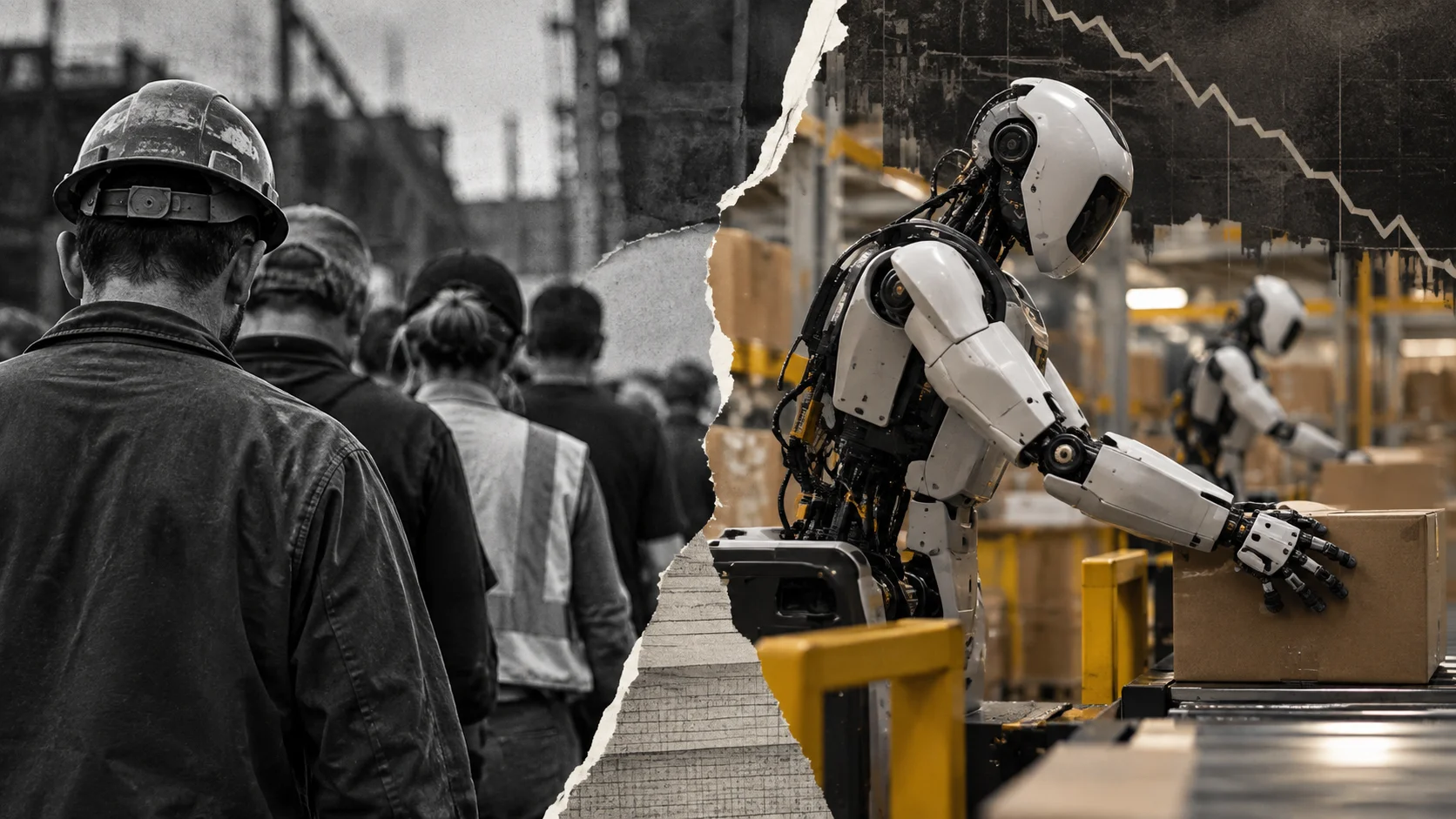
A new Anthropic study estimates that robots available today can already perform 74% of physical tasks performed in the United States in some type of environment. These activities account for about 34% of all hours worked in the country. But the leap from technical capability to economic replacement remains enormous: only 0.3% of work would be cost-competitive with robots under current conditions.
This gap helps answer a question that increasingly sophisticated robotics demonstrations tend to hide. The main obstacle to mass physical automation is no longer simply getting a machine to perform a task. It is doing so reliably, in the real environment and at a lower cost than human labor.
Capability does not mean work is ready to be automated
The 74% figure requires an important distinction. Anthropic does not conclude that robots could immediately take over three-quarters of existing physical work.
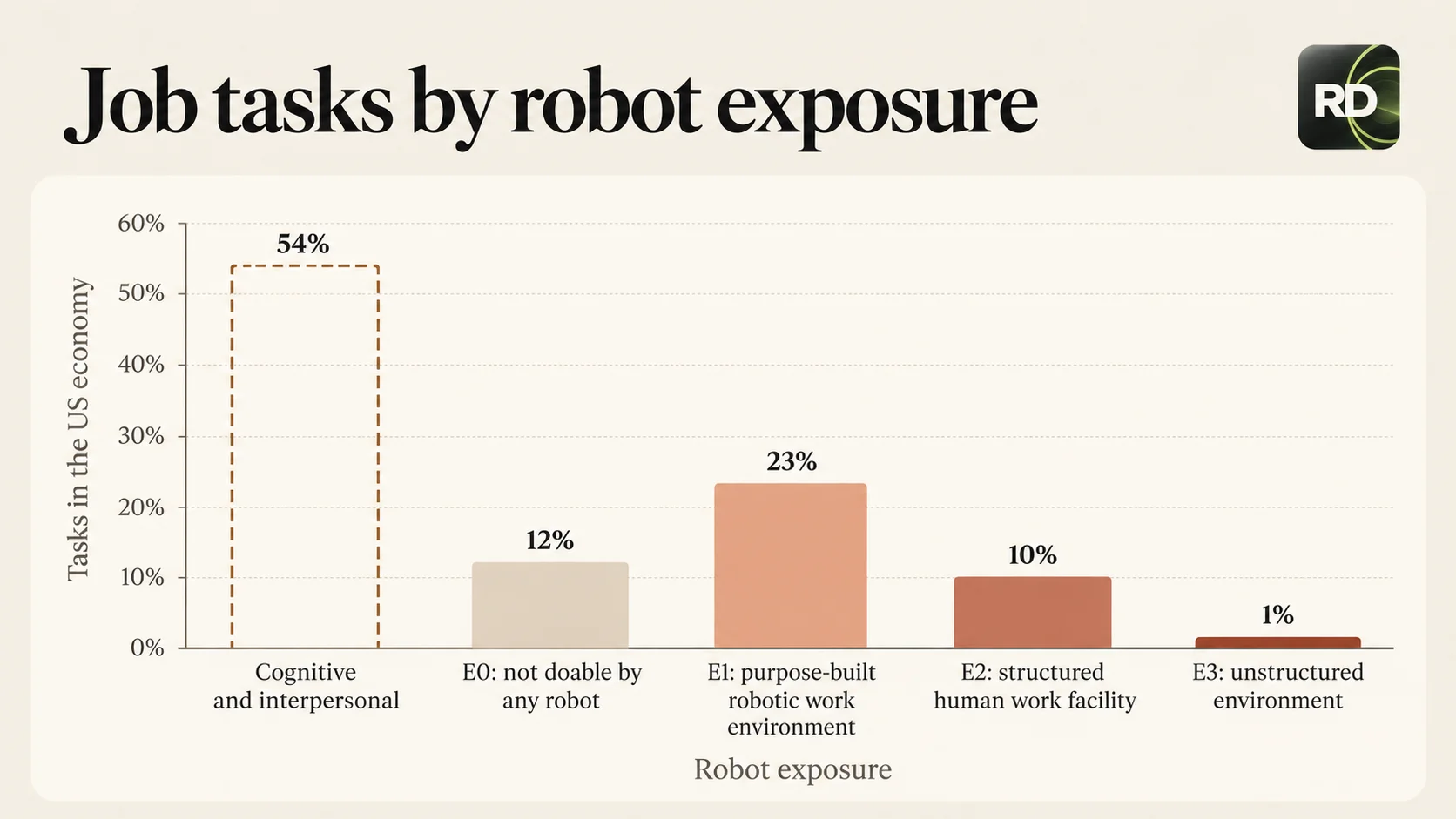
The largest share of these tasks can only be performed when the environment is adapted to the machine. According to the study's classification, 23% of all work time corresponds to activities that robots can perform in environments specifically built for them, such as industrial lines. Another 10% can occur in structured human spaces, such as logistics centers.
Only about 1% of all work, or 2% of physical tasks, can already be performed by robots in unstructured environments, such as streets and other spaces subject to changes that are hard to predict.
This makes the environment part of the economic equation. A company can automate a task not only by buying a better robot, but by redesigning processes, reducing exceptions and making the space around the machine more predictable.
That is precisely why factories and logistics centers appear before hospitals, construction sites, homes or dispersed maintenance operations.
Logistics shows where the math starts to work out
Current investments in robotics already follow this pattern. Data released by the International Federation of Robotics show that 117,500 professional robots for transportation and logistics were sold in 2025, up 21%. The category accounted for 47% of all professional robot units sold worldwide.
Amazon offers a demonstration of the possible scale when the environment can be organized around automation. The company reached in 2025 the milestone of 1 million robots deployed across more than 300 facilities, while artificial intelligence systems began coordinating the movement of these machines inside distribution centers.
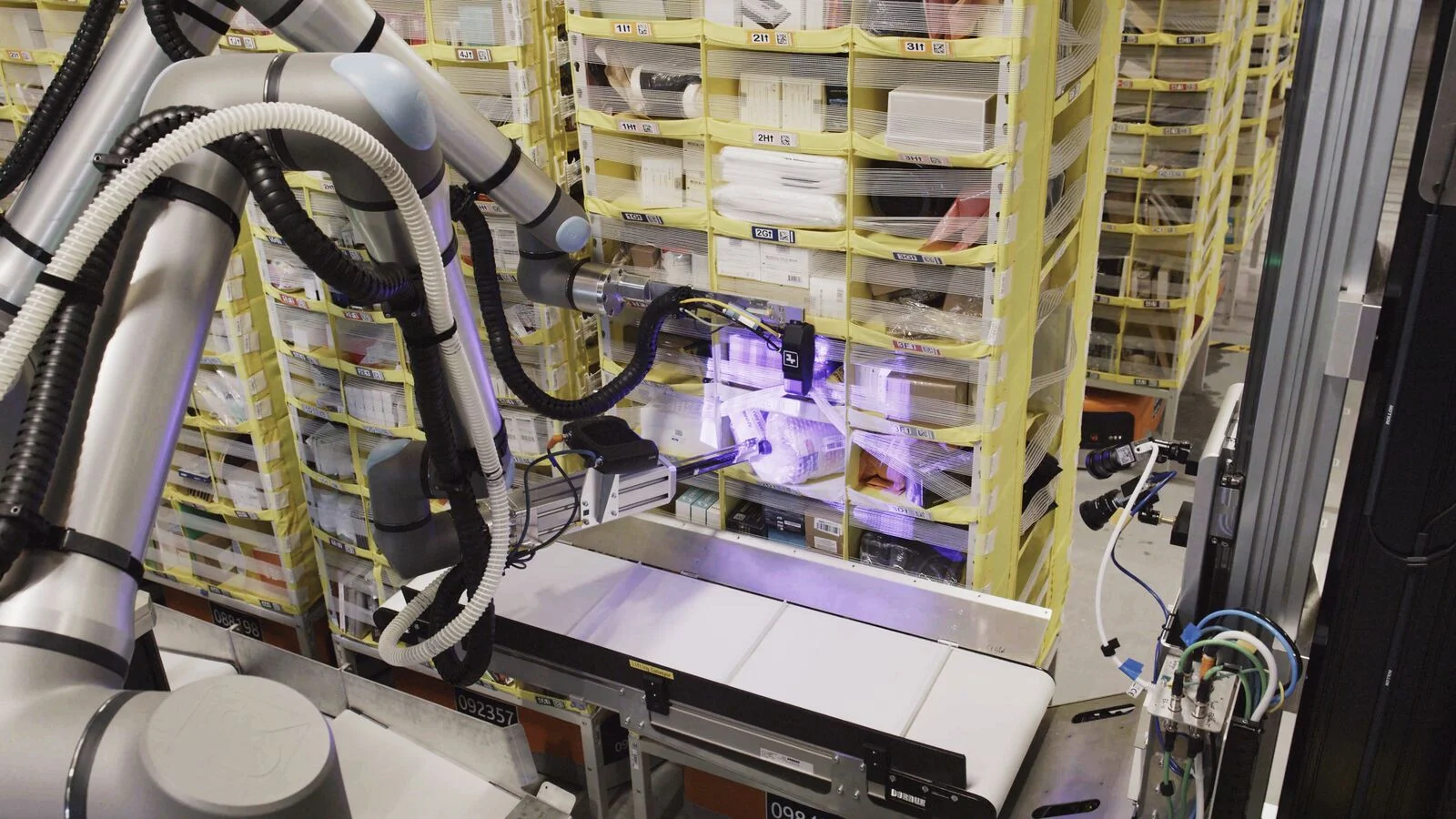
The movement does not immediately eliminate human labor. It first tends to break roles down into automatable tasks and tasks that remain with people.
Vulcan, for example, can handle approximately 75% of the different types of items stored in Amazon centers at speeds comparable to those of employees. When it encounters an object it cannot handle, the system can transfer the task to a person.
This model helps explain why the impact may appear earlier in the composition of work than in the complete disappearance of an occupation.
Cost still shields many physical occupations
The broader barrier appears when Anthropic puts hardware, installation, maintenance, energy and supervision in the same calculation as human wages.
For packers, one of the few occupations in which this ratio is already approaching parity, the study estimates that the necessary equipment would cost more than US$ 2 million for purchase and installation, but could replace the annual output of approximately 14 workers.
After spreading the investment over the useful life of the equipment and adding operating costs, the expense comes to around US$ 45,000 per equivalent worker per year, compared with approximately US$ 49,000 in human compensation.
Not coincidentally, the Bureau of Labor Statistics projects a reduction of 5% in the number of manual packers between 2025 and 2035, from 555,500 to 528,000 workers.
But this logic changes quickly outside highly repetitive processes. Welding, cleaning and various maintenance functions already have robots capable of performing important parts of the work. Automating the necessary set of activities, however, can still cost several times more than keeping human workers.
Even robotaxis show this limit. Anthropic estimates that the cost is only about US$ 7,000 above the human equivalent, but regulation and other frictions still restrict adoption.
At the same time, the BLS projects 12% growth in taxi driver employment between 2025 and 2035, recalling that technological capability and effective replacement do not necessarily advance at the same pace.
Dexterity remains a bigger bottleneck than reasoning
Price also does not solve every task.
Anthropic estimates that capability limitations still prevent adoption in about 70% of physical tasks. The main problem is not reasoning, but manipulation: approximately half of these activities would require additional advances in the ability to touch, grasp, position and move objects.
Planning and reasoning deficiencies appear as the main limitation in only 8% of physical tasks. This means that rapid evolution of AI models does not automatically eliminate mechanical obstacles.
Untangling cables, working with parts positioned in unpredictable ways, performing repairs in tight spaces or handling people safely require a combination of perception, strength, mobility and fine control that is still difficult to reproduce economically.
There are also barriers that do not disappear with better hardware. According to the study, current regulations would limit the automation of 14% of physical tasks, while human preferences would restrict about a quarter of them.
Health care, education and services involving direct contact are particularly exposed to these factors, even as technical capability evolves.
The cost curve may define the speed of the next wave
Anthropic estimates that robot prices have historically been declining by about 3% per year. At this pace, a reduction of approximately 70% in costs would be needed for robots to become competitive in 10% of current work.
That would take about four decades.
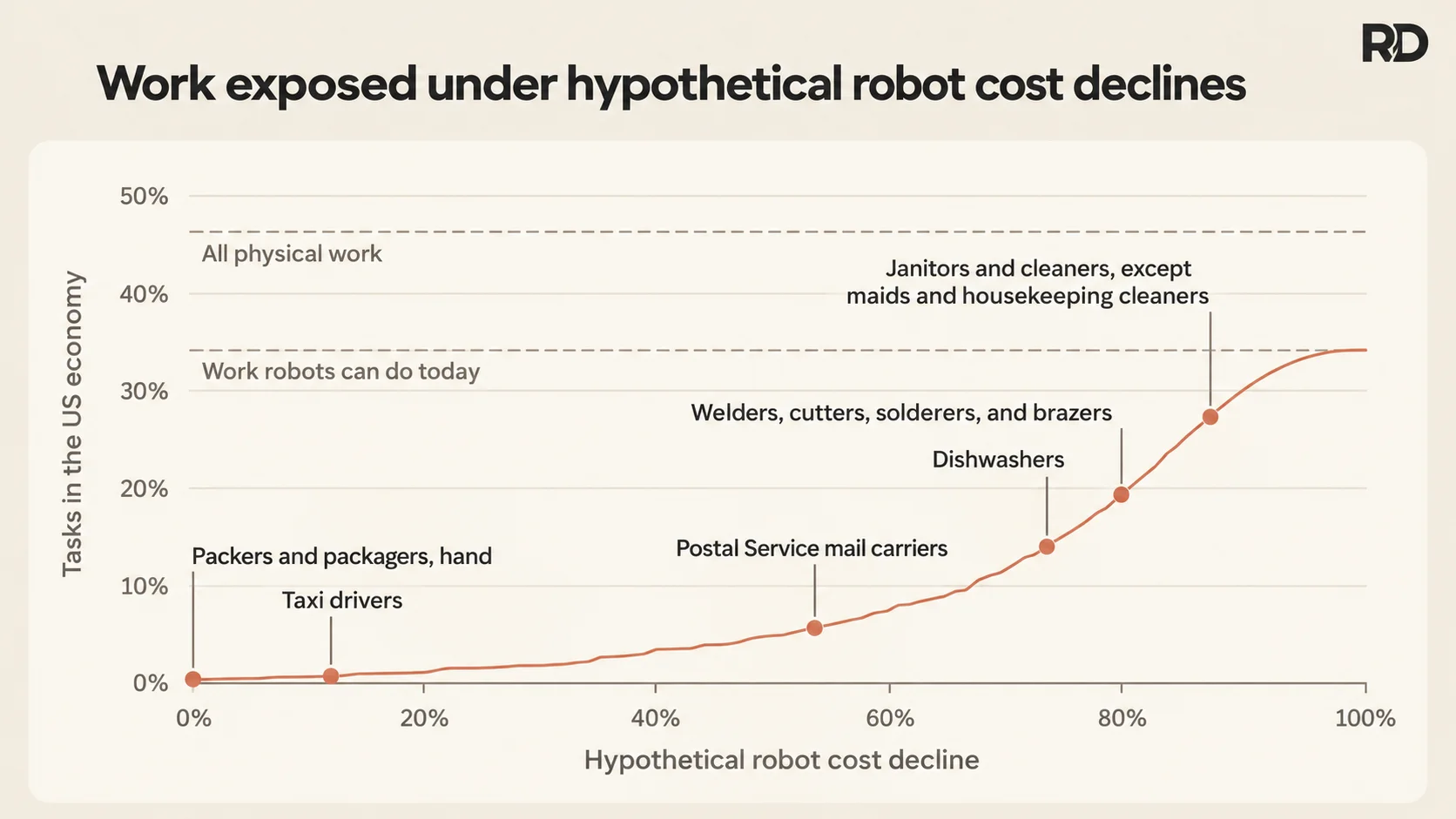
This timeframe should not be treated as a forecast. The study itself works with simplified scenarios and holds constant elements that can change, such as wages, the choice of tasks prioritized by industry and the pace of hardware advancement.
In an accelerated scenario, in which quality-adjusted cost falls up to four times faster and capabilities advance at twice the historical pace, half of current physical work could reach economic competitiveness by 2050. In the scenario based on the historical trend, this point would only be reached in 2085.
The difference between the two scenarios shows where to watch for the next signals.
The most relevant indicator may not be how many new tasks a humanoid can perform in a demonstration, but how much it costs to perform each task over thousands of hours, how many exceptions still require human intervention and how much of the environment needs to be rebuilt for the machine to work.
The study also offers historical evidence for this reading. By reconstructing the exposure of occupations since 1977, researchers found larger subsequent declines in employment and wages in jobs that were already more accessible to the robots existing at that time.
Capability, therefore, matters as an early signal. But economics determines when that potential starts to gain scale.
Today, this combination points first to transportation, material handling, storage and other highly structured processes. The more variable the environment and the greater the need for dexterity, in-person judgment or human contact, the greater the distance remains between a technically possible demonstration and an economically automatable operation.