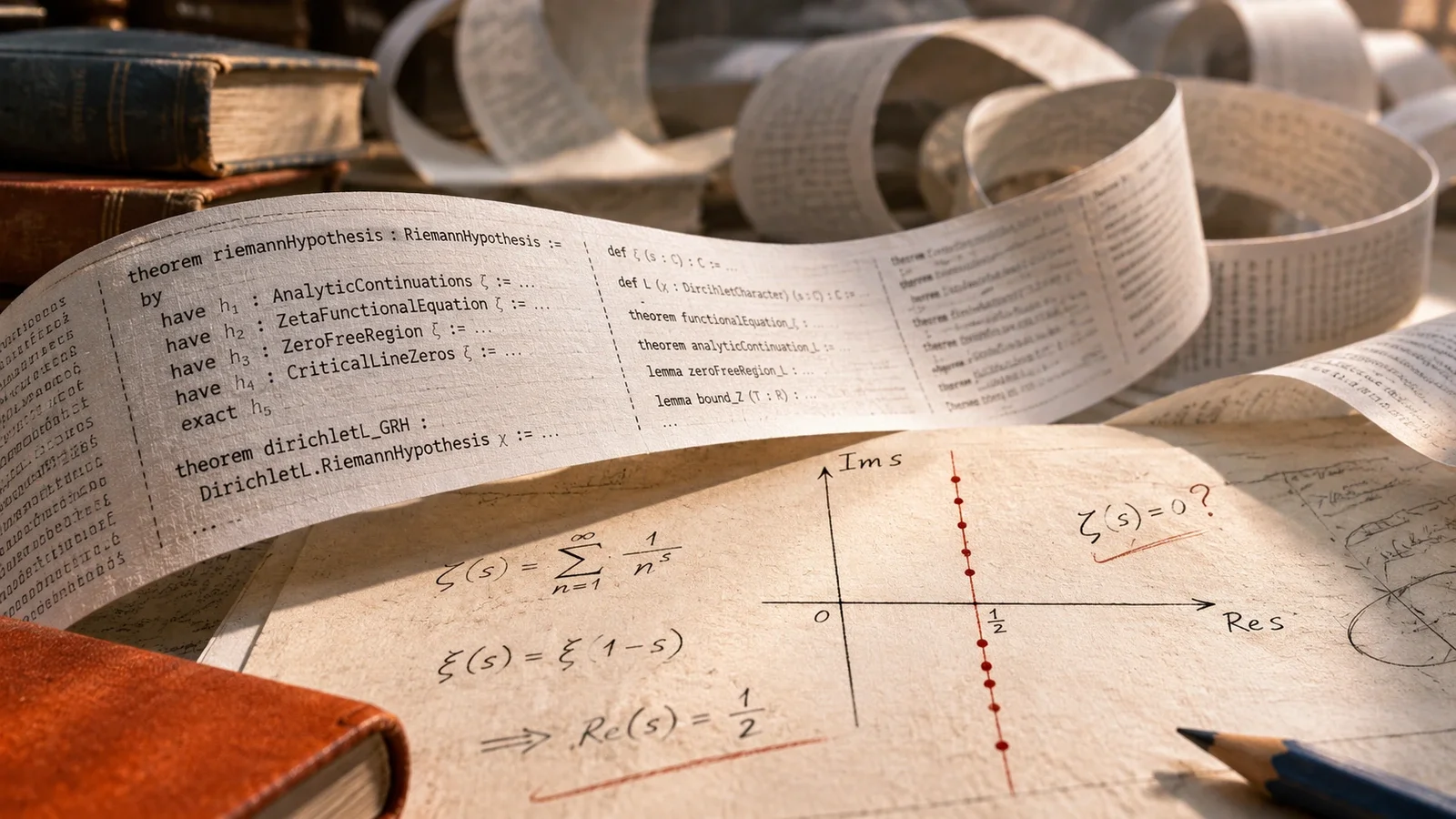
A possible solution to one of the hardest problems in advanced mathematics moved forward through independent tests after being presented with the help of Anthropic's artificial intelligence Claude. Mathematician Levent Alpöge announced the discovery on Friday (20), and verifications conducted by Andrew Sutherland, of MIT, have already confirmed that the code meets a series of formal requirements. This still does not mean that the Riemann hypothesis has been officially solved.
Formulated in 1859, the hypothesis establishes a property of the nontrivial zeros of the Riemann zeta function, fundamental to understanding the distribution of prime numbers. The problem remains without a recognized solution and is part of the Clay Mathematics Institute's list of mathematical challenges with a US$ 1 million prize.
Alpöge, a member of Anthropic's technical staff, stated in a four-page note that he and Claude found a demonstration of the hypothesis and of its generalized version for Dirichlet L-functions. Instead of publishing a conventional mathematical paper, he made available a package with 175,187 modules in Lean, approximately 17.4 million lines of code and 239 MB of compressed files.
Lean is a mathematical formalization system capable of verifying logical deductions. Its role is to check whether a conclusion follows from the definitions, hypotheses and rules used, without depending on human reading of each step.
In the update of November 21, at 12:55 UTC, Sutherland reported that all modules had compiled without errors and that the proof passed the individual recheck of each module by the Lean kernel. Two independent verifiers, nanoda and con-leche, also accepted the complete exported demonstration.
The con-leche tool also confirmed that the presented solution justifies the five theorems required by an independent reference file. Among them is `riemannHypothesis : RiemannHypothesis`, formulated with the very definition from the Mathlib mathematical library.
What the kernel verifies — and what it does not verify
The axiom check identified only three standard Lean principles: `propext`, `Classical.choice` and `Quot.sound`. This is relevant because an alleged proof could appear valid by introducing, as a premise, precisely what it should prove.
The tests also cover results on Dirichlet L-functions, which represent the generalization claimed by Alpöge. This coverage, however, does not include all families of L-functions considered in broader versions of the problem.
Sutherland added another verification: he combined the package with an independent formalization of the Robin and Lagarias criteria, equivalent to the Riemann hypothesis. From this combination emerged two formalized arithmetic inequalities that were also accepted by nanoda and con-leche. The procedure offers additional evidence, although it continues to depend on the mathematical definitions employed.
Two steps remained in execution: the complete verification by the `lake comparator` and the recheck of the exported proof by Lean's standard and paranoid kernels. The original compilation also occurred on machines without sandbox isolation, and a full reproduction in that environment had not yet been compared.
There is an essential distinction between these verifications and scientific acceptance. Lean examines whether the formalized statements follow logically from the established premises. It does not determine, by itself, whether all definitions correspond exactly to the intended mathematical concepts nor whether the argument offers an understandable explanation for researchers.
The absence of a readable paper widens this challenge. In the note itself, Alpöge acknowledged that he still needed to better understand parts of the mathematics involved and committed to developing a conventional presentation.
The announcement also occurred one day after the debut of Anthropic's shares on Nasdaq, on November 19. Alpöge acknowledged the discomfort with the coincidence: “The exact timing is terrible”, he wrote, rejecting interpretations that the disclosure had been motivated by the initial public offering.
For now, the Clay Mathematics Institute continues to classify the Riemann hypothesis as unsolved. Its rules require publication in a qualified academic venue, at least two years of scrutiny after publication and general acceptance by the mathematical community before a solution can be considered for the prize.
The case presents an unusual situation: a frontier mathematical proof submitted to extensive computational verifications before an explanation accessible to specialists exists. The next work will be to transform this formal result into mathematical knowledge understood and examined by the community.