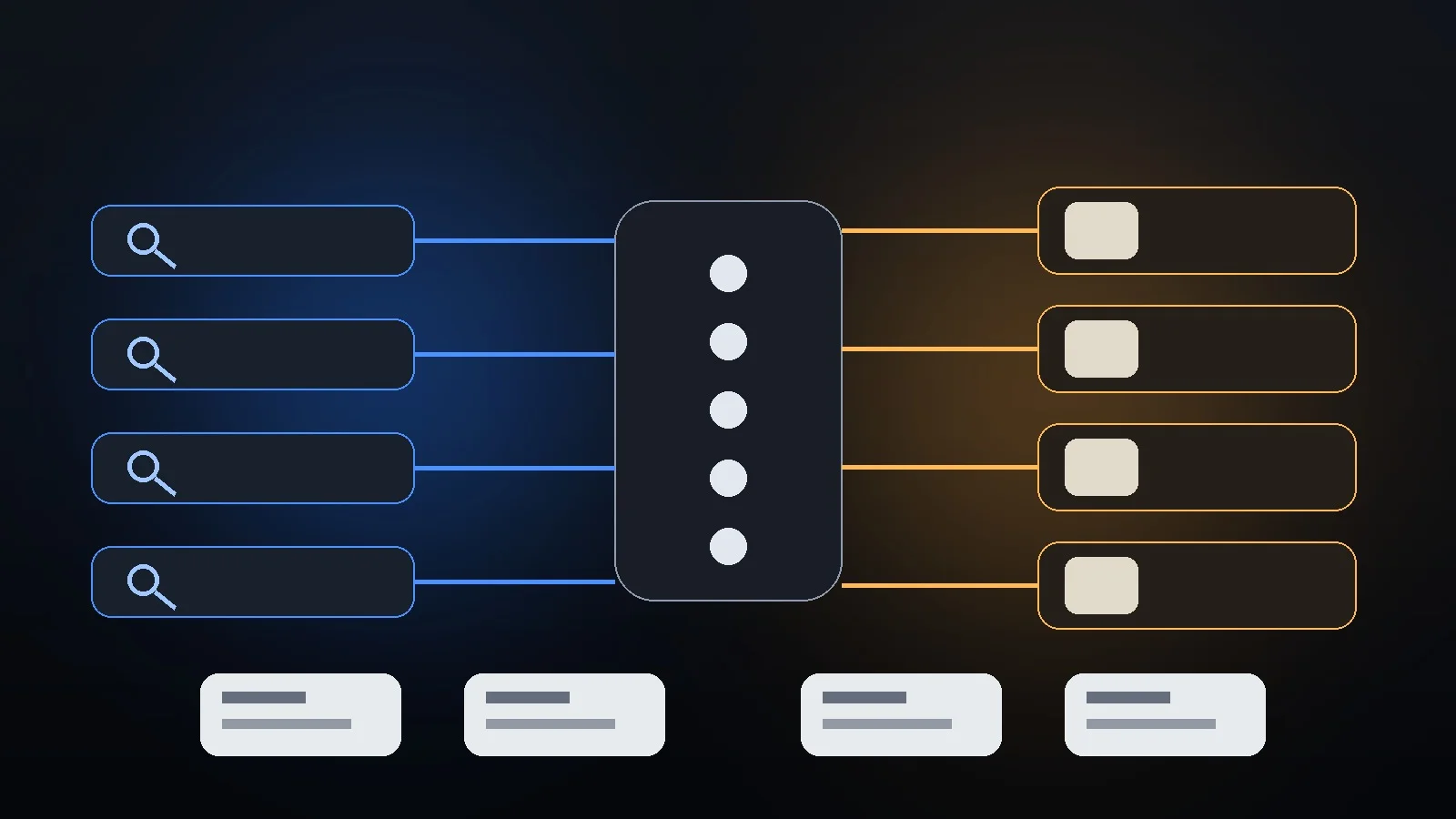
Structure should protect decisions, not preserve old habits
Google Ads account architecture used to be built around manual control.
Advertisers split match types, devices, geographies, audiences, products and bidding logic into separate campaigns because each split created another lever. That model made sense when operators were expected to decide more of the auction mechanics themselves.
AI Max and Performance Max change the purpose of structure.
Google now describes AI Max as an optimization layer for Search rather than a separate campaign type. It can expand search term matching, customize text and use Final URL expansion to choose more relevant landing pages. Performance Max already spans multiple inventories and can use search themes, brand exclusions, account-level negatives, Final URL expansion and asset automation.
The account therefore needs fewer structural boundaries created for convenience and more boundaries created for business reasons.
A campaign should exist because it protects a meaningful difference in economics, budget ownership, geography, product availability, compliance, conversion objective or experiment design.
If two campaigns optimize toward the same value, operate under the same constraints and compete for the same demand, splitting them merely to create neat reporting can reduce the data available to automation without creating a real strategic benefit.
Start with the business segmentation layer
Before deciding where Search ends and Performance Max begins, define the segmentation that exists outside Google Ads.
The most important questions are:
- Which products or services have materially different contribution margins?
- Which markets have different economics or legal constraints?
- Which conversions are genuinely different business outcomes?
- Which inventory needs independent budget protection?
- Which areas require strict brand, landing-page or compliance control?
- Which parts of the portfolio need to be tested separately?
Those answers should determine the major campaign boundaries.
A retailer, for example, may have one product category with a 65% gross margin and another with a 25% margin. If both are optimized against raw revenue in the same economic pool, the bidding system may rationally chase revenue that is less valuable to the business.
The first architecture decision is therefore not campaign type. It is what the system is allowed to treat as economically equivalent.
Search is becoming a controlled exploration system
AI Max makes this especially important in Search.
According to Google Ads Help, AI Max combines three major capabilities: search term matching, text customization and Final URL expansion. Search term matching can use broad-match, asset and landing-page signals to reach queries beyond the existing keyword set. Text customization can generate additional copy from the advertiser's domain, landing pages, ads and keywords. Final URL expansion can route users to a more relevant page on the domain.
Google has also added corresponding controls: brand inclusions and exclusions, locations of interest, URL inclusions and exclusions, text guidelines, search-term reporting with source information and reporting for optimized assets.
That means the professional Search structure should be designed around a question:
Where is exploration acceptable, and where is precision mandatory?
A tightly regulated financial product may need a narrow set of landing pages and language restrictions. A large ecommerce category may benefit from broader query discovery and URL expansion. The correct architecture does not force both into the same control regime.
Use campaigns for hard boundaries and ad groups for operating context
A useful hierarchy in 2026 is:
Campaign = hard boundary. Budget, bidding objective, geography, major brand control, experimentation boundary and other strategic constraints.
Ad group or asset group = operating context. A coherent product, service, intent or creative theme that gives the automation useful context.
Asset and feed layer = expression. The copy, imagery, product data and landing pages the system can use to match intent.
This hierarchy prevents the account from turning into a taxonomy project.
In Search, ad groups should still have enough semantic coherence that landing pages, ads and search-term matching point in the same direction. AI Max does not eliminate relevance. It increases the number of signals Google can use to infer relevance.
In Performance Max, asset groups should likewise reflect meaningful product or message clusters. They are not a substitute for campaign-level economic segmentation, and they should not be multiplied only to imitate the old ad-group model.
Decide how Search and Performance Max coexist
Search and Performance Max can both participate in search demand, so coexistence needs explicit rules.
Google states that when a user's query exactly matches an exact-match keyword in a Search campaign, Search is prioritized over Performance Max. Search themes in Performance Max do not behave like exact-match ownership; Google says they have the same prioritization as phrase and broad match keywords.
That makes Search useful for areas where query-level intent, copy, landing-page control or strategic visibility matters enough to justify a dedicated structure.
Performance Max can then operate as a broader inventory and discovery system around product feeds, asset groups and cross-channel delivery.
A practical architecture often looks like this:
- Search campaigns for strategically important query families, high-control categories, regulated claims and areas where query reporting materially affects decisions.
- Performance Max for broader product coverage and cross-inventory expansion where strong conversion values and feed quality are available.
- Separate campaign boundaries when margin, geography, budget ownership or conversion value differs.
- Brand controls and negatives where the business needs explicit separation between acquisition and demand capture.
The objective is not to prevent overlap at all costs. It is to understand what each campaign is responsible for.
Final URL expansion turns website architecture into media architecture
When Final URL expansion is enabled, the website itself becomes part of targeting.
Google can choose a landing page that it predicts is more relevant to the query. In Search, URL inclusions and exclusions can narrow the eligible destination set. In Performance Max, Google recommends page feeds and URL exclusions when advertisers want to steer automated landing-page selection.
This changes a traditional paid-search assumption.
Landing pages are no longer only destinations chosen after keyword strategy. They are also machine-readable inventory that can influence query matching and creative generation.
Teams should therefore audit:
- duplicate or low-value indexable pages;
- out-of-stock category pages;
- editorial pages that should never receive paid traffic;
- weak international or regional variants;
- pages with compliance-sensitive claims;
- parameterized URLs that create reporting noise;
- category and product pages whose titles fail to describe the offer clearly.
A poor site taxonomy can now become a paid-media problem.
Treat conversion architecture as part of campaign architecture
AI-driven accounts need strong signals more than they need elaborate naming conventions.
Search term expansion, automated creative and cross-inventory bidding all depend on the conversion outcomes supplied to Google.
The account should therefore be reviewed together with:
- primary conversion definitions;
- conversion values;
- customer-quality or offline outcomes;
- Enhanced Conversions;
- Data Manager integrations;
- product-margin logic;
- transaction IDs and deduplication;
- attribution and incrementality assumptions.
If the conversion model changes, the campaign architecture may need to change as well.
For example, a lead-generation account that begins importing qualified-lead value can often consolidate structures that previously existed only to proxy for lead quality.
Separate reporting structure from delivery structure
One of the biggest causes of over-segmentation is using campaigns as reporting folders.
That is increasingly unnecessary.
Reporting can be built through labels, custom dimensions, product attributes, asset groups, search-term source data, Merchant Center product taxonomy, BI layers and campaign naming standards.
Delivery structure should be reserved for cases where separation changes how money can be spent or what the algorithm is allowed to do.
That distinction keeps the account legible without starving individual campaigns of data.
Build an experimentation lane
Automation should not be activated account-wide on faith.
Google supports AI Max experiments that compare a treatment campaign with a base Search configuration and allow campaign-level choices such as text customization, Final URL expansion and brand settings.
That makes controlled rollout part of architecture.
A mature account should reserve a repeatable testing process for:
- AI Max activation;
- broader search-term matching;
- Final URL expansion;
- new value models;
- target changes;
- new Performance Max segmentation;
- creative automation;
- feed changes.
The test should define the expected business outcome before launch. A platform improvement in conversion volume is not enough if the change reduces margin or lead quality.
The account should become simpler as the measurement becomes better
The strongest Google Ads architecture is usually not the most granular one.
It is the architecture that preserves the few distinctions that materially affect business outcomes while allowing automated systems enough data and flexibility to optimize inside those boundaries.
That is the transition AI Max and Performance Max force operators to make.
The account is no longer a map of everything the media buyer can control.
It is a map of everything the business must control.