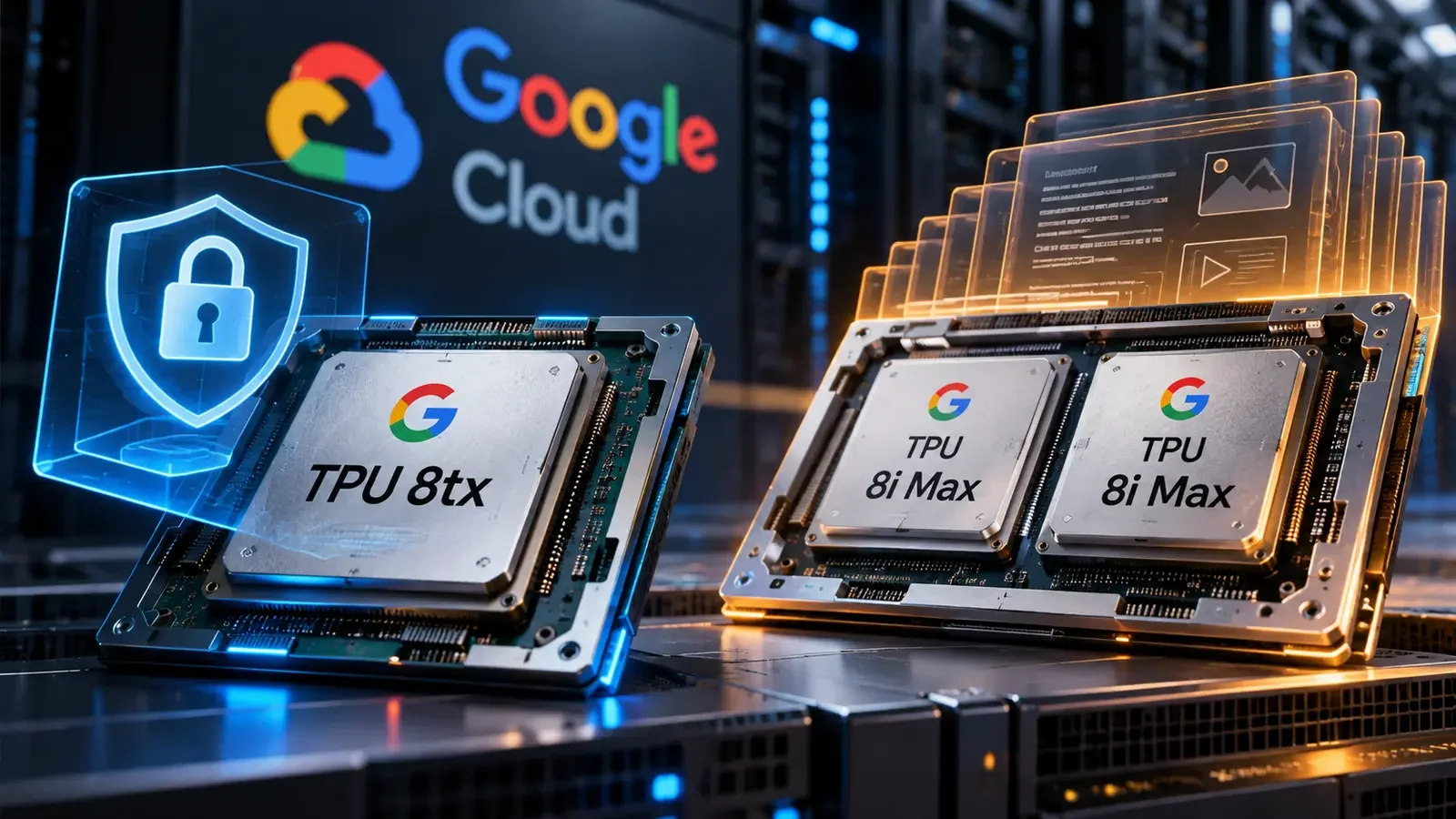
Google announced this Monday (9) two new configurations of its eighth-generation tensor processing units (TPUs), aimed at different artificial intelligence needs. The TPU 8tx prioritizes the protection of confidential information during processing, while the TPU 8i Max expands computing capacity and memory bandwidth for applications that work with large volumes of context.
The TPU 8tx uses the same chip as the TPU 8t but incorporates hardware-level security features and custom AMD processors. The configuration was developed for companies in regulated sectors and government agencies that need to run proprietary models without exposing sensitive data or model parameters during processing.
According to Google, the new configuration also uses a low-latency communication network and can offer latency up to two times lower than the TPU 8t, with practically no impact on performance resulting from the security protections. The results are presented by the manufacturer and do not represent an independent comparison between different workloads.
The system also enables inference and smaller-scale training tasks, including model tuning with private data, without the need to transfer sensitive information between different sets of servers.
TPU 8i Max doubles resources for applications with extensive contexts
The TPU 8i Max addresses a different need: running applications that need to maintain and process large amounts of information simultaneously, such as AI agents that analyze extensive codebases or long video sequences.
To this end, Google combined two TPU 8i chips in a single package. According to the disclosed specifications, the system offers double the computing capacity, SRAM memory, and HBM memory bandwidth compared with a TPU 8i.
The configuration also allows concentrating more processing capacity in the same physical space occupied by equipment in data center racks.
The two new products expand the portfolio announced by Google in 2026, which already included the TPU 8t, intended for training large models, and the TPU 8i, optimized for reasoning and low-latency inference.
In the announcement signed by Amin Vahdat, senior vice president and chief technologist for AI and infrastructure, the company clarified that 8tx and 8i Max are new configurations of systems based on existing chips, and not two entirely new processor architectures.