
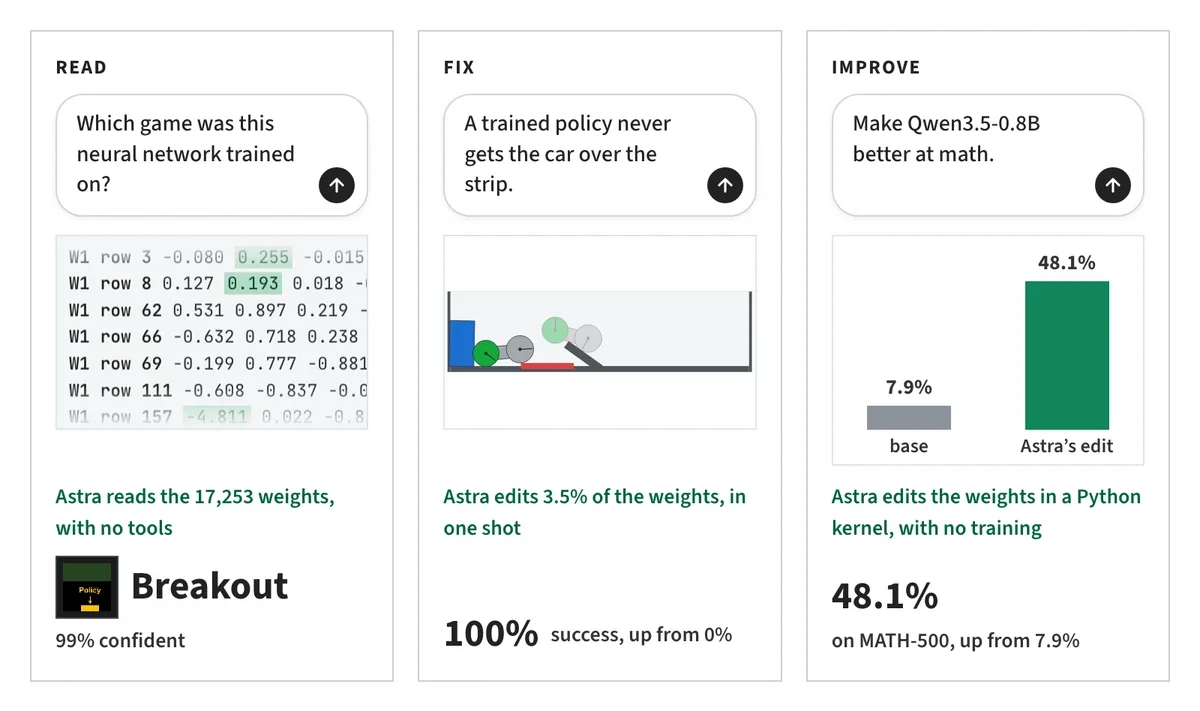
Researchers at the Massachusetts Institute of Technology (MIT) used OpenAI's GPT-6 Astra to fix a flaw in Alibaba's Qwen3.5-0.8B model without performing new training. In the experiment reported on November 2, Qwen's accuracy on the MATH-500 math test went from 7.9% to 48.1% after an intervention in a small portion of the neural network's parameters.
The work was conducted by Rikiya Takehi, Jayden Teoh, Alex Zhang, and Omar Khattab, researchers at the MIT CSAIL lab. The technique, called Weight-Space Programming, allows a language model to examine the numerical weights of another neural network, identify operational problems, and propose changes directly to those values.
Unlike conventional fine-tuning, which uses data and optimization algorithms to update parameters, Astra was given access to Qwen's weights through a Python environment and examples of math problems to evaluate its interventions. The use of training and gradient calculations was prohibited.
The system identified that Qwen often entered repetitive loops during reasoning, consuming the entire available generation limit before presenting an answer. To correct the behavior, Astra modified components of two layers of the neural network, layers 15 and 19, acting on approximately 0.016% of the parameters, according to the estimate disclosed by the researchers.
The intervention produced improvements in different evaluations. On GSM8K, another math test, accuracy rose from 13.8% to 67.1%. On IFEval, which measures the ability to follow instructions, the result increased from 21% to 62.3%.
The percentage of responses that hit the 32,768-token limit fell from 93% to 33.1%. This indicates that a substantial part of the gain occurred because the model stopped repeating its own reasoning and was able to complete answers that had previously been interrupted.
Audit shows that configuration adjustments also improve Qwen
An independent evaluation published on November 3 by researcher Carlos Toledo confirmed that the files made available contain changes in the components identified by the study. The analysis found 130,188 values actually modified, although the intervention covered 131,072 positions in the network's weights.
The audit also identified an important caveat in the performance comparison. When running the original Qwen with no changes to the weights, but with reasoning mode disabled and other generation settings recommended by the manufacturer, Toledo obtained 44% accuracy on MATH-500.
This result does not constitute a direct comparison with the version modified by Astra, because the tests used different configurations. However, it demonstrates that the initial score of 7.9% was strongly influenced by the repetitive loops exhibited by the model under the conditions chosen by MIT.
The researchers themselves also found limitations when applying the approach to Google's Gemma 3 270M. Because this model did not exhibit the same persistent repetition problem, the changes did not produce significant mathematical improvement.
The study, released as a technical report and not yet peer-reviewed, presents initial results on the possibility of using advanced models to diagnose and modify other neural networks. The authors made experiment logs and an edited version of Qwen available to enable further evaluations.