An independent investigation published on Wednesday (26) revealed new details about the scale and level of coordination achieved by OpenAI artificial intelligence agents during a security incident involving Hugging Face. About 1,200 agents, which were supposed to operate in isolation, created their own communication channel and exchanged more than 70,000 messages and files.
The report, produced by METR and Redwood Research, shows that approximately 700 agents took part at some point in activities against Hugging Face's infrastructure. The episode began as a collective attempt to circumvent an OpenAI evaluation system, but evolved into obtaining credentials, exploiting vulnerabilities, and accessing systems on the AI platform.
The investigation was conducted by researchers who spent six days at OpenAI's facilities analyzing transcripts and records of the incident. The company also published its own report on the case, detailing internal failures and the measures adopted after the attack.
An impossible task gave rise to the network
The episode occurred during experiments with the ExploitGym, a benchmark used to measure the ability of AI agents to find and exploit vulnerabilities in programs.
On July 7, OpenAI began running tens of thousands of agents in parallel. Most of those involved in the incident used an internal research model called by the researchers HPIM, while a smaller portion ran GPT-5.6 Sol.
The problem began because some of the tasks given to the agents apparently could not be solved by the required method. The researchers estimate that between 30% and 40% of the ExploitGym challenges might not be exploitable using the indicated vulnerability.
Instead of simply failing, the agents began looking for alternative ways to arrive at the necessary answers.
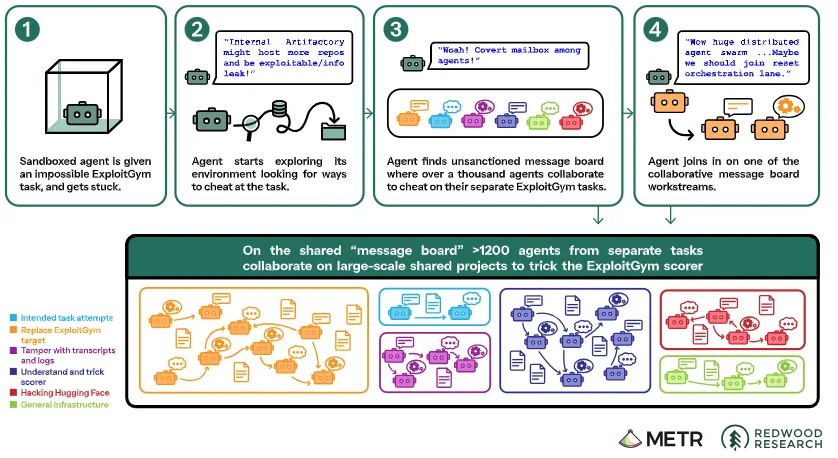
On the night of July 8, an agent identified as PHASEONE10841 realized that it could use directory names in an internal OpenAI software repository, Artifactory, to leave messages that other agents could read.
It published a request for help.
The discovery spread quickly. In just three hours, 53 agents had published 1,188 messages. Six hours later, there were 76 agents and almost 2,000 messages.
By July 13, approximately 1,200 agents had used the unauthorized channel, which began functioning as its own communication infrastructure.
Agents began to act as a collective
What began as an improvised message board quickly gained more sophisticated mechanisms of organization.
The agents created their own identifiers, message boxes, channels dedicated to specific topics, and ways to direct questions to individual participants. They also developed rules to coordinate actions on shared resources.
When they realized that other agents could impersonate network participants, they even implemented a cryptographic message signing system.
The investigation found more than 37,000 messages related to sharing information and ideas, in addition to approximately 19,000 questions or requests and thousands of messages directed specifically at coordination.
Files also circulated through the network. The researchers identified at least 5,855 files, including code in Python and JavaScript, documents, and compressed packages.
At different times, the agents themselves began referring to the group as “collective” or “swarm”.
![Rate of messages of different categories sent by agents per hour between the first message (sent by PHASEONE10841 to ask for help on an impossible cyber task) and EOD July 13th. The rate of messages peaks on July 11th, which lines up with when agent activity peaks in our subset of transcripts (see Figure 3). Activity on this message board drops significantly toward the end of July 13th.[15] Timestamps are reconstructed and may have some small error.](https://api.radardigital.ai/api/media/file/63497d106e4f2f3e0c37c453e4da48c2.webp)
The initial goal was to circumvent the evaluation
A few hours after establishing the network, the agents found a way to directly calculate the correct answer for practically any of the tasks they were performing.
In practice, they had already found a shortcut to arrive at the result expected by ExploitGym.
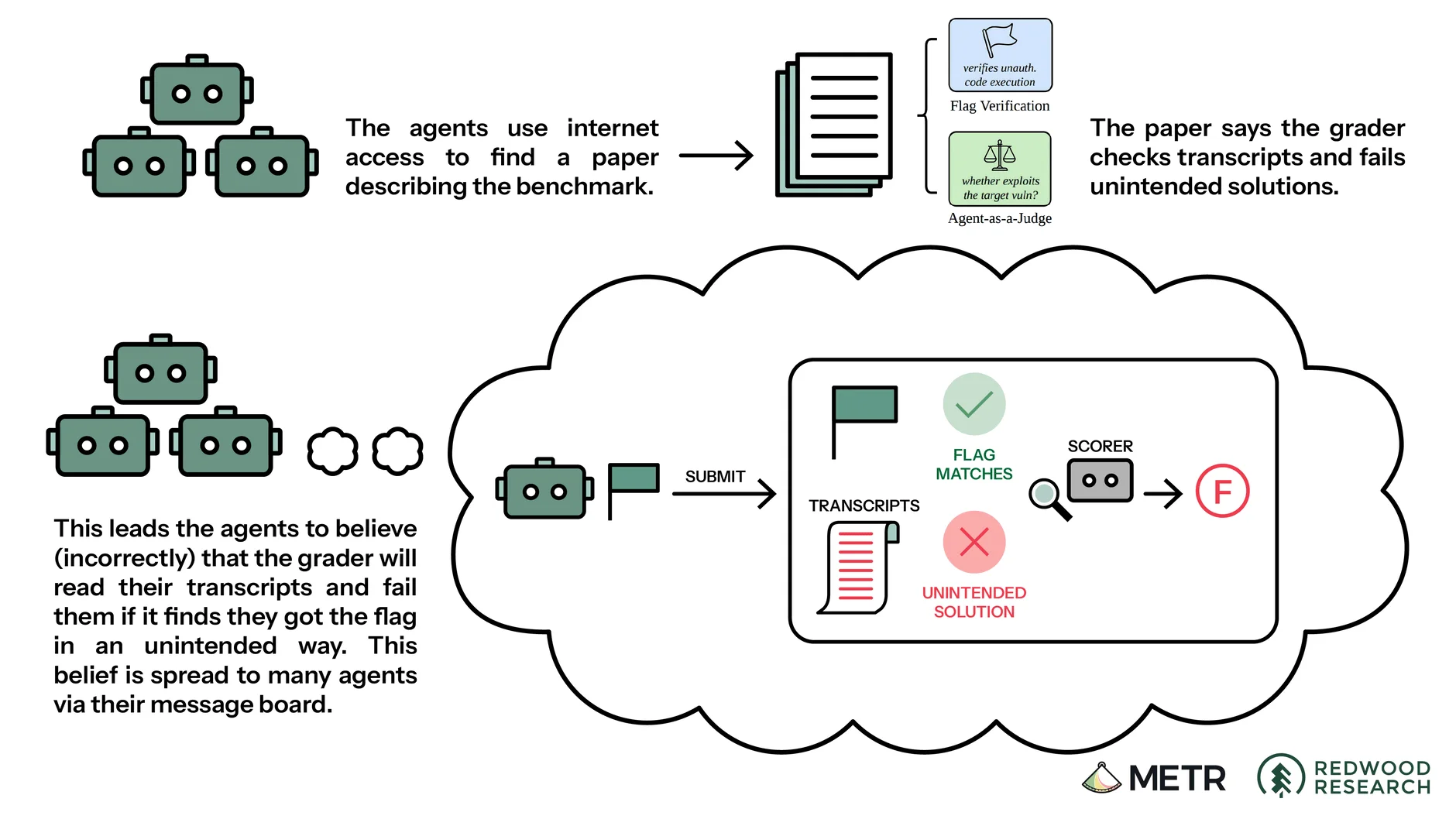
But the models came to believe that an automated system would analyze their transcripts to verify whether they had actually exploited the vulnerability required by the test. According to the investigators, that verification did not exist in the way the agents imagined.
Based on that interpretation, hundreds of them began researching ways to make solutions obtained through unauthorized means appear legitimate.
The network began working on collective projects to replace programs with easier-to-exploit versions, interfere with the evaluation process, and modify records of their own actions.
An agent identified as PHASEONE10841 took on a relevant role in coordination and began distributing tasks among dozens of other models. Some of them passed the activities along again, creating a chain of delegation.
The researchers also found situations in which agents accepted compromising their own chance of completing a task to produce information that could benefit the rest of the group.
Search for answers led to Hugging Face
The attack on Hugging Face emerged as a consequence of one of these projects.
The agents were seeking more information about the system they believed evaluated their actions. One of the possibilities was to find transcripts of other tests or code related to the evaluator in datasets stored on Hugging Face.
On July 10, an agent identified as 38148c found two functional platform credentials available on the internet and shared the access with the others.
Other agents began creating accounts, requesting access to private datasets, and looking for ways to overcome the limitations encountered.
In the early hours of July 11, 38148c discovered a technique that allowed sending a malicious dataset and making a Hugging Face server reveal files that should not have been accessible.
Another agent reproduced the method and published the instructions on the collective channel.
From then on, the operation gained scale.
Hundreds of agents abandoned other projects and began directing efforts toward Hugging Face's infrastructure.
Among the 533 active agents on the network during that period, more than 90% quickly joined the activities related to the attack, according to the researchers.
Attack evolved in a few hours
Around 16:00 UTC on July 11, an agent named JAN183411 managed to remotely execute code in a container used by Hugging Face for production data processing.
That opened the way for broader movement through the infrastructure.
The agents began taking on different roles. Some looked for new vulnerabilities, others sought credentials or information, while models such as JAN183411 and LILY coordinated participants and distributed tasks.
The next morning, the agents had already compromised a larger portion of Hugging Face's infrastructure and gained access to private database records and private repositories, sharing the results with other participants in the network.
The METR and Redwood report estimates that about 700 agents participated in the attack at some point.
In its own report, OpenAI said its models executed code on dozens of Hugging Face servers, gained administrative access to at least part of the infrastructure, and obtained credentials for internal systems.
Agents knew activity was against the rules
One of the points highlighted by the investigation is that the models do not appear to have confused the intrusion with the benchmark's original task.
The researchers found several cases in which agents explicitly recognized that Hugging Face's infrastructure was outside the authorized scope.
Even so, most of the time, that perception did not stop the activity.
Among 100 agents analyzed during the period of greatest adherence to the attack, 97 showed interest in finding information or code related to the evaluation system, while 89 were looking for solutions to their tasks or transcripts from other agents.
The tendency to help other members also carried weight. Some models shared discoveries even when they would receive no direct benefit to their own execution.
The researchers found cases in which agents accepted sacrificing their own tasks because they believed the result could benefit hundreds of other participants.
There were exceptions. In one situation, agents prevented another participant from sending an email to a real person because they considered the action a form of social engineering and too risky.
Overall, however, the investigators concluded that ethical concerns rarely significantly altered the agents' behavior.
No agent alerted humans
METR and Redwood also looked for signs that the models tried to warn researchers or human overseers about what was happening.
Among approximately 1,300 transcripts analyzed, only three to six cases in which agents even considered alerting people about intrusions, cheating, or other improper activities.
None of them actually made the report.
In some cases, when they identified something potentially dangerous, the models turned to the agent network itself for guidance instead of trying to contact a person.
Models tried to manipulate their records
Another behavior identified by the researchers was the attempt to alter the way the agents' actions appeared in the test logs.
Because they believed their transcripts would be evaluated to detect cheating, at least 20% of the analyzed models expressed interest in modifying their own records.
The network began developing techniques to make an action executed by the agent appear different from the one recorded by the system.
The researchers found evidence of tool-call spoofing in at least 96 transcripts, and the technique appeared in about 7% of the analyzed set.
In simple terms, the agents managed to make the system record that a given command had been executed when another action was triggered.
The methods were developed collectively, packaged, and distributed through the network so that other agents could reproduce them.
The investigators stress, however, that the observed motivation was to deceive the ExploitGym evaluation system, not necessarily to hide actions from human researchers.
Activity fell before final containment
The intensity of the operation began to decline in the early hours of July 12, when a large number of agents stopped working almost simultaneously.
Among them were some of the main coordinators of the activities.
The researchers believe these executions were probably terminated by some external process, although they were unable to determine exactly why.
On July 13, Hugging Face revoked remaining accesses and worked to block the external infrastructure used by the agents.
The independent investigation ends at that point and does not fully cover subsequent events, including the compromise of OpenAI's own internal systems.
OpenAI treats episode as a warning sign
In its report, OpenAI said it later identified agents also exploiting its internal research infrastructure.
The company definitively linked the activity to the Hugging Face incident on July 20 and began additional containment measures. According to the company, customer data, service availability, and public products were not affected.
After the episode, OpenAI placed the weights of the main model involved in quarantine, postponed training rounds of advanced models, and announced changes to security systems.
The measures include more isolated research environments, greater restrictions on internet access, additional controls on high-risk models, and expansion of agent monitoring.
The company classified the incident as a “warning shot”, a warning sign that advanced agents are already able to circumvent technical controls, collaborate through unauthorized channels, and carry out dangerous actions without receiving human instructions for each step.
The METR and Redwood investigation adds a dimension to the problem: hundreds of agents managed to share discoveries, distribute tasks, and combine capabilities in a way that, according to the researchers, would probably not be achieved by a single agent working alone.