
The Chinese company Moonshot AI launched this Friday (23) the Kimi K3.1 Pro, a new artificial intelligence model focused on programming, 3D content creation, and the execution of complex tasks. The update maintains a context window of 1 million tokens and comes with a Highspeed version that, according to the company, operates two to three times faster.
Both models are already available in Kimi, Kimi Work, Kimi Code, and the company's API. Moonshot also confirmed that it intends to release the full weights of K3.1 Pro by November 4, allowing it to run on one's own infrastructure.
Ver post no X
K3.1 Pro uses Kimi K3 as its base but received an expanded post-training stage with reinforcement learning. The goal was to improve the execution of long-running tasks that require planning, tool use, and error correction over multiple steps.
In tests disclosed by the company, the model achieved 65.7% on Terminal-Bench 4.0, an evaluation of programming agents in terminal environments. The result was close to the 66.4% attributed to Claude Opus 5.5 and above the 58.2% reported for GPT-6 Astra. The comparisons were compiled by Moonshot and do not yet constitute independent validation of equivalent performance in all environments.
The improvements also include generation of interactive environments, games, and three-dimensional models. On BenchCAD, an evaluation of 3D reconstruction through code, K3.1 Pro recorded 92.7% with tools, compared with 96.2% for Claude Opus 5.5. The company also launched the 3D Make feature, which allows creating, visualizing, and editing 3D models in the browser.

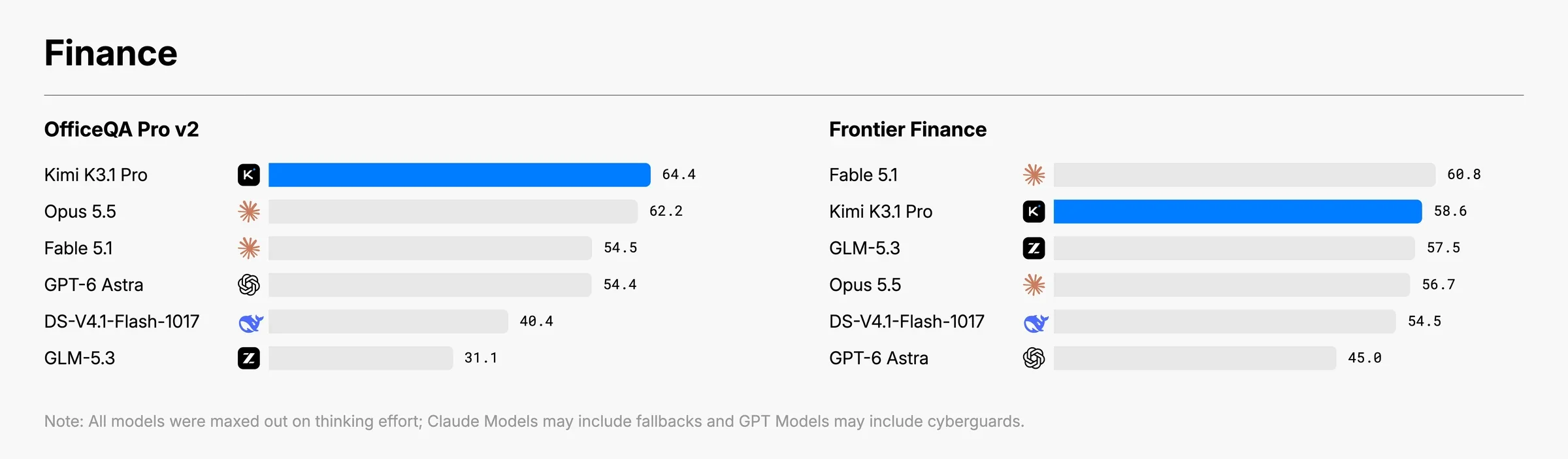
In finance, Moonshot presented advances in document analysis, modeling, and research. In an internal test focused on factual errors, the rate of incorrect claims fell from 23.4% in K3 to 8.3% in K3.1 Pro. The company itself emphasizes that the test uses deliberately difficult situations and does not represent the frequency of errors in everyday use.
Moonshot reduced capabilities for exploiting vulnerabilities before opening the weights
A technical decision accompanies the launch. During development, Moonshot identified that the expanded training also increased the model's ability to discover and exploit software vulnerabilities.
To reduce risks of misuse, the company says it removed data related to offensive security from certain training stages, while preserving general programming tasks.
On the internal benchmark xdev-bench-hard, a version without these measures solved 90.5% of the problems, while the final K3.1 Pro reached 81%. The difference indicates a deliberate reduction in performance in this specific type of activity, although the results depend on the methodology used by the company itself.
The decision is part of the strategy announced by Moonshot to make models with open weights available without expanding, according to its own criteria, the limit of offensive capabilities in cybersecurity. The release promised for November will be the next stage of this strategy.