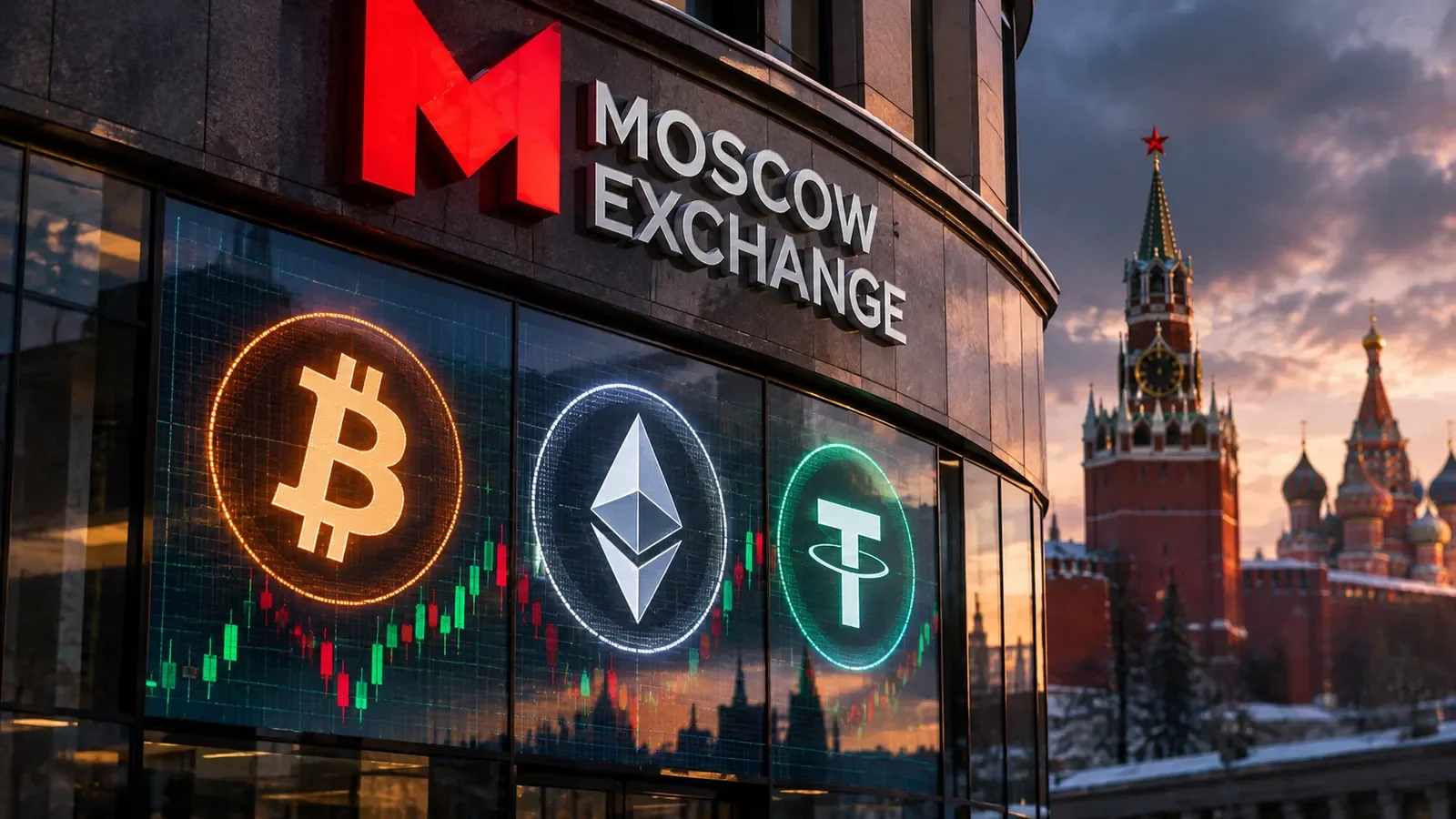
The Moscow Exchange (MOEX) plans to start trading bitcoin (BTC), ether (ETH) and USDT on December 1st, 2026, creating Russia's first organized cryptocurrency market. The launch will begin with pilot operations and the gradual entry of financial institutions, according to an official statement released on Monday (2).
Trading will be held from 6:50 a.m. to 11:50 p.m., Moscow time, using the infrastructure already employed in the stock market. The National Clearing Center (NCC) will be responsible for clearing the operations, with settlement on the same day or the next business day.
The platform will also offer swap operations for liquidity management. Initially, only the three announced assets will be available, but the exchange intends to expand the list with Russian and international digital instruments.
Access to the market will be restricted. Non-qualified investors will need to pass a test and will be able to buy up to 300,000 rubles per year, approximately US$ 3,700, per brokerage. Qualified investors will not be subject to the same financial limit.
The launch comes after Federal Law No. 282-FZ took effect in September, establishing rules for crypto-asset trading by authorized intermediaries in Russia.
American sanctions raise doubts about USDT transactions
The inclusion of USDT presents an additional issue: both the Moscow Exchange and the National Clearing Center are under US financial sanctions since June 2024.
The stablecoin, pegged to the US dollar, is issued by Tether, a company that maintains a policy of freezing wallets associated with individuals and entities included in the US Treasury Department's sanctions list.
This creates operational uncertainty about the treatment of USDT traded through the sanctioned Russian infrastructure. The existence of the restrictions, however, does not mean that the tokens used in these operations will be automatically blocked.
CoinDesk reported this Wednesday (4) that it reached out to Tether to clarify how its freezing policy would be applied to assets held through the Moscow Exchange's clearing structure. The report did not present a response from the issuer.
The project also represents a change in the structure of the Russian market. Instead of relying exclusively on foreign platforms and direct trading between users, investors will have access to a domestic trading environment supervised by financial authorities.
The debut is scheduled for December, but the exchange itself emphasizes that institutions' participation will be expanded gradually, according to their operational readiness.