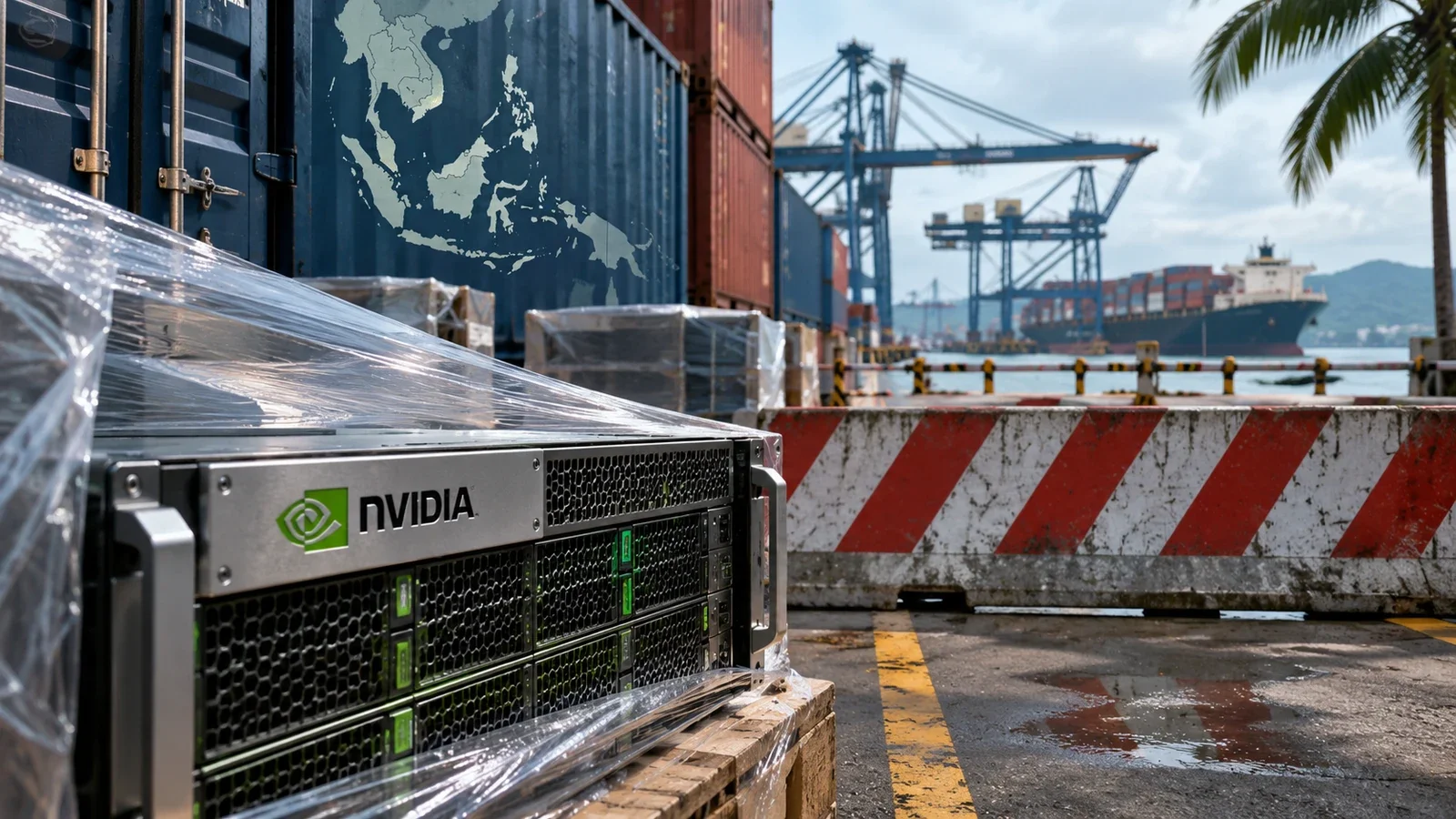
Nvidia has instructed its manufacturing partners to suspend shipments of servers equipped with its chips to Malaysia, Singapore, Thailand and Indonesia, according to a report published this Thursday (26) by the Financial Times. The move comes after the United States expanded restrictions on Chinese companies' access to computing capacity used in artificial intelligence development.
Manufacturers such as Dell and Supermicro have already notified buyers in the four countries that their orders would not be released. The newspaper spoke with three people familiar with the matter, but it is still unclear whether the suspension will be temporary.
The block has also hit infrastructure financing in the region. Aolani, a Singapore-based cloud computing provider, planned to provide advanced computing capacity to ByteDance, the owner of TikTok, through lease agreements.
According to the reporting, banks that had agreed to finance the project stopped granting approximately US$ 500 million in credit. ByteDance may also abandon the deal.
Chinese demand for computing capacity has driven billion-dollar investments in data centers in Southeast Asia, especially in Malaysia and Indonesia. Contracting cloud services abroad allowed Chinese developers to use advanced Nvidia processors without having to import them directly.
The manufacturer's subsidiary in Singapore recorded US$ 104 billion in revenue in 2025, growth of 72% over 12 months, according to financial documents cited by the Financial Times. The amount, however, includes revenue from Taiwan and China and does not exclusively represent sales in Southeast Asia.
The rule no one knows how to comply with
In effect since November 19, the new regulation from the Bureau of Industry and Security (BIS), part of the U.S. Department of Commerce, establishes controls on the remote provision of computing capacity to companies based in China, Macau and other jurisdictions subject to the restrictions.
The licensing requirement covers operations that exceed 12 million TPP, an aggregate computing performance metric, a threshold equivalent to approximately 750 Nvidia H100 GPUs, according to Reuters. The limit also considers capacity distributed across interconnected data centers.
The regulation also establishes specific licensing requirements for exports of advanced chips to the four Asian countries and to Brazil, with exceptions conditioned on compliance with regulatory requirements for companies based in or controlled by parent companies in the United States. Brazilian territory does not appear among the destinations affected by the suspension reported by the Financial Times.
Operators that were already providing services covered by the regulation have 90 days to obtain a license. The implementation of the requirements, however, has caused uncertainty among service providers.
“No one knows how to apply for this license while the 90-day deadline is running. It is causing absolute chaos in the region,” an executive at a cloud computing provider, whose identity was not disclosed, told the Financial Times.
Nvidia declined to comment on the matter. Dell, Supermicro, ByteDance and Aolani did not respond to the newspaper's requests for comment. There is no official confirmation on the duration or the conditions for resuming deliveries.