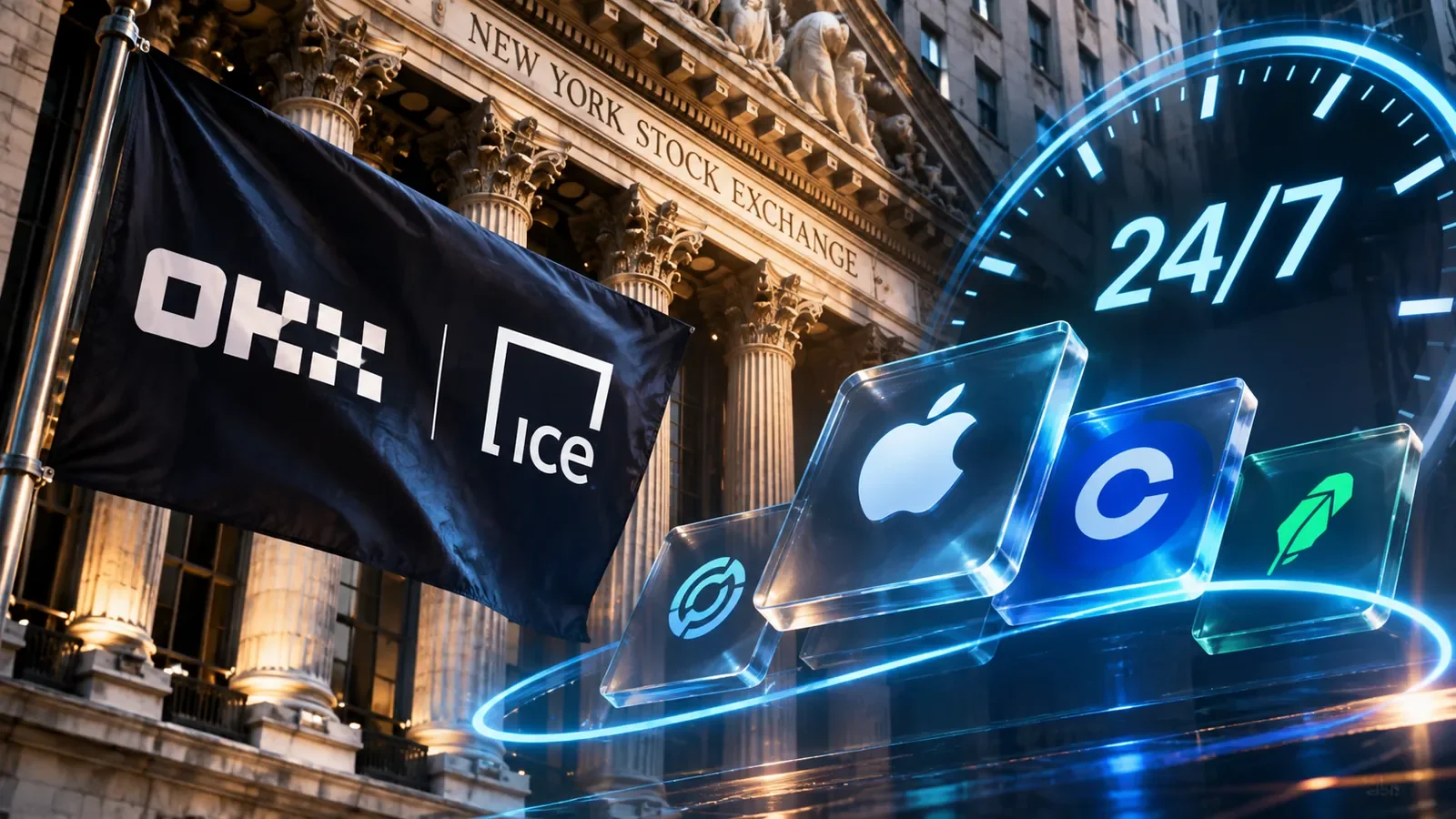
OKX and Intercontinental Exchange (ICE), parent company of the New York Stock Exchange (NYSE), announced this Wednesday (11) that they intend to begin, on November 23, trading of tokenized stocks and other securities in the United States. The new platform, called OKXICE, will offer 24-hour, seven-day-a-week trading, but will face access restrictions and objections from dozens of companies.
The launch is planned with more than 70 assets, including instruments linked to Coinbase, Circle, Robinhood, BitGo, Securitize and Strategy, as well as 59 Direxion ETFs. Trading will be made available through the OKX app to U.S. customers who meet the platform's requirements.
The tokenization infrastructure will be provided by Securitize. According to the announcement, each token will represent rights to securities backed one-to-one by U.S. stocks, including rights applicable to dividends, voting and participation in corporate events.
Transactions will use automated liquidity pools based on Uniswap v4, implemented on X Layer, a layer-2 network tied to Ethereum. The assets will remain in investors' self-custody wallets, without OKXICE holding their private keys.
Access, however, will not be unrestricted. Users will need to activate a CeDeFi wallet, complete identification procedures and meet the geographic and eligibility conditions established by the company.
Why 67 companies opposed the tokenization of their shares
The announcement comes amid significant resistance from American companies to the trading of tokenized versions of their shares.
According to The Block, 67 companies had raised objections by November 5, including Apple, Meta, Tesla, Netflix, Costco and Home Depot. Among the 62 companies initially selected by OKXICE, 56 had expressed opposition to the inclusion of their shares, according to a CoinDesk survey.
The objections have practical consequences. Under the rules established by the Securities and Exchange Commission (SEC), a company can prevent a specific venue from trading versions of its tokenized shares by third parties not affiliated with the issuer, provided it submits its opposition within the regulatory deadline.
The concerns encompass possible effects on prices, liquidity and volatility, as well as the risk that investors will interpret the trading as an initiative authorized by the issuing company.
Applied Optoelectronics raised these concerns when justifying its opposition, according to statements from a representative to The Wall Street Journal. Nasdaq also questioned the regime, especially the possibility of trading stocks outside the traditional structure of oversight, data disclosure and transparency in the U.S. market.
Securitize President and CEO Carlos Domingo defended an approach based on shares that actually exist and on preserving shareholder rights. The company will be responsible for the infrastructure used in OKXICE's debut.
The operation will be conducted under the Innovation Exemption, a temporary regime created by the SEC in September 2026. The regulatory authorization allows certain venues to trade tokenized stocks without registering as traditional exchanges, provided they comply with specific conditions.
These conditions include limits on assets and trading volumes, guarantees of rights equivalent to those of the underlying shares, and suspension of operations when trading in the original shares is suspended.
The exemption is expected to last five years, but it does not represent individual approval of OKXICE by the SEC. The company itself clarifies that its platform is not a registered exchange or a broker authorized by the commission.
With the debut scheduled for November 23, OKXICE intends to offer continuous trading of securities on blockchain. The actual scope of the catalog, however, will remain subject to regulatory rules and to objections raised by issuers.