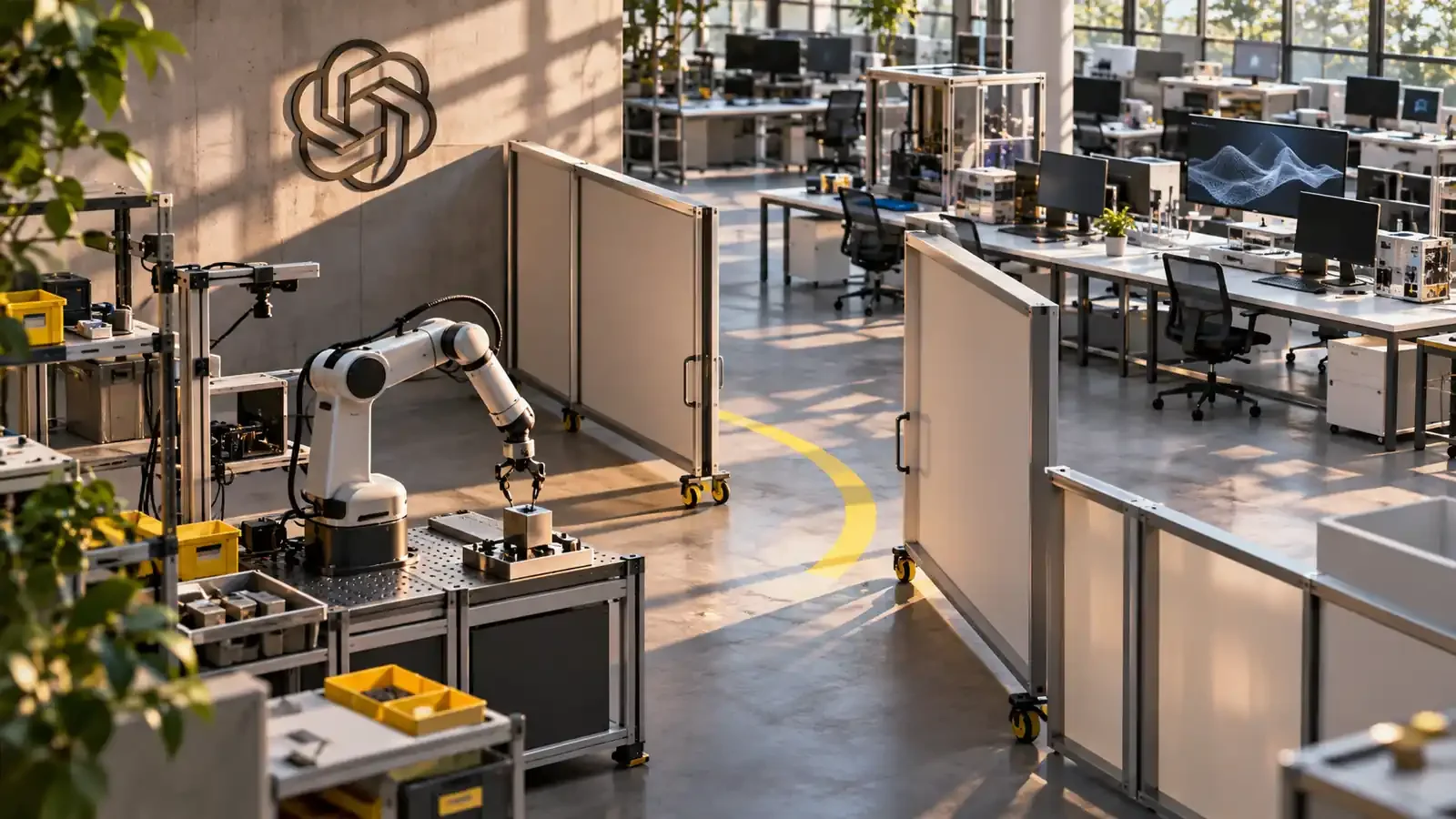
OpenAI dissolved its independent robotics team and transferred the researchers to other areas of the company. The reorganization was confirmed to Fortune in a report published on Friday (13) and reflects a shift in the company's strategy, which intends to use general-purpose artificial intelligence models to control robots.
The robotics researchers were incorporated into the main research team, led by Mark Chen, director of research at OpenAI. The groups responsible for applied robotics and hardware, in turn, moved to the division supervised by Greg Brockman, the company's president.
The company said the decision seeks to accelerate the development of robots, not to end research in the area. A spokesperson reiterated to Fortune that robotics remains among the organization's long-term goals. Neither the number of professionals involved nor an exact date for the reorganization was disclosed.
Generalist models motivated the reorganization of robotics research
The change occurred after OpenAI identified that its most advanced models, including GPT-6 Astra, could perform robotic tasks without necessarily depending on systems developed specifically for that purpose.
According to the company, the previous strategy favored technologies capable of representing how the physical world works, such as the models used in video generation. Recent results with generalist systems led to a review of that approach.
A study published by Nvidia in October helps contextualize the decision. In tests carried out in the simulated environment RoboLab-120, an agent based on GPT-6 Astra achieved 74.8% success in object manipulation tasks, against 51.0% for the best-placed specialized model in the comparison.
The results, however, do not demonstrate superiority in physical robots. The research also identified limitations related to response time and computational cost, important factors for equipment that needs to perform movements continuously.
OpenAI had already shut down a robotics team in 2020 and resumed a dedicated structure in 2024. The current reorganization keeps the researchers within the company but brings their work closer to the teams responsible for developing general artificial intelligence models.