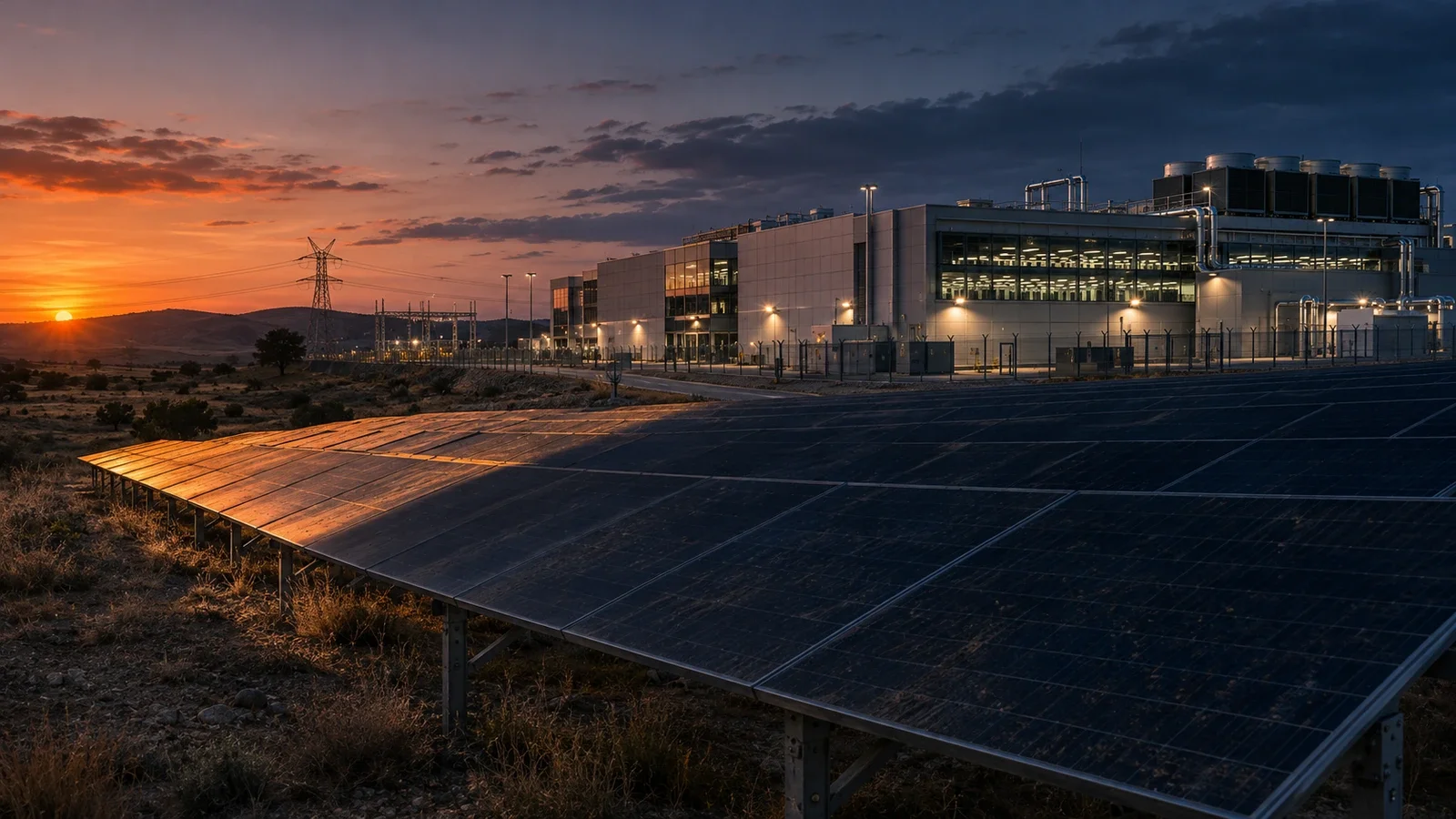
Spain put into force on Sunday (22) a rule that obliges large data centers to prove that at least 80% of the electricity consumed in each hour is backed by renewable generation in the same period. Royal Decree 1032/2026, approved on November 20 and published the following day, establishes new conditions for these installations' access to the electricity grid, amid the expansion of artificial intelligence infrastructure in the country.
The requirement covers data centers with access capacity equal to or greater than 10 megawatts (MW), including projects with pending connection requests and installations that have already received authorization but are not yet connected. The latter will have six months to prove compliance with the requirements.
The rule establishes two distinct obligations. The first requires that 80% of total consumption be covered by additional renewable generation, through self-consumption or long-term power purchase agreements (PPAs). As a rule, generating installations must have entered operation at most 36 months before the start of supply, with exceptions provided for photovoltaic projects, certain biomass installations and repowering.
The second obligation is hourly matching: it is not enough to contract renewable energy equivalent to annual consumption. Operators must demonstrate that, in each hour, there was renewable generation corresponding to at least 80% of the electricity used, also considering the storage possibilities provided for in the decree.
The rule that requires renewables in the hour when there is no sun
Hourly matching is the main point of conflict between the government and the industry. Data centers operate continuously, while solar production disappears during the night and wind generation varies with weather conditions.
To comply with the requirement, operators must combine renewable sources with different generation profiles, contract additional capacity or resort to storage. According to the business association SpainDC, in criticism reported by Xataka, batteries with autonomy of approximately four hours do not solve prolonged periods of low renewable production on their own.
The decree offers a temporary five-year alternative for installations that join the Automatic Power Reduction System (SRAP). Under this regime, the required hourly coverage starts at 60% during peak hours until the end of 2028, rising to 70% in those hours and 60% in intermediate periods from 2029. In return, operators must accept consumption reductions determined by the electricity system, which can reach zero in situations provided for in the regulation.
In addition to the energy conditions, the rule establishes maximum efficiency requirements for water and electricity use. While the European classification system is not fully applicable, the transitional parameters include PUE of up to 1.25 and WUE of up to 0.1 liter per kilowatt-hour. Centers that host public systems classified in the ALTA category will also be subject to specific digital sovereignty requirements, regardless of installed capacity.
Government and industry differ over billions of euros
The Spanish government estimates that the absence of these restrictions could generate € 5 billion per year in additional electricity costs for consumers, mainly due to greater use of gas in electricity generation. The Minister for Ecological Transition, Sara Aagesen, also presented a scenario in which industrial consumers' bills could rise 25%.
SpainDC contests the regulatory design and warns of compromised investments. Its sector report projects € 66.9 billion in direct and indirect investments accumulated through 2030, an amount the entity considers threatened by the new conditions. The figures are not directly comparable: the first represents a government estimate of annual avoided cost; the second, a projection of investments over several years, not a loss already materialized.
The decree itself presents another contrast. Spain has already granted more than 15 GW of grid access capacity to data centers, while its Artificial Intelligence Strategy foresees between 3.5 and 4 GW of electricity demand from these installations in 2030. The authorizations, therefore, far exceed projected demand, although they do not represent capacity actually built or in operation.
The dispute has also entered the campaign for the general elections of November 29. The Partido Popular (PP), the main opposition force, promised to revoke the decree if it comes to government and replace it with another regulation. SpainDC announced that it will challenge the rule in court, but its entry into force remains valid as long as there is no decision suspending or revoking it.