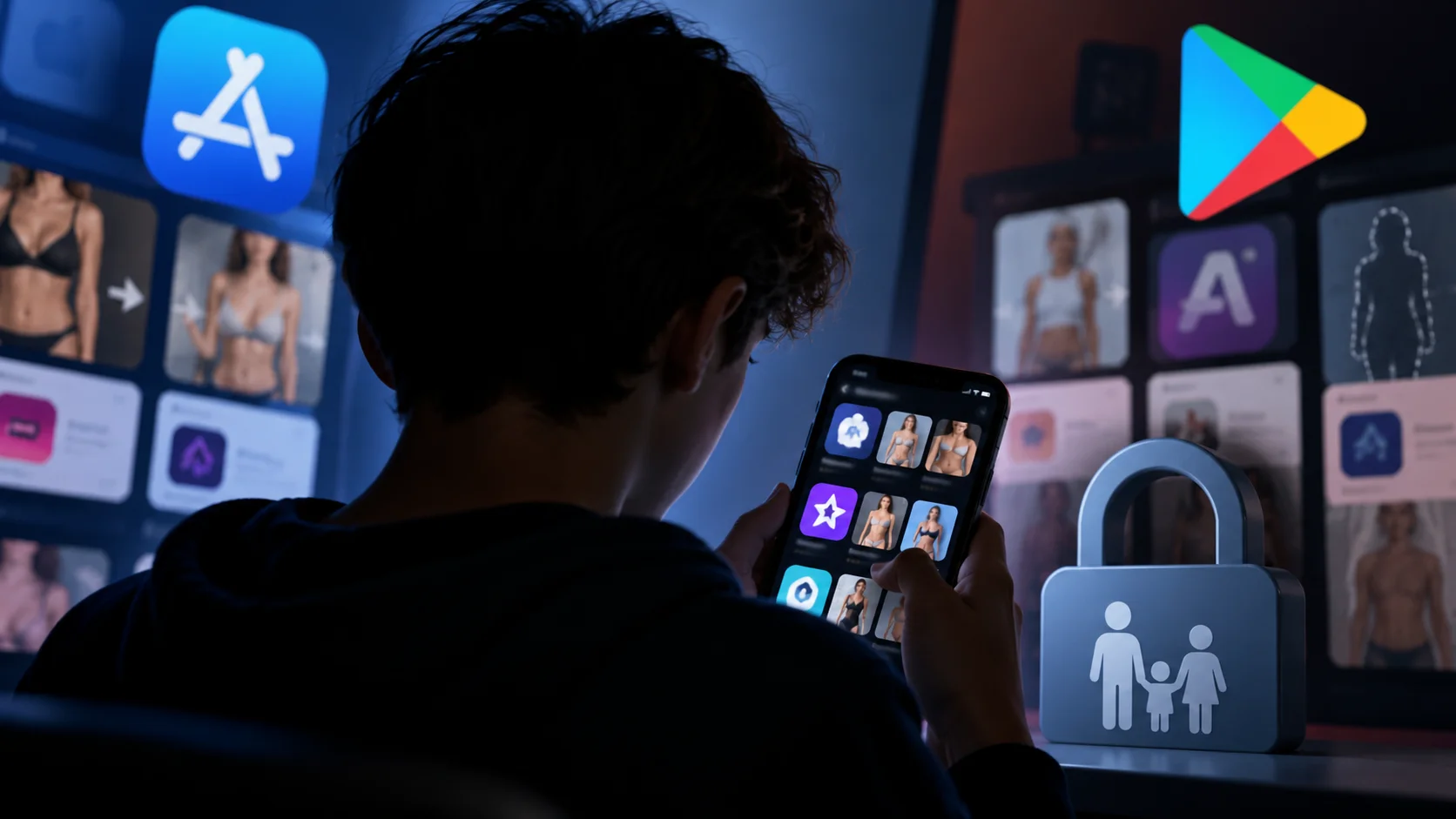
Even with parental controls enabled, accounts configured for 13-year-olds were able to access 24 apps on the App Store and 51 on Google Play capable of producing sexualized images. The finding is part of an investigation published this Monday (19) by the Tech Transparency Project (TTP), which identified flaws in age ratings and in oversight of apps distributed by the two companies.
In total, the researchers found 135 apps with these capabilities accessible under different test configurations. Among the tools were conventional photo editors, AI image generators and services capable of creating explicit nudity from clothed people.
The investigation used four fictitious accounts for a 13-year-old boy in the United States, two on each platform. In one account for each company, the researchers enabled parental controls, restricted installation to apps rated as appropriate for the age and required authorization from a guardian for downloads and purchases.
On the accounts without additional supervision, the results were also significant: 61 apps accessible on Apple and 47 on Google. All image manipulation tests were conducted with synthetic photographs, without using images of real people.
How apps rated for children got past the controls
One of the main flaws identified involves age ratings. Apple and Google use information provided by the developers themselves to determine the suitability of apps for different ages.
The report found tools rated for children aged 4 or 9 years old that, during testing, were able to generate images of nudity. In other cases, sexualized features were available only through a subscription.
In the supervised tests, the fictitious guardians approved the installation of apps rated as age-appropriate. This means the research did not necessarily demonstrate a way to bypass the requirement for authorization for downloads. The problem also lay in the rating of tools whose capabilities were not evident to guardians.
The researchers identified another flaw: subscription purchases made with gift cards did not generate notifications for linked parental accounts, even with the requirement for payment authorization. Apple said that this behavior does not correspond to the feature's expected operation and that it is investigating the problem.
The study also found that removing apps from the stores did not prevent their use on devices where they were already installed. As of September 28, 25 apps had been removed from the App Store and six from Google Play, but they continued working on the devices used by the researchers.
According to estimates from AppMagic cited by TTP, the 135 apps identified had accumulated 5.5 billion downloads and US$ 3.9 billion in global revenue. These totals cover the apps as a whole and do not exclusively represent the use or revenue of their sexualized features.
Apple disputes classification and strengthens rules against intimate images
The definition used by TTP is broader than the one adopted by Apple. The investigation considered apps capable of producing full or partial nudity, including images in which regular clothing was replaced by bikinis or lingerie.
Apple does not consider that this latter capability, by itself, characterizes a nudification app. Adam Dema, a company spokesperson, told the Guardian that some of the services cited are conventional photo and video editing tools, with legitimate and widely used features.
On October 16, three days before the report's publication, Apple announced changes to its guidelines. The rules strengthen the obligation to prevent and remove non-consensual intimate images, including those generated by AI, and prohibit apps that hide features during review to activate them later.
Google also disputed the presence of prohibited tools in its store. Dan Jackson, a company spokesperson, told the Guardian that identified violations are investigated and can result in the suspension of apps and the restriction of search terms, measures that, according to him, have already been adopted in this case.
The investigation does not establish how many minors actually used these apps. Its result documents, however, that the age ratings and supervision mechanisms tested did not prevent access to certain tools capable of producing sexualized images, even when guardians applied the restrictions recommended by the platforms.