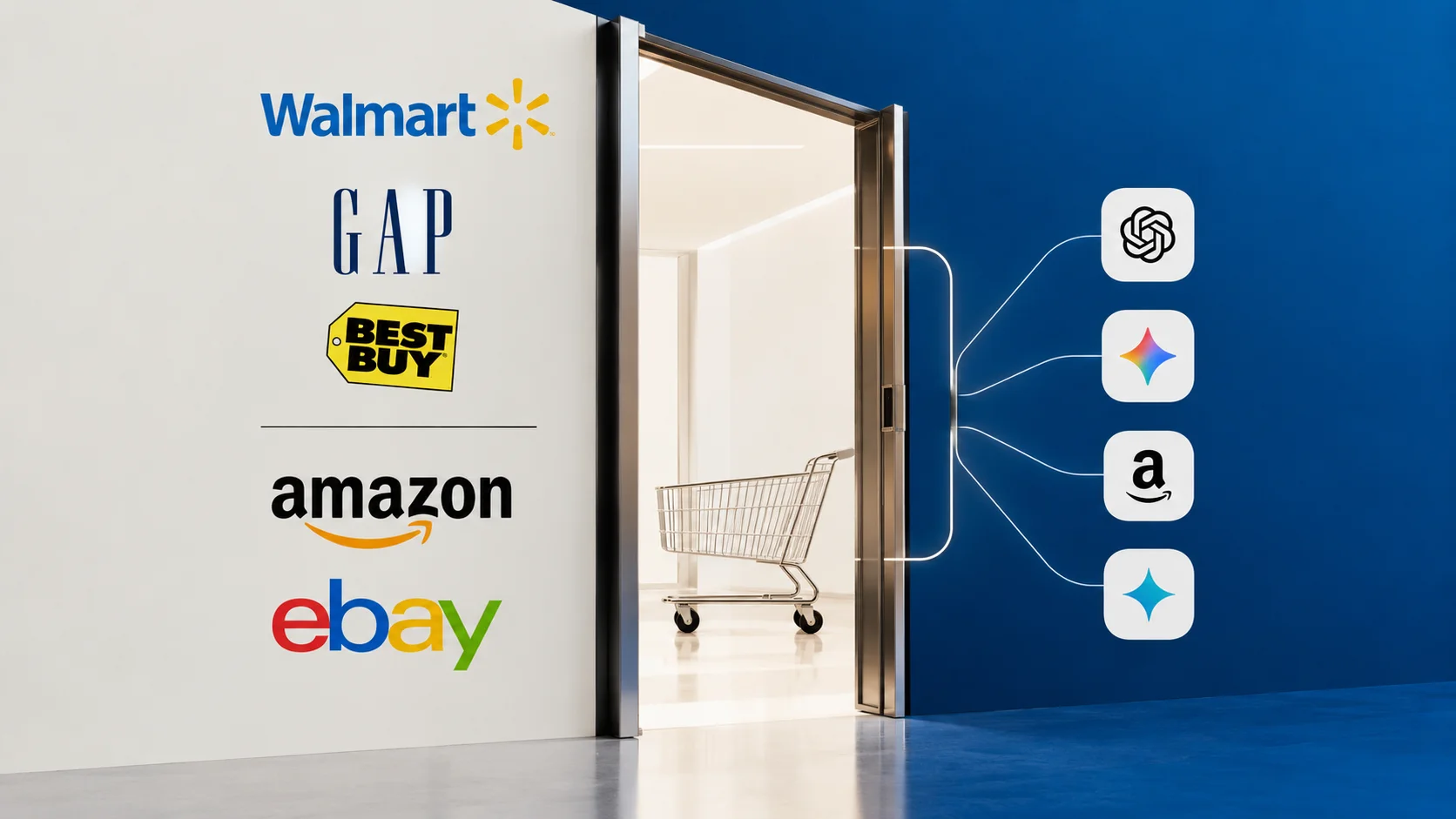
The arrival of agents capable of searching for products and completing purchases is dividing retail between companies willing to integrate this new layer and groups that prefer to limit their access. Walmart, Gap and Best Buy are among the retailers that have opened paths for agents, while Amazon, eBay and others have adopted restrictions. The difference appears technical, but it reaches the center of digital commerce: if the consumer stops entering the store and starts delegating the purchase to an AI, the dispute is no longer only about the sale and becomes about who controls intent, data and the checkout.
The scenario described by The Wall Street Journal shows that there is no single answer. Some companies allow discovery and purchase. Others accept that agents find products, but impose barriers before the transaction. There are also platforms that restrict external automation while developing their own agents. This fragmentation suggests that the first battle of agentic commerce will not simply be between retailers in favor of or against AI. It will be about which agents receive access, to which stages of the journey and under which rules.
Opening the store to an AI does not mean handing over the customer
Walmart's strategy shows how this frontier can work. In January, the company announced an integration with Gemini through the Universal Commerce Protocol (UCP), a communication standard between commerce systems. The experience was designed so that relationship, account, cart, loyalty benefits and consumer history remain connected to Walmart's ecosystem. According to the company, account linking will make it possible to use previous purchases, combine items with the existing cart and preserve Walmart+ and Sam's Club benefits.
The logic is relevant because it separates two functions that for decades were concentrated on the same website or app. The agent can control the point of discovery without necessarily controlling the complete commercial relationship.
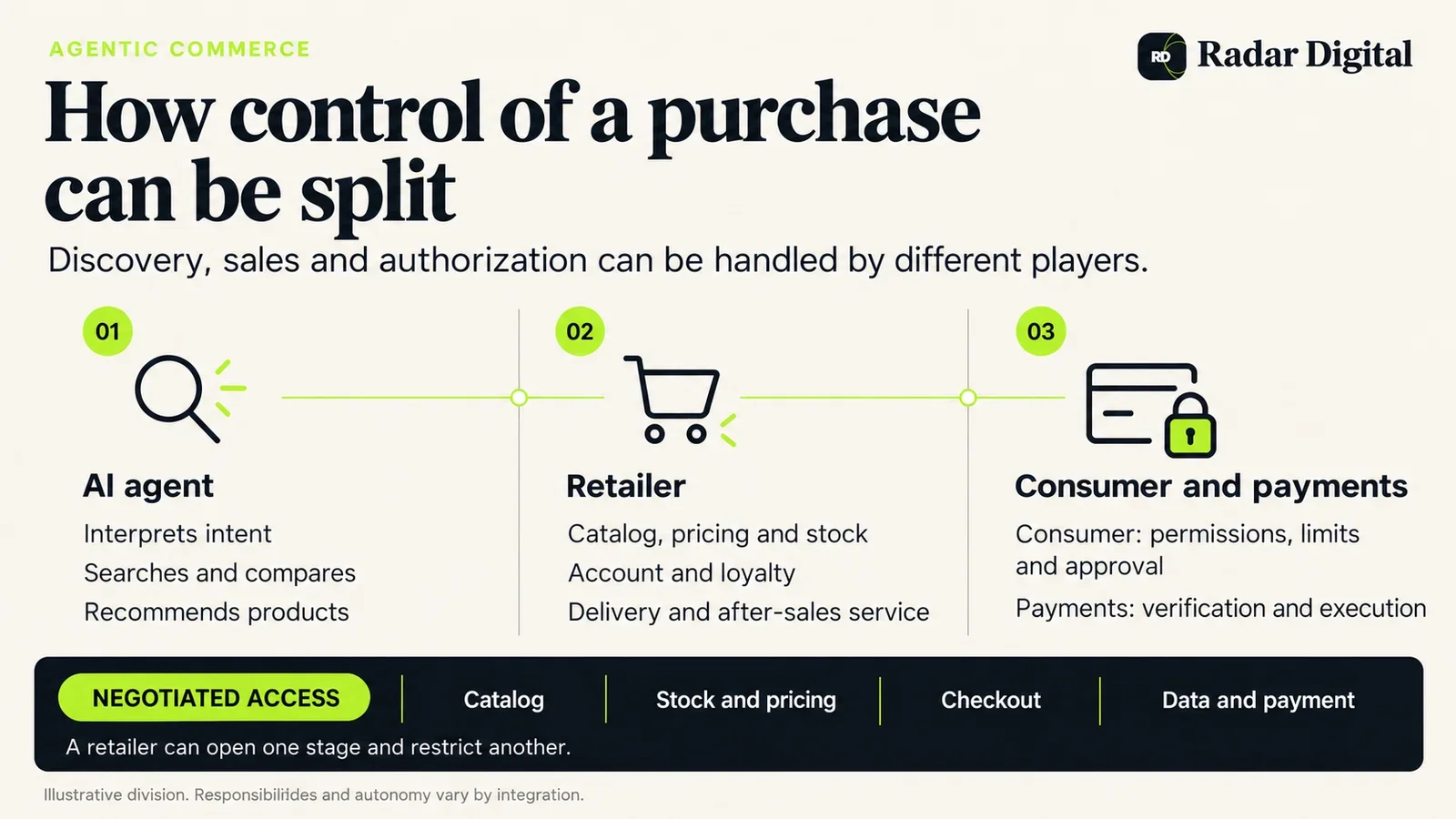
In this model, Gemini or ChatGPT can become the interface through which the consumer expresses intent. The retailer remains responsible for the catalog, price, inventory, preparation and delivery of orders, account and an important part of the transaction. The real negotiation becomes about how much of the journey occurs within the AI interface and how much remains under the retailer's control.
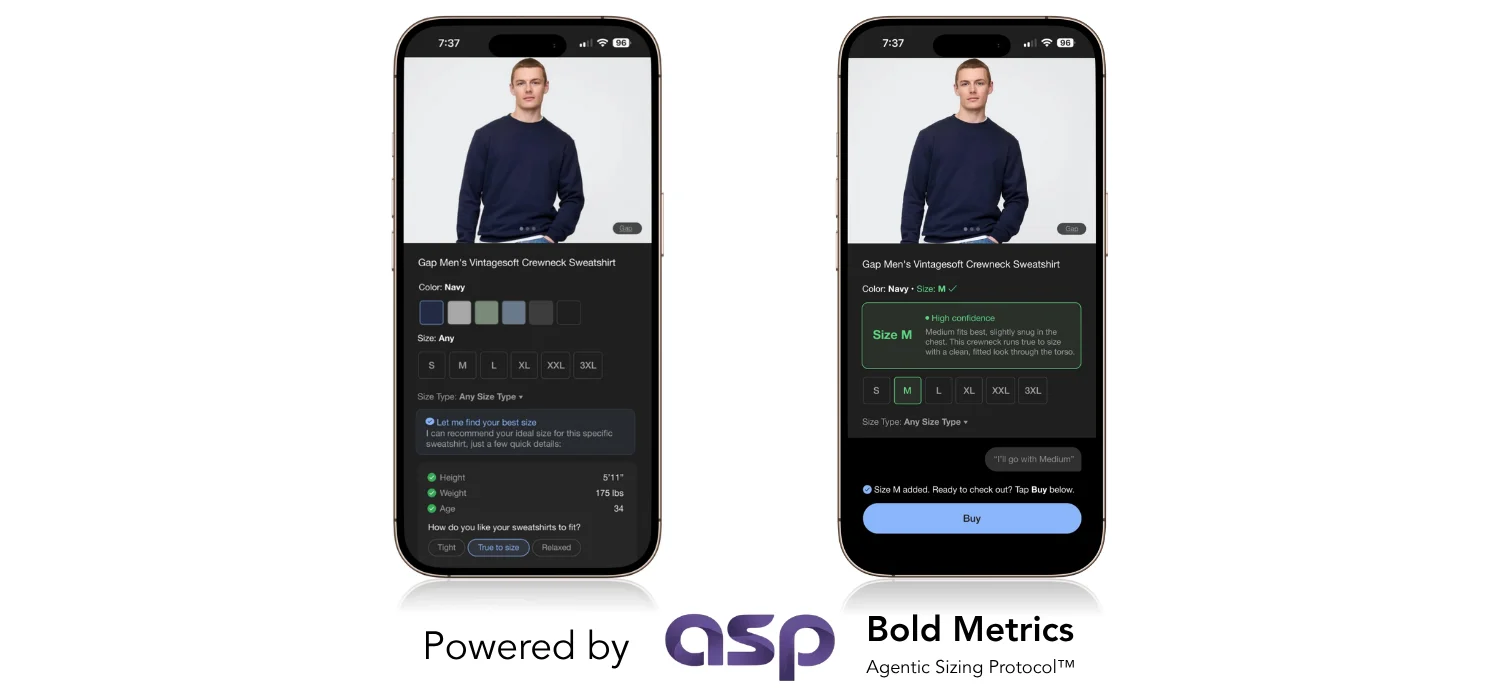
Gap adopted a similar strategy. The company announced support for UCP to make its products available and ready for checkout in experiences such as Google Search AI Mode and Gemini. Instead of waiting for the consumer to start the journey on its own website, the company is trying to make its catalog transactable wherever intent arises. In the same announcement, it introduced the integration of Bold Metrics size recommendations into the AI purchasing flow.
The new strategic asset may be permission to access the checkout
Tapestry's situation shows why the division between open and closed stores is insufficient to explain the market. The WSJ reports that the owner of Coach and Kate Spade restricts purchases made by certain agents. At the same time, Tapestry itself announced in September that products from the two brands can already be purchased directly through Gemini and Google Search, with checkout via Google Pay and UCP.
The apparent contradiction reveals a more likely architecture for the market: retailers may not choose between accepting or rejecting agents, but decide which agents, protocols and platforms will have authorization to execute each action.
This gives more weight to a layer of commercial permissions: in addition to authorizing an integration, the retailer must define what each agent can do on behalf of the buyer. One agent may receive access to the catalog. Another may check inventory and price. An approved partner may initiate checkout. Only certain systems may receive account data or execute payments.
In this scenario, blocking bots does not necessarily mean rejecting agentic commerce. It may mean rejecting unauthorized access while the company negotiates structured integrations.
Amazon and eBay show why platforms have more to lose
For marketplaces, the conflict is especially sensitive because their advantage is not only in product offering. It also depends on data about searches, comparisons, clicks, purchases, recurrence and consumer behavior.
eBay made this boundary explicit in its user agreement. The platform prohibits the use, without prior authorization, of robots and other automated means, specifically citing agents that purchase on behalf of the user, bots controlled by language models and flows that attempt to complete orders without human review.
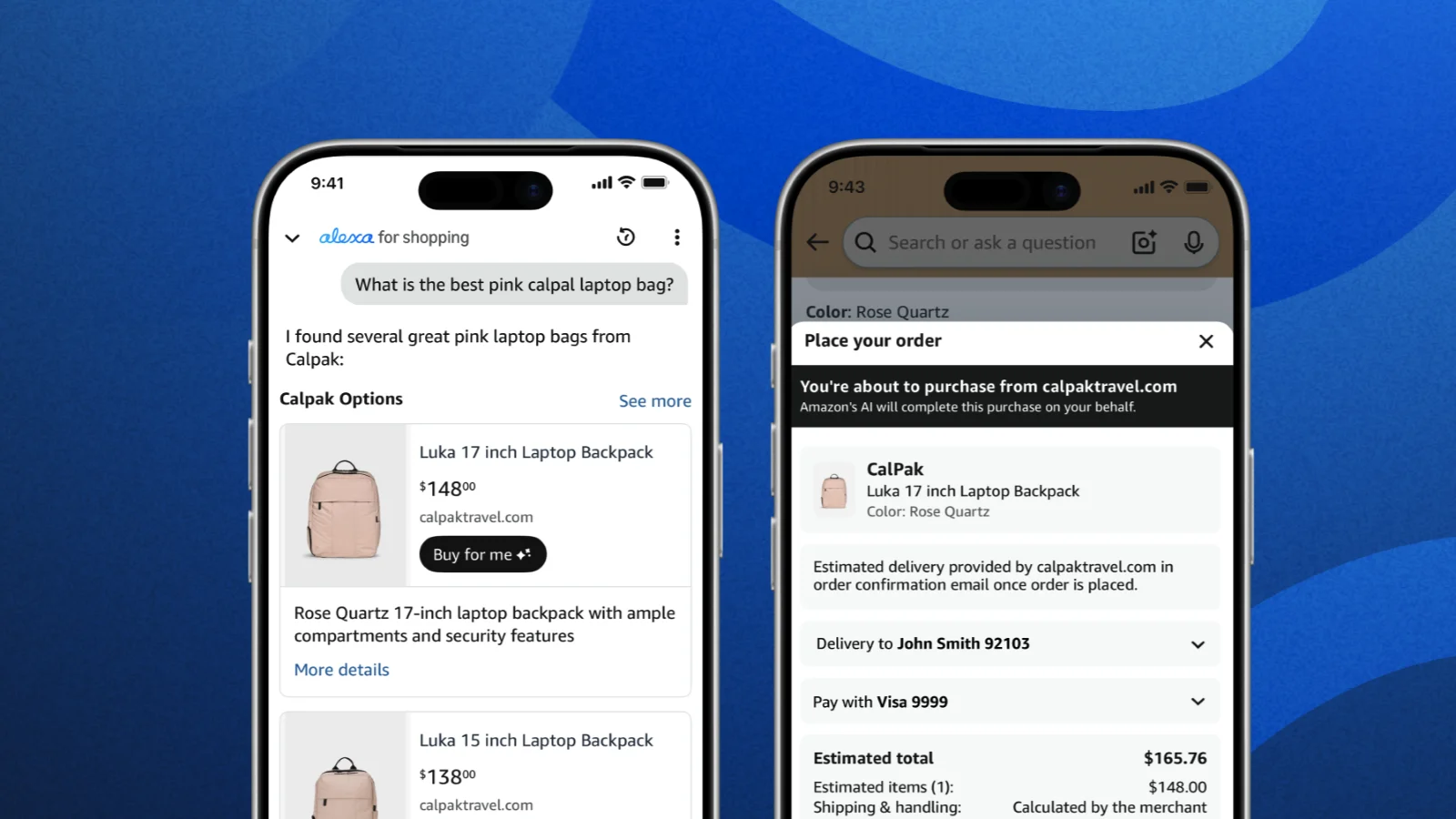
Amazon also introduced, in March 2026, a specific policy for agents in the agreement governing its services for sellers. It requires identification of automated systems, compliance with its rules and interruption of access when requested by the company. In parallel, Amazon operates its own shopping agent, Alexa for Shopping, powered by catalog information, purchase history, preferences and data from the platform itself.
The reach of this agent is not limited to Amazon's store. According to the company, Buy For Me allows customers in the United States to request, for eligible products, purchases in external stores using the payment and delivery data from their Amazon account. The platform can thus intermediate the purchase even when another company sells the product.
This design helps explain the incentives. A marketplace that hands the discovery interface to an external agent runs the risk of turning its platform into invisible infrastructure for catalog, logistics and payment, while another company starts controlling the conversation with the consumer.
For a retailer or manufacturer that depends on third parties to generate traffic, however, the equation may be reversed. If consumers start searching within AI assistants, not being available in these environments may mean disappearing from part of the consideration process.
Discovery also puts advertising and attribution in dispute
The change does not end at checkout.
Current e-commerce was built largely around observable sessions. The retailer knows which page the consumer visited, which products they searched for, which ads they received and which items they compared before purchase.
An agent can compress all of this into one conversation.
If someone asks an AI to find a laptop for video editing for less than a certain price, compare four alternatives and buy the best option, much of the discovery may happen before any visit to the store.
This transfers power to the layer that interprets intent. A product's position no longer depends only on SEO, paid media, merchandising and internal ranking. It also starts depending on the agent's ability to understand the catalog, receive updated information and decide which options to present.
For retailers with significant advertising businesses, the issue is even greater. Less direct browsing may reduce traditional opportunities for sponsored exposure, forcing the market to develop new forms of attribution and monetization within conversational interfaces.
Payments are creating the boundary between agents and bots
Fraud and authorization help explain why an internet completely open to agents seems unlikely.
Visa and Mastercard are already building specific infrastructure to differentiate an authorized agent from ordinary automation. Visa works with credentials linked to agents, authentication and controls that relate the transaction to the user's original instruction. The company is also developing mechanisms to verify agents and block malicious bots.
Mastercard follows a similar direction with the concept of Verifiable Intent, which records explicit consumer permissions and preferences to create an auditable trail of actions executed by agents.
These mechanisms address problems that traditional checkout did not need to solve in the same way. Who authorized the purchase? Could the agent choose another product? Was there a price limit? Could the purchase be repeated? Who is responsible when the action executed does not match the original intent?
The more autonomy agents receive, the more these answers will need to travel along with the transaction.
The consumer still limits the speed of change
The advance of infrastructure still faces resistance among consumers who prefer to keep the purchase decision under their control.
An online survey by YouGov commissioned by ACI Worldwide, conducted in June 2026 with 3,328 adults aged 18 to 65 in the United States and the United Kingdom, examined shopping and payment preferences in fashion and sporting goods. Among the consumers surveyed, 53% said they were uncomfortable with purchases made by an AI on their behalf. Only 7% would accept autonomous purchases under predefined conditions.
This reduces the likelihood of a rapid replacement of traditional websites and apps.
The initial scenario tends to be more fragmented: agents helping with research, comparison and cart building, while the consumer continues to participate in the more sensitive moments of the decision. Recurring categories and utilitarian purchases offer more room for automation than products in which taste, appearance, configuration or experience are part of the value.
The dispute over checkout, therefore, began before there was consensus on how much of the checkout the consumer really wants to hand over to a machine.
The decisive question will be who remains visible when the purchase ends
The next signals will not only be in the number of retailers announcing compatibility with agents.
It will be more important to observe where customer identity remains, who receives the transaction data, how attribution will be calculated, which platforms will be able to initiate payments and whether large retailers will allow multiple competing agents on the same infrastructure.
The design announced by Walmart shows how to open discovery to an external platform while preserving account, loyalty and delivery operation. Amazon shows the opposite movement: strengthening its own agent while increasing control over external automations. Gap and Shopify bet on protocols to distribute their catalogs across different interfaces.
None of these models has yet demonstrated that it will be dominant.
But the architecture being built makes one consequence concrete: the entry point of the purchase is separating from the place where the sale is executed.
If this separation gains scale, controlling e-commerce will no longer mean only owning the store or the marketplace. It will also come to mean deciding who has permission to represent the buyer when they reach the checkout.