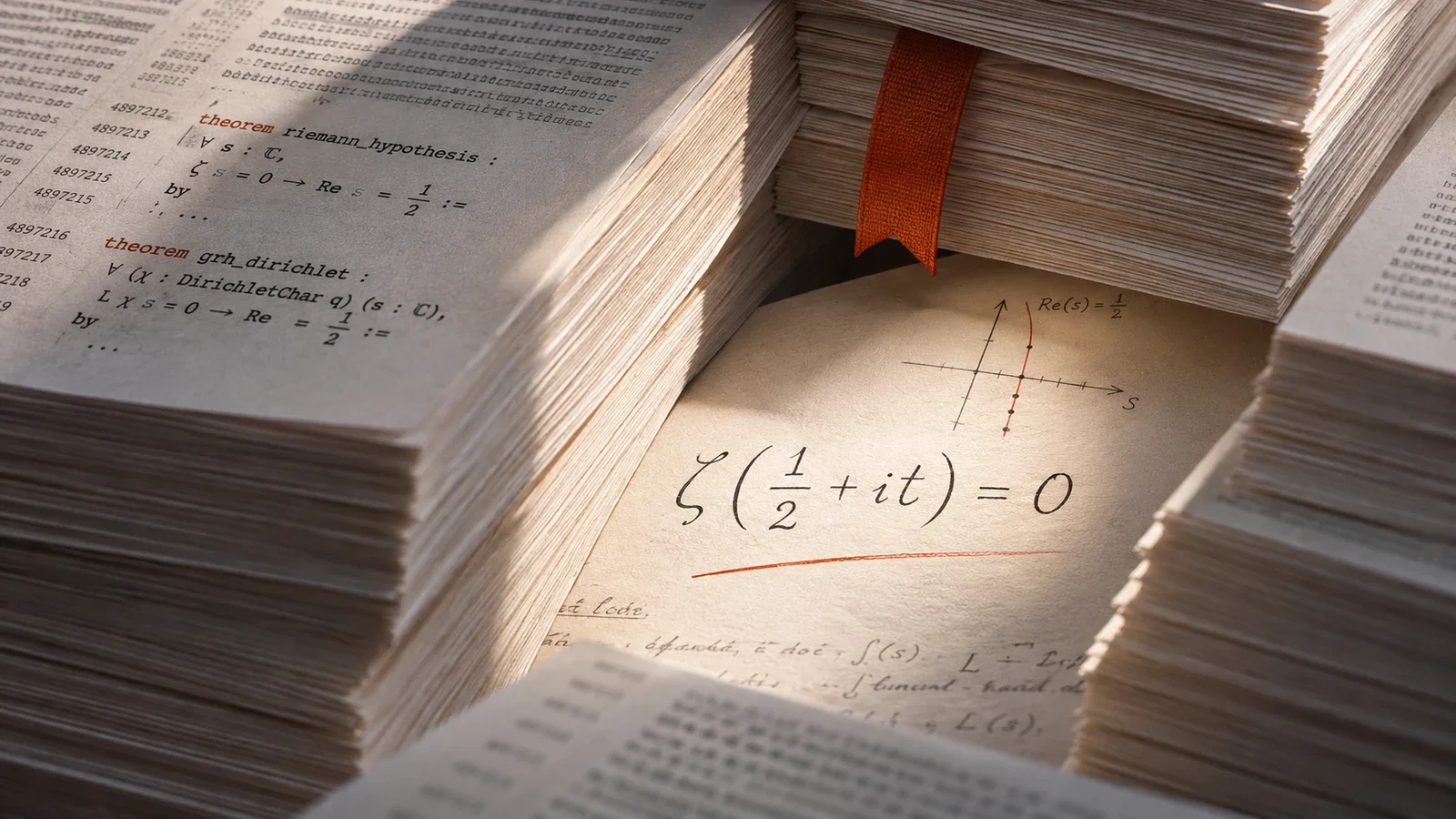
A proof of the Riemann hypothesis, one of the most important problems in mathematics and one that has remained without an officially recognized solution since 1859, received formal certification from the Lean Focused Research Organization (Lean FRO) and the Mathlib Initiative on November 21. Developed by Levent Alpöge, a mathematician at Anthropic, in collaboration with Claude, the proof was made available as a library of approximately 17 million lines of code, without a conventional scientific paper that fully explains the reasoning.
The hypothesis, formulated by the German mathematician Bernhard Riemann, describes a property of the zeros of the Riemann zeta function, directly related to the distribution of prime numbers. Its proof is one of the seven Millennium Problems established by the Clay Mathematics Institute in 2000, each with a prize of US$ 1 million.
Alpöge announced the result on November 20, in a four-page note published on his personal website.
“I believe that, working with Claude, I discovered a proof of the Riemann hypothesis,” wrote the mathematician, who also acknowledged that the artificial intelligence model surpassed him during the final stages of the investigation.
The work also covers the generalized Riemann hypothesis for Dirichlet L-functions, an extension of the original problem. The certification, however, does not extend to all classes of L-functions.
How 17 million lines of code were verified
The proof was developed in Lean, a programming language and formal verification system that allows mathematical definitions, theorems, and arguments to be represented in a computationally verifiable way.
Unlike an evaluation performed by a language model, Lean's logical core verifies whether each step of a proof validly follows from the definitions, axioms, and previous results.
In a joint statement, Lean FRO and the Mathlib Initiative established four fundamental conclusions:
- The mathematical statement used corresponds to the Riemann hypothesis.
- The published library compiles without errors.
- The code proves exactly the statement it was supposed to prove.
- The proof was accepted by different independent formal verifiers.
The use of different verifiers reduces the risk that a specific flaw in the Lean implementation would allow an invalid proof to be accepted.
Andrew Sutherland, a mathematician at the Massachusetts Institute of Technology (MIT), also made available the results of independent verifications. His records show that the 175,187 modules of the library were compiled without errors and that a recompilation in an isolated environment fully reproduced the published proof file, with approximately 61.57 GB of uncompressed data.
The five main theorems depend exclusively on the three fundamental axioms habitually used by Lean, without the introduction of additional unproven hypotheses.
A complementary round of verification with version 4.36 of Comparator was still ongoing in the update published by Sutherland on November 24.
The 250,000 pages that were never a scientific paper
The size of the proof gained attention after Alpöge mentioned, in the original note, a document with more than 250,000 pages. The number began to be repeated by the press as a measure of the proof's length.
On Monday (the 23rd), however, the mathematician clarified in posts on X that the reference was a joke.
According to a report by The Next Web published on November 24, Alpöge confirmed that the pages did actually exist as generated material, but that they should never have been considered a serious mathematical exposition.
The researcher also acknowledged that the Lean library contains unnecessary material and that simplifying the argument proved more difficult than he expected. He stressed, however, that these difficulties do not call into question the results of the formal verification.
Other researchers have already begun developing materials to facilitate the study of the proof. Michael Rubinstein, from the University of Waterloo, made available on November 22 a second version of a provisional guide of 265 pages, prepared with the help of Claude, Codex, and Gemini.
The document seeks to explain the proof for the case of the Riemann zeta function, but it constitutes study material in development, not a definitive scientific exposition.
Formal certification is not the same as recognition of the Millennium Problem
The case establishes an important distinction between verifying the logical validity of a proof and understanding the mathematical strategy that made it possible to construct it.
Although the computational verifiers have accepted the proof, the work remains of identifying its central arguments, eliminating redundant steps, and producing an exposition that allows specialists to study, discuss, and evaluate the methods used.
Alpöge himself declared that he intends to deepen his understanding of the argument, pass on that knowledge, and present the proof in an appropriate way.
As of November 25, the Clay Mathematics Institute continued to classify the Riemann hypothesis as an active problem, without officially recognizing its resolution or awarding the prize.
The institution's rules require that a solution be published in an eligible scientific outlet, that at least two years pass since that publication, and that the result obtain broad acceptance from the international mathematical community.
The proof developed with Claude, therefore, has already undergone important independent formal verifications. Its scientific exposition and institutional recognition remain distinct and still incomplete stages.