
Ema raised US$ 77 million in a Series B, raising its total raised to US$ 140 million, to expand an “AI Employees” platform that executes corporate processes in areas such as HR, IT and finance. The financing, however, exposes a larger dispute: the startup wants to tie its revenue to completed work, instead of simply charging for the number of people with access to the software.
The proposal hits one of the economic foundations of enterprise SaaS. For two decades, increasing the number of users normally meant selling more licenses. If agents start performing the work that previously required those users, the relationship between seats, utilization and value produced begins to weaken.
Ema wants to sell completed work, not access to software
Founded in 2023, Ema coordinates multiple agents capable of acting on the systems companies already use. Its platform advertises more than 250 integrations and explicitly positions SaaS consolidation and outcome-based billing as part of its commercial proposition.
The company says it has more than 50 active enterprise contracts, more than 1 million active enterprise users and more than 5 million actions and queries processed. It also says its revenue grew 50-fold in two years and that bookings surpassed US$ 150 million.
That last number requires an important distinction. According to CEO Surojit Chatterjee, the US$ 150 million represents the total value of contracts that can last two or three years. They are not ARR, and Ema did not disclose its current annualized revenue. The commercial metrics are also provided by the company itself.
There is, however, an indicator that helps explain why investors are funding the expansion: more than 90% of customers reportedly expanded usage beyond the first implemented use case, while the company reports net dollar retention close to 180%. This suggests expansion within existing accounts, although the numbers are not publicly audited.
When the agent does the work, the seat loses part of its economic function
The traditional per-user model works particularly well when software increases the productivity of people who continue to operate the product. More employees using CRM, financial systems or support tools normally mean more licenses.
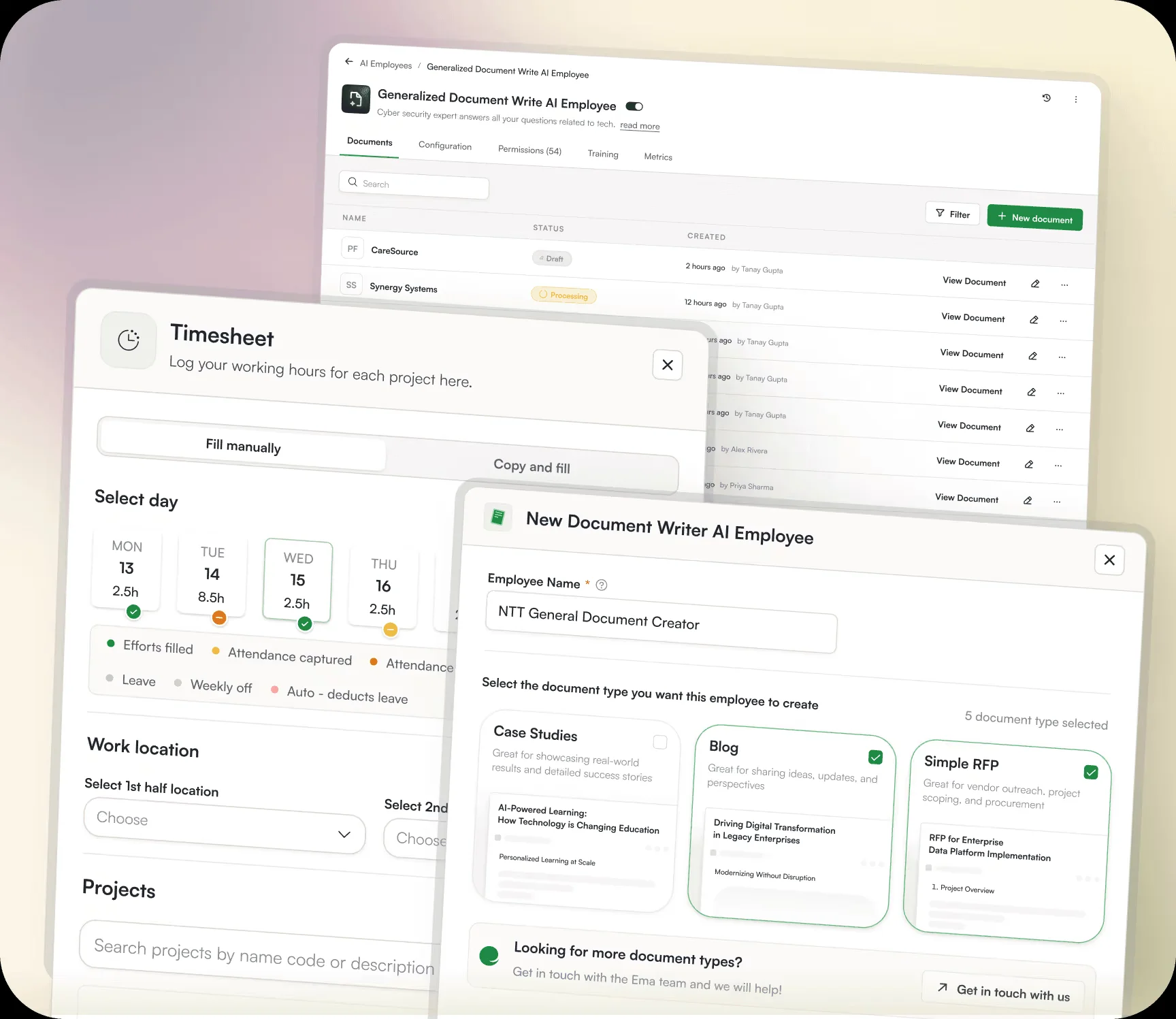
An agent changes that relationship. If it resolves tickets, processes documents, conducts onboarding or updates different systems without requiring a person permanently connected, the volume of work can grow without the number of human users growing along with it.
This shift has already moved beyond startup talk. Salesforce offers Agentforce by consumption, charging per action or conversation, while maintaining per-user options. A standard action consumes Flex Credits currently equivalent to US$ 0.10. Microsoft keeps Copilot for Microsoft 365 at US$ 30 per user per month, but also offers Copilot Studio in a pay-as-you-go model based on credits consumed by agents.
Intercom goes even more directly to the outcome: the Fin AI Agent charges, for example, US$ 0.99 per resolution, with no charge when certain attempts do not reach a billable outcome.
It is not, therefore, a simple dispute between startups with outcome pricing and incumbents tied to the seat. Traditional vendors themselves are already building hybrid models, trying to preserve the predictability of licenses while capturing revenue as agents begin to perform more tasks.
Sheryl Kingstone, an analyst at 451 Research, part of S&P Global Market Intelligence, described this transition similarly: companies still show a preference for license models, but demand is growing for pricing more directly tied to the outcomes produced.
The threat increases when the agent stops being just an additional layer
In the short term, agents still depend heavily on existing systems. They query CRMs, ERPs, HR platforms, knowledge bases and customer service tools to find data and execute actions.
This protects part of the traditional market. The agent can change the interface and automate the work, but the system of record remains necessary.
Ema’s most aggressive thesis begins after this phase. Chatterjee says the company initially connects to existing enterprise applications, but that some customers later begin to reduce their dependence on them. In the executive’s view, certain applications may end up playing mainly the role of a database while the agent layer concentrates process execution.
If this pattern is confirmed at scale, the pressure would not come only from the complete replacement of large platforms. It could appear earlier in reduction in contracted modules, slower growth in seats and transfer of budget to agentic layers that operate multiple systems at the same time.
This is where agents threaten the economic logic of SaaS: they do not need to eliminate Salesforce, ServiceNow or Workday to affect their revenues. It is enough for a growing share of value to stop being measured by the number of people who access these platforms.
The same logic begins to reach consulting firms and IT services
Ema is also targeting another share of enterprise budgets: implementation, integration and professional services.
Chatterjee told TechCrunch that agents can take on parts of the work that traditionally accompanies large enterprise platforms, including integration and implementation. Services firms already work with Ema, according to the executive, as they reconsider models heavily dependent on human labor.
In this case, the economic change is similar. A consulting firm normally monetizes hours, projects and teams. An agent capable of repeating integrations, validating configurations or executing parts of a project reduces the link between revenue and the number of professionals mobilized.
This does not mean consulting firms are no longer necessary. Enterprise projects still require process design, governance, integration with legacy systems, risk management and decisions that cannot simply be delegated. The pressure would be mainly on repeatable and measurable work that can be turned into automated execution.
Charging for outcomes solves one problem and creates another
Outcome pricing seems more aligned with the customer because it reduces the incentive to buy licenses that remain idle. But it requires a difficult answer: what exactly counts as an outcome?
A support resolution is relatively simple to measure. The same is not necessarily true for a financial analysis, a better-executed hiring or a corporate process involving five systems and several human approvals.
Ema itself acknowledges in its pricing materials that outcome-based billing depends on clearly defined metrics and can generate disputes when different factors influence the outcome.
There is also the problem of variable cost. KPMG research released in June showed that only 26% of organizations surveyed in the United States had complete, real-time visibility into their AI costs, while 35% pointed to cost management and knowledge about the economics of AI as a barrier.
McKinsey also warned that agentic workflows can present complex and unexpectedly high costs as they gain autonomy and begin to execute multiple calls, tools and steps per task.
The per-seat model offers predictability. The outcome model offers greater alignment with value, but transfers part of the complexity to measurement, attribution and cost control.
The next dispute will be over which unit represents value
Ema’s funding round does not prove that companies will abandon large SaaS platforms. Salesforce’s and Microsoft’s own moves indicate something less binary: seats, consumption, actions and outcomes can coexist within the same contract.
What Ema’s expansion makes more concrete is another shift. When software stops merely helping a person work and starts executing the process, “user” stops being automatically the best unit for measuring value.
Confirmation of this thesis will come less from new funding rounds and more from the next contracts. It will be necessary to observe whether Ema’s customers renew and expand while effectively reducing licenses, modules or spending on services from other vendors; whether competitors expand per-action or outcome models; and whether Ema itself can preserve margins when agents take on more complex workflows.
If these signs appear together, the change will not be merely technological. Enterprise software will continue to exist, but a growing share of its revenue may stop being calculated by the number of people authorized to use it and begin to depend on how much work it can actually complete.