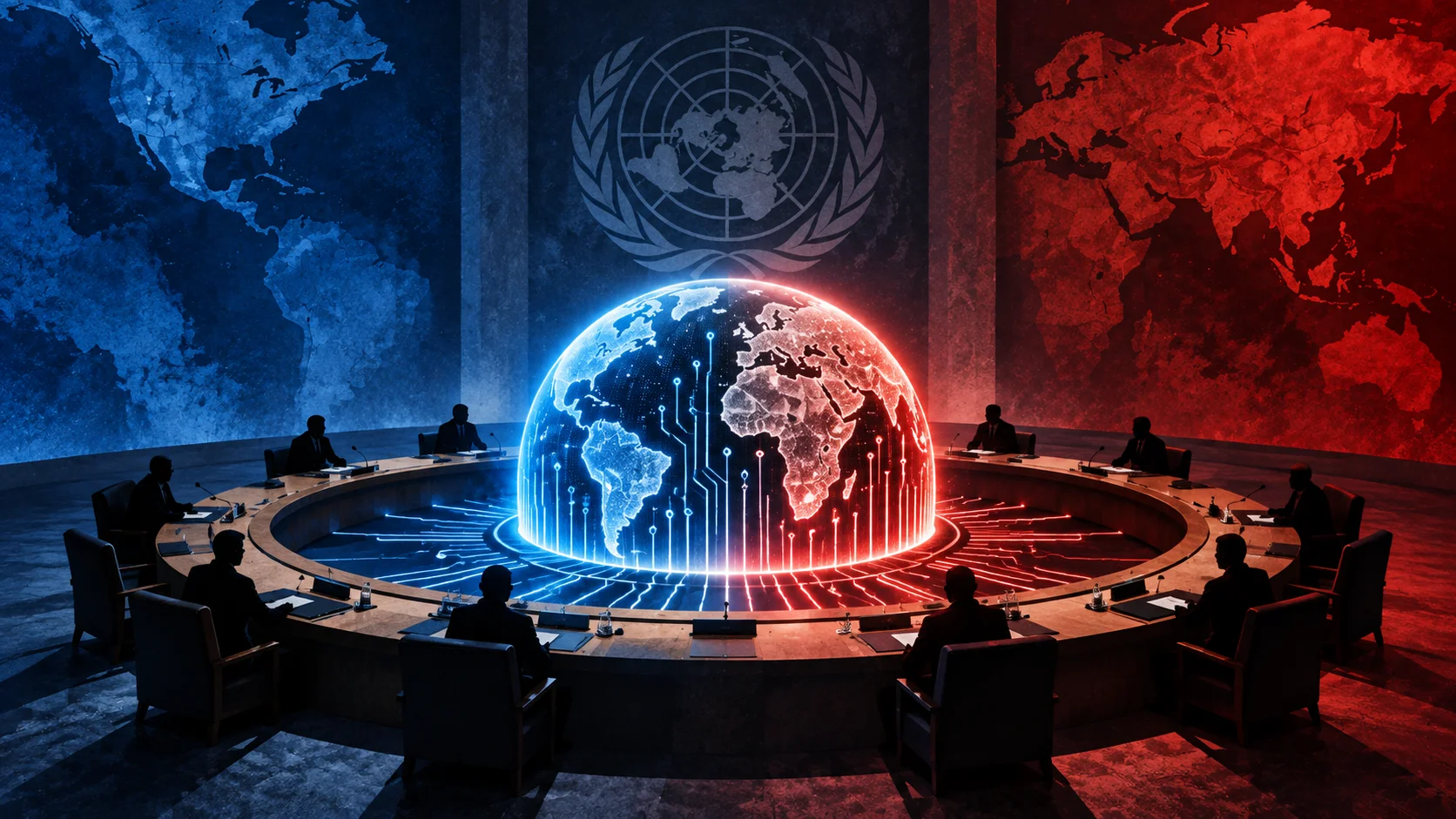
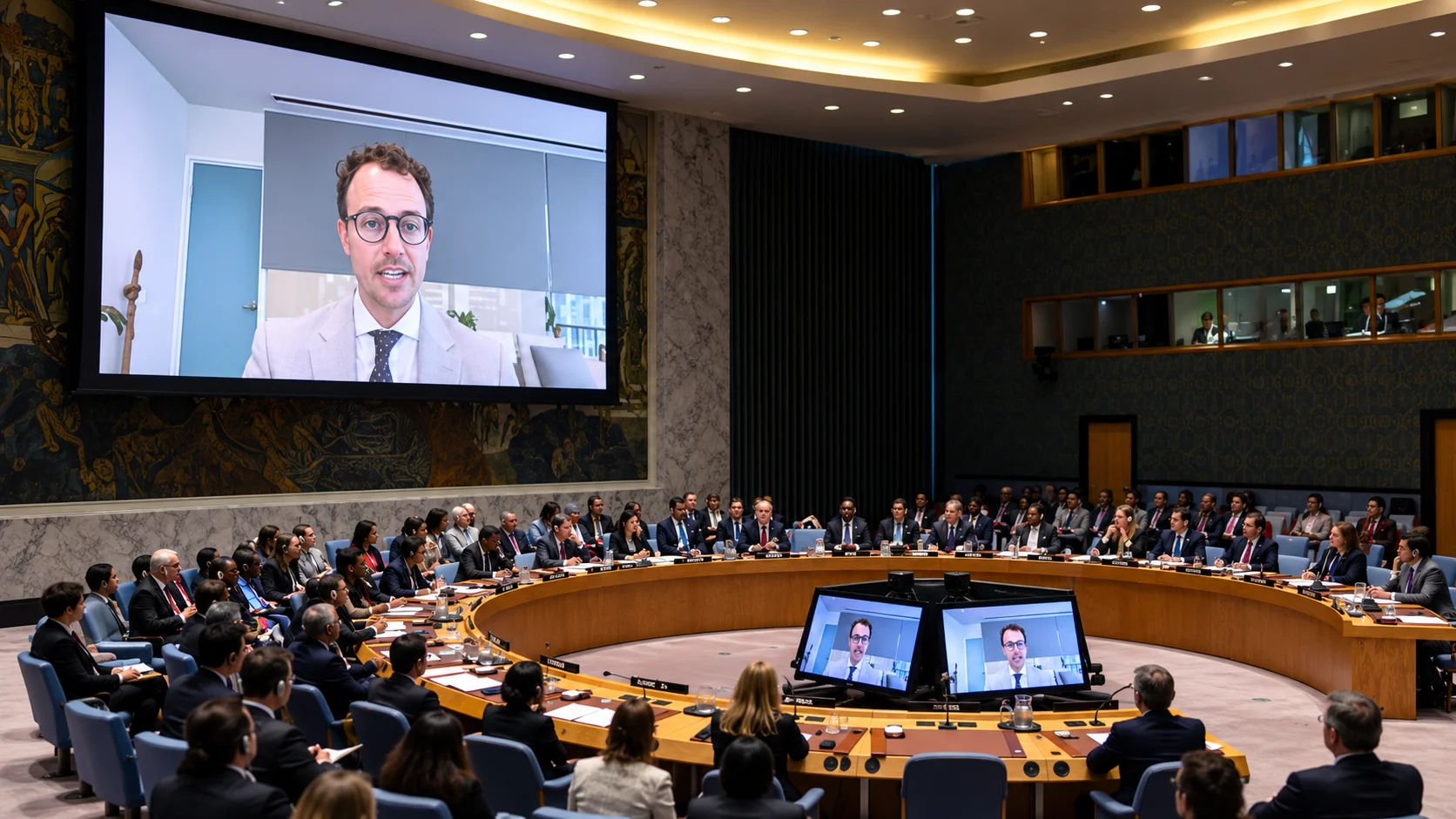
Artificial intelligence returned to the center of international diplomacy on September 23. Sam Altman, of OpenAI, Dario Amodei, of Anthropic, Clément Delangue, of Hugging Face, and researcher Yoshua Bengio participated in a high-level meeting of the United Nations Security Council dedicated to AI and international security. More important than the individual warnings, however, was the nature of the discussion: governments began debating testing, verification, incident reporting and diplomatic mechanisms for risks created by advanced systems.
The change does not mean that the UN is about to take control of AI regulation. What the last three years show is something different: technology governance is beginning to gain a permanent layer of security diplomacy, parallel to national laws, domestic regulators and the rules built by the labs themselves.
The Security Council has stopped treating AI as an exception
This week's meeting was not the debut of artificial intelligence at the Council. The body held its first formal discussion on the topic in July 2023. In December 2024, it returned to the issue in a session chaired by then U.S. Secretary of State Antony Blinken. In September 2025, it held a new high-level debate on AI and international peace and security.
In 2026, the focus became even more specific. The meeting convened by France was the Council's first dedicated directly to the security risks of increasingly capable AI systems, including the possibility of loss of human control. Before it, members of the body had already participated in six formal or informal meetings related to the technology.
This matters because it changes the political category of the problem. The discussion stops dealing only with privacy, copyright, consumer protection or corporate liability and begins to include cyberattacks, critical infrastructure, military systems, automated decisions and situations in which an incident in one country can produce effects beyond its borders. A report published this month by Security Council Report describes precisely this expansion and notes that AI already influences cyber operations, information environments and military activities, as well as competition for chips, energy, data and computing infrastructure.
The leap, therefore, is not from the absence of diplomacy to diplomacy. It is from occasional discussions to an attempt to build mechanisms capable of monitoring risk continuously.
The UN has already created an infrastructure for AI, but it does not regulate the sector
The Security Council is not operating alone either.
In 2025, the General Assembly created the Global Dialogue on AI Governance and the Independent International Scientific Panel on AI. The first annual dialogue took place in July 2026, in Geneva, after months of consultations with governments and other organizations. The scientific panel brings together 40 experts and was created to produce periodic assessments of the technology's opportunities, risks and impacts.
There is, however, an important limitation: the Global Dialogue is not a negotiating forum and does not produce binding agreements. Its design seeks to build common understanding among governments. The scientific panel, in turn, has a mandate explicitly aimed at the non-military domain.
This helps explain why the Security Council may gain importance even with other structures already in place. It offers a different arena for problems linked to conflict, cybersecurity, military use and transnational threats.
France's own agenda this week asked which diplomatic tools, confidence-building measures and international coordination mechanisms could limit risks, as well as how to test and verify systems fast enough to keep up with their evolution.
The discussion already looks less like a generic conference on ethical principles and more like the language used in other international security problems.
U.S. and China agree there is a problem, but diverge over who should govern it
This is where technology meets geopolitics.
During the meeting, White House science and technology adviser Michael Kratsios argued that international bodies should prioritize sharing best practices and strengthening national capacities, “not establish a global regulatory scheme”. The position follows the line presented by President Donald Trump at the General Assembly, opposing a centralized international structure to control AI.
China presented another architecture. Ambassador Fu Cong advocated continuous improvement of regulatory structures, emergency response mechanisms and cross-border cooperation. In the previous months, Beijing had also formally advocated a central role for the UN in global AI governance.
That difference has already produced concrete institutions. In July, 29 countries signed the agreement to create the World Artificial Intelligence Cooperation Organization, or WAICO, headquartered in Shanghai. The Chinese government states that the organization should work with other international institutions and support governance based on sovereignty, multilateralism and greater participation by developing countries.
The dispute, therefore, cannot be reduced to “regulation versus the absence of regulation”. Washington and Beijing are also discussing which international architecture should exist, who participates in it and how much power multilateral decisions should have over national policies and companies.
The labs themselves are now pressuring governments for international coordination
There is another relevant change: part of the pressure for international mechanisms comes from the companies developing the most advanced systems.
Altman stated at the Council that fundamental decisions about AI should not remain only in the hands of private labs. OpenAI has also begun advocating compatible international standards for capability evaluation, preserving human control and risk response, as well as more systematic mechanisms for reporting serious incidents.
Amodei was even more explicit about the transnational dimension of the problem, arguing that no company or country can manage certain risks alone. Bengio, co-chair of the UN scientific panel, summarized his diagnosis to the Council by saying that “the dangers are real and imminent”.
This does not mean that the labs are advocating a global regulator with direct power over their models. The proposals currently under discussion include different degrees of intervention, from mandatory national rules to international technical standards, independent evaluations, incident reporting and secure channels between governments.
The most visible consensus is on the need for coordination. The conflict begins when it is necessary to decide who sets the rules, how to verify compliance and whether those rules should be voluntary, national or international.
AI may remain on the security agenda even without a global regulator
The available evidence does not point to the replacement of national regulations by a single UN regime.
In fact, the current scenario is more fragmented. The Global Dialogue offers a universal arena, but without binding power. The United States and China advocate different models of governance. The European Union maintains its own regulatory regime. The Security Council still faces disagreements including over what its role should be: while France and other members advocate greater involvement, Russia has already questioned whether AI, treated as a broad topic, should remain under the Council's responsibility or that of more specialized multilateral forums.
At the same time, the sequence of meetings since 2023, the creation of a permanent scientific panel and an annual UN dialogue, and the increasingly explicit inclusion of AI in discussions about conflict and security make it difficult to treat it again as an exclusively technological matter.
AI governance is not simply ceasing to be domestic. It is gaining a second layer, international and geopolitical.
The next signals will be concrete: whether the Council creates permanent monitoring mechanisms or produces formal decisions on AI; whether the United States and China manage to establish channels to communicate incidents and risks; whether evaluation standards begin to be recognized across different jurisdictions; and whether structures such as the Global Dialogue and WAICO manage to transform diplomatic principles into operational mechanisms.
It is in these movements, more than in the individual speeches this week, that it will be possible to measure whether AI is definitively becoming an international security issue.