
Germany could fail to generate €155 billion per year in additional economic value if the European Union tightens rules on access to data used in artificial intelligence training. The estimate was released this Tuesday (13) by the German ifo Institute, based on a simulation of the effects of possible regulatory restrictions.
The study calculates that generative AI could add €440 billion annually to the German economy by 2034. Stricter limitations on training data would reduce that potential by approximately 35%, mainly due to the development of less efficient models and slower adoption of the technology by companies.
The researchers identified three sources for the projected economic potential: €330 billion from the widespread use of AI, €65 billion from productivity gains in research, and €45 billion from the development of artificial intelligence in Germany.
Less efficient models account for €75 billion of the estimated €155 billion
The largest share of the projected reduction is associated with model quality. According to the calculations, systems trained with more limited access to data could represent €75 billion annually in unrealized economic gains.
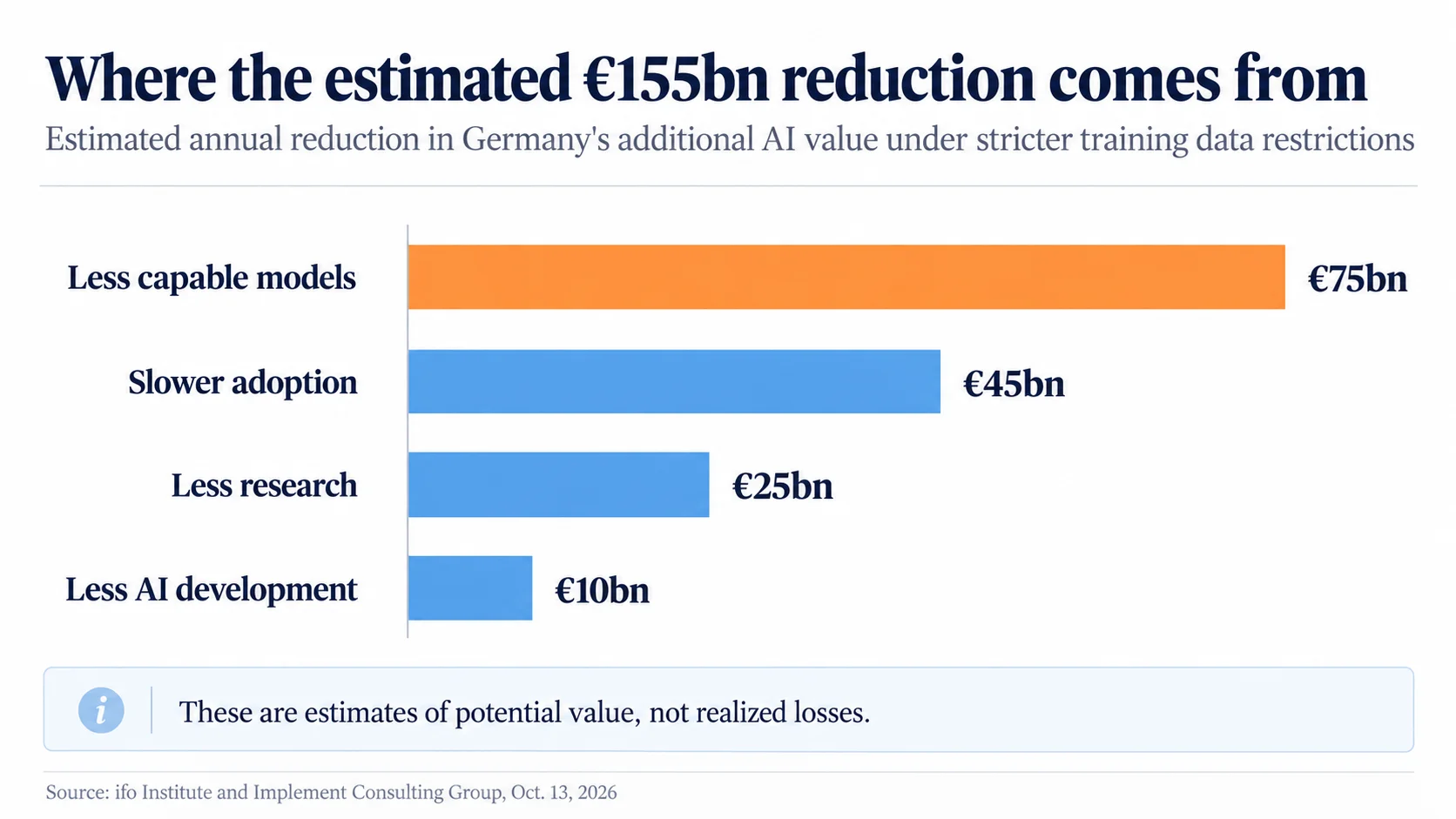
Another €45 billion would be related to slower adoption of the technology, while €25 billion would stem from the reduction in research potential. The remaining €10 billion would correspond to lower AI development activity in Europe.
The difference in data availability helps explain the researchers' concern. The largest European collection of copyright-free data contains approximately 2 to 3 trillion tokens, units used in text processing by language models. Advanced international systems, by comparison, already use between 15 and 36 trillion tokens in their training.
For Oliver Falck, director of the ifo Center for the Economics of Innovation and Digital Transformation, hindering access to these materials compromises Europe's ability to develop competitive models.
The discussion takes place during the European Commission's review of the Copyright Directive, initiated in May 2026. The authors advocate preserving the exception that allows text and data mining for commercial purposes, combined with proportionate transparency requirements, mechanisms for rights holders to object, and voluntary licensing agreements.
The €155 billion does not represent losses already recorded or a definitive economic forecast. Ifo itself emphasizes that the figures are estimates of potential, conditioned on the assumptions used in the modeling.
The research was developed by Implement Consulting Group in collaboration with the ifo Institute, commissioned by CCIA Europe and Google, organizations with interests in the debate over access to data for AI training.
The results add an economic estimate to the European regulatory debate, but do not demonstrate that the restrictions analyzed will necessarily be adopted or will produce the calculated effects.