A historical mystery that had resisted for more than two centuries got an answer in just 22 minutes and one second. Canadian historian Mark Humphries used OpenAI's GPT-6.2 Astra to investigate the authorship of an 1808 album of drawings preserved by Yale University. The artificial intelligence identified a probable author and located the reference to a diary that, after being consulted by the researcher, provided decisive evidence for the discovery.
The experiment was presented by Humphries on November 24, in the publication Generative History. A professor at Wilfrid Laurier University, he had been trying to discover the artist's identity since 2022, when he found the album in the catalog of the Beinecke Library, which specializes in rare books and manuscripts.
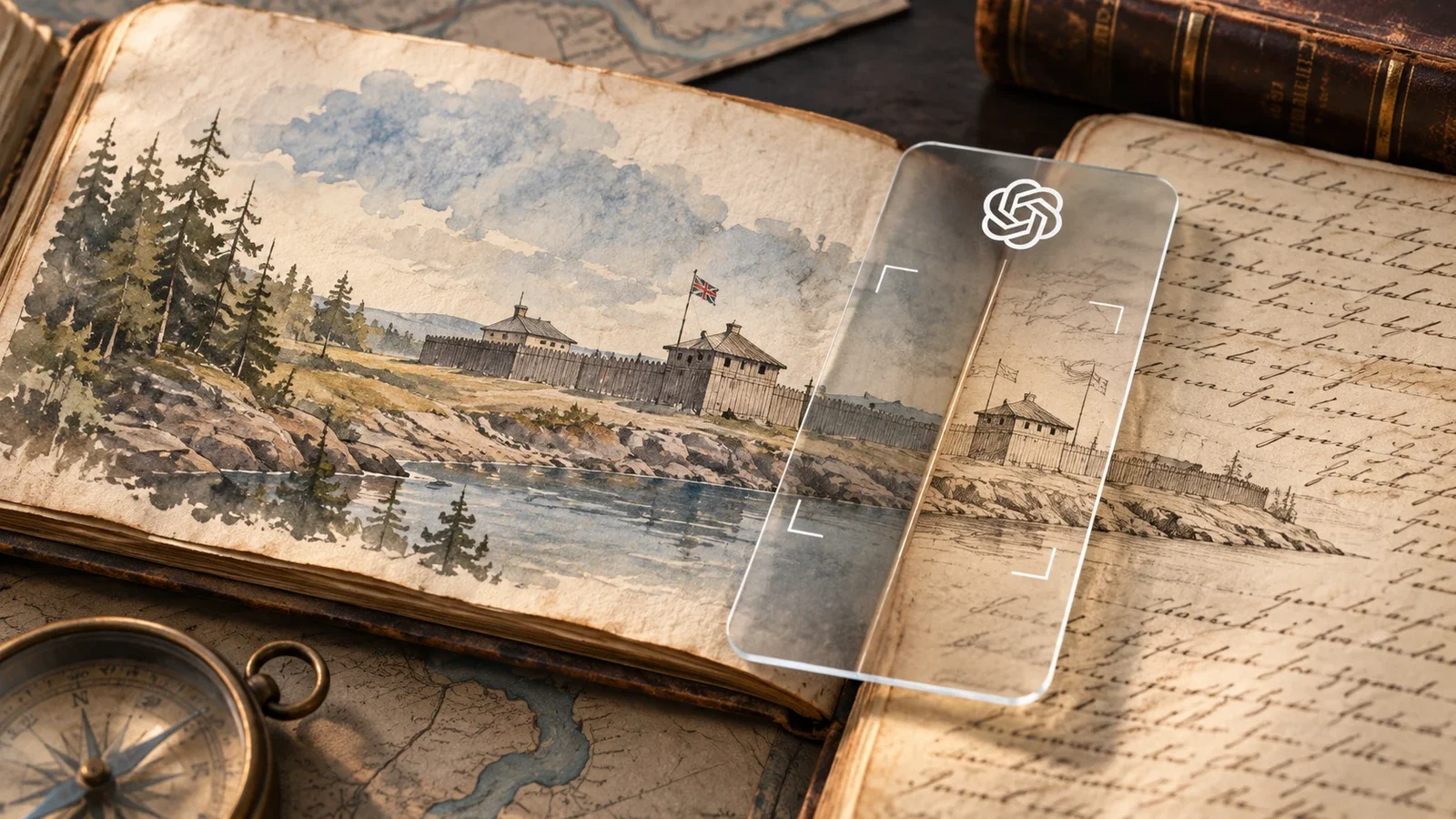
The document contains 84 pages, of which 34 feature drawings or watercolors, depicting a journey from Montreal to the Lake Superior region, in Canada. Although several illustrations have captions, only three are dated. The identification was especially difficult because thousands of travelers covered that same route in the early 19th century.
When analyzing the images and consulting historical records, the model pointed to Louis-Guy-Charles-Guillaume de Rohan-Chabot (1780–1875), Viscount of Chabot, as the probable author. The French aristocrat had served in the British Army and spent part of 1808 in Canada.
The first clue emerged in the diary of Joseph Frobisher, a fur trader who recorded his activities in Montreal. An entry from June 6, 1808 mentioned Chabot's departure for the interior of Canadian territory, accompanied by William McGillivray and William McKay. The itinerary was compatible with the dates recorded in the album.
162-page diary provides the decisive evidence
The most important discovery came from a little-known bibliographic reference. GPT-6.2 Astra identified, in a footnote of a 2014 doctoral thesis written by historian Juliette Reboul, the existence of a diary of Chabot's journey.
The manuscript had been preserved on microfilm in the Lafayette Collection, with copies available at Cleveland State University, in the United States. Following the AI's recommendation, Humphries requested reproductions from the archives responsible.
The comparison revealed similarities between the diary's handwriting and the album's captions. The dates and the places covered also matched. The strongest evidence, however, appeared in an entry from June 18, 1808.
That day, Chabot recorded his arrival at Fort St. Joseph and wrote: "I made a sketch", describing the same perspective of the fortification reproduced on one of the pages of the Yale album.
For Humphries, the combination of handwriting, itinerary and image description settled the question of authorship. The identification, however, remains an attribution supported by the historian's research, and not a formal update of the university's catalog.
The work also revealed a second result: the diary has approximately 162 handwritten pages, with detailed descriptions of life in 19th-century Canada. Associated documents include letters, commercial records and information about the activities of the North West Company and the fur trade.
Humphries repeated the experiment with the competing model Fable 5.2, which also pointed to Chabot as the probable author, in approximately 35 minutes. The difference was that the second system did not find the diary that made it possible to verify the hypothesis.
The case demonstrates an application of AI to historical research based on cross-referencing scattered sources. The 22 minutes represent the time needed to identify the candidate and indicate the path of verification; the documentary confirmation later required human consultation of the archives.