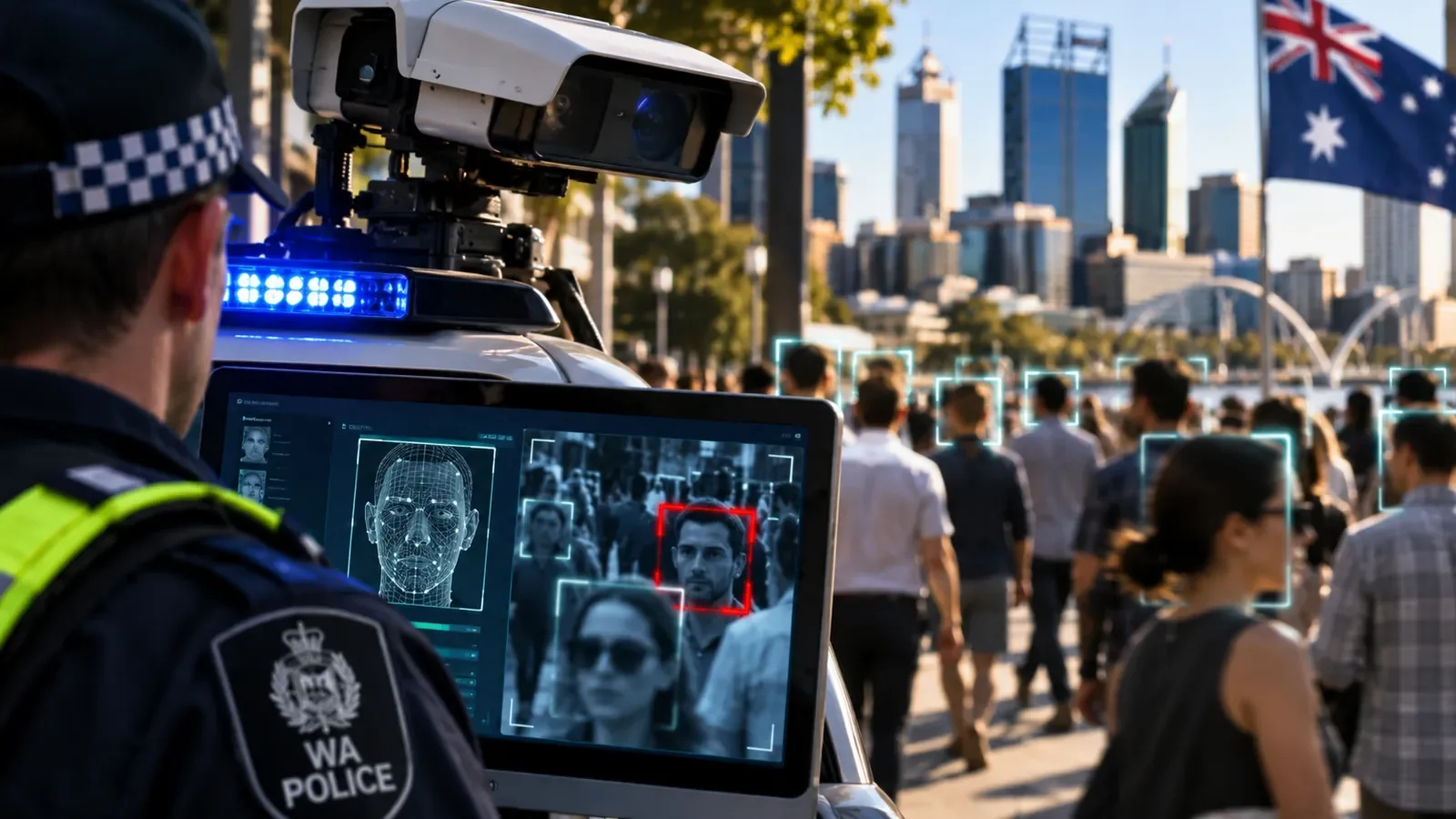
The Western Australia Police conducted 1,380,882 facial scans during a real-time facial recognition experiment in public spaces. The report, released this Monday (2), records 122 arrests and nine incorrect alerts. Operations ended on October 31, after just over four months of testing.
Between June 22 and October 31, the agency conducted 100 operations in 43 locations, including metropolitan and regional areas. The system generated 292 alerts, made it possible to identify and approach 146 registered sex offenders, and located ten people for welfare checks.
The cameras were installed in marked police vehicles or nearby. The equipment compared captured faces with an image list maintained by police and flagged possible matches for officers to assess.
According to the agency, images of people who did not match the list were automatically pixelated and discarded, without storage of biometric data. The report does not specify how many of the 122 arrests resulted directly from alerts produced by the technology.
Nine incorrect alerts represent 3.08% of flagged identifications
One of the main results released by police was the proportion of incorrect identifications. The institution reported a error rate of 0.00065%, calculated over the total of 1.38 million facial scans performed.
However, when the same nine errors are compared with the 292 alerts actually generated, they represent 3.08% of flags. This means that approximately three out of every hundred alerts were classified as incorrect.
Both percentages are mathematically correct, but they measure different things. The first considers all scans performed, including those that did not produce alerts. The second considers only situations in which the system flagged a possible match.
This distinction is important because neither indicator, on its own, demonstrates the technology's overall accuracy. The figures released also do not make it possible to determine how many wanted people may have passed the cameras without being identified.
Police Commissioner Col Blanch acknowledged that the technology was not perfect. In remarks reproduced by The Guardian, he confirmed that the nine incorrect alerts led to approaches for identity verification, but none resulted in an arrest or formal complaint.
Civil rights organizations questioned the interpretation of the results and the risks associated with biometric surveillance. Sarah Schwartz, legal director of the Human Rights Law Centre, warned that mistaken identifications can lead people to be approached, questioned, or investigated because of algorithm errors.
Concerns also include the proportionality of monitoring in public spaces and the use of the technology at protests.
The experiment has now entered internal evaluation phase, which will examine technical performance, operational effectiveness, impacts on the community, and compliance with governance rules. The surveillance vehicles were withdrawn from public operations while the review is conducted. The police have not yet announced a definitive decision on the program's continuation.