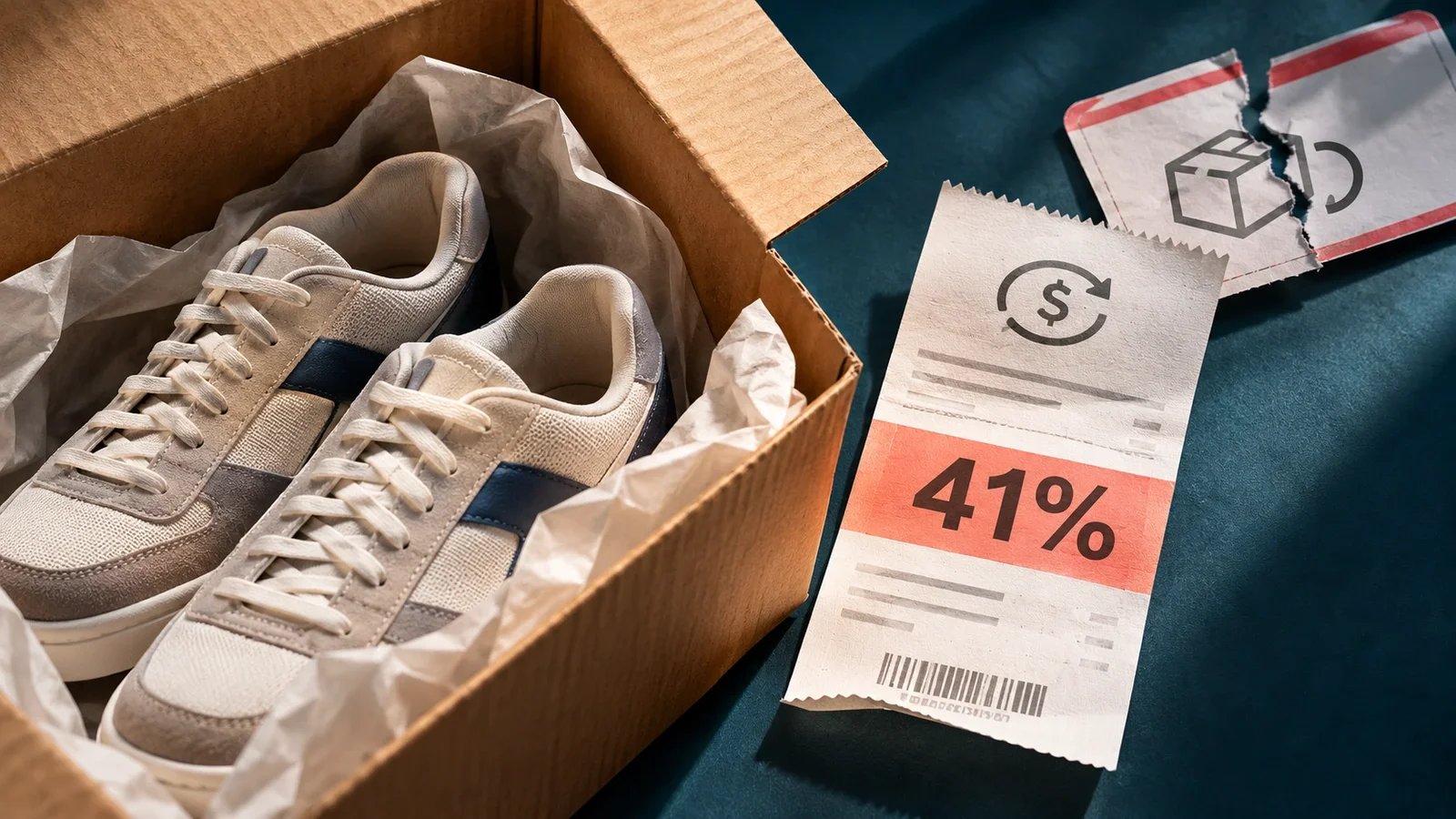
Offering a partial refund without requiring the return of the product can increase the value generated by a customer, but more generous payouts do not always produce the best result. A study published in the scientific journal Marketing Science estimated that refunding, on average, 41% of the price would be the optimal point for a large international e-commerce platform, considering operational costs, future purchases, and opportunistic compensation requests.
The research, originally published on September 23, 2026, and reported on Sunday (22), analyzed an experiment with 853,521 consumers who had requested returns. The policy generated a net transaction value gain of US$ 1.44 per customer over 30 days, reaching US$ 4.41 over 90 days.
Conducted by Lu Fang, Chunhua Wu, Zhe Yuan, and Kaifu Zhang, the experiment took place between August 2024 and January 2025. Participants were randomly distributed between two groups: 425,578 customers could receive partial refund offers without return, while 427,943 followed the traditional procedure.
The platform used a multi-agent artificial intelligence system to examine messages, images, and videos sent by consumers. When the complaint met the established criteria, the system presented an offer in real time. The customer could accept it and keep the product or proceed with the conventional return.
The test had two phases, with average refunds equivalent to 50% and 30% of product prices. This variation allowed researchers to assess how the generosity of the offers affected costs and purchasing behavior.
On the first request, the company paid out an additional US$ 0.63 in refunds per customer, but saved US$ 0.35 in return processing. The immediate balance was negative by US$ 0.28.
The advantage appeared in subsequent purchases. Over the following 30 days, consumers in the experimental group spent, on average, US$ 1.92 more than those in the control group. The combination of this increase with refunds and operational costs resulted in the net gain of US$ 1.44 per customer.
Why 41% is not a universal ceiling
The most relevant result of the study lies in the difference between evaluating only the immediate cost of a return and considering the subsequent relationship with the consumer.
When the researchers analyzed only the initial request, the average refund that maximized value for the platform was approximately 6% of the price. In this scenario, the policy ceased to outperform the traditional return when the proportion exceeded 36%.
When future purchases were incorporated, the estimated optimal point rose to 41%, while the break-even threshold calculated by the model reached 90%. Therefore, 41% represents the estimated maximum of the value curve, not a threshold above which any refund necessarily produces a loss.
The authors describe the result as a balance between customer value, operational costs, and opportunism.
There is also an important financial distinction: net transaction value is not equivalent to accounting profit. The metric used deducts refunds and processing costs from the transaction value, without directly incorporating the margin on all additional sales.
In an illustrative calculation assuming a gross margin of 35%, the researchers estimated a profit gain of only US$ 0.19 per customer over 30 days, reaching US$ 1.23 over 90 days. These values are estimates dependent on the margin adopted, not observed accounting results.
The policy also presented a behavioral tradeoff. Customers exposed to the new option made 15.5% more subsequent return requests. The decline in approval rates for certain requests, especially subjective complaints and rapidly repeated requests, was considered consistent with opportunistic behavior, although it does not prove individual fraud.
As an offset, there was a reduction of approximately 12% in physical return shipments. For the experimental sample, the authors calculated carbon emissions savings equivalent to the sequestration carried out by about 2,000 adult trees.
The results have limitations. The experiment involved a single platform, products sold directly by it, and specific complaint categories. Because the refund policy and the AI system were tested together, it is not possible to isolate how much of the gain came from automation.
Kaifu Zhang, one of the four coauthors, is also identified in the publication as affiliated with the experiment's partner company, a relationship relevant to assessing potential conflicts of interest.
For other retailers, the 41% benchmark depends on conditions that need to be measured individually: shipping and processing costs, the product's resale value, commercial margin, repurchase behavior, and the frequency of new complaints. The experiment demonstrates the economic viability of the policy in that context, but does not establish a universal refund proportion.