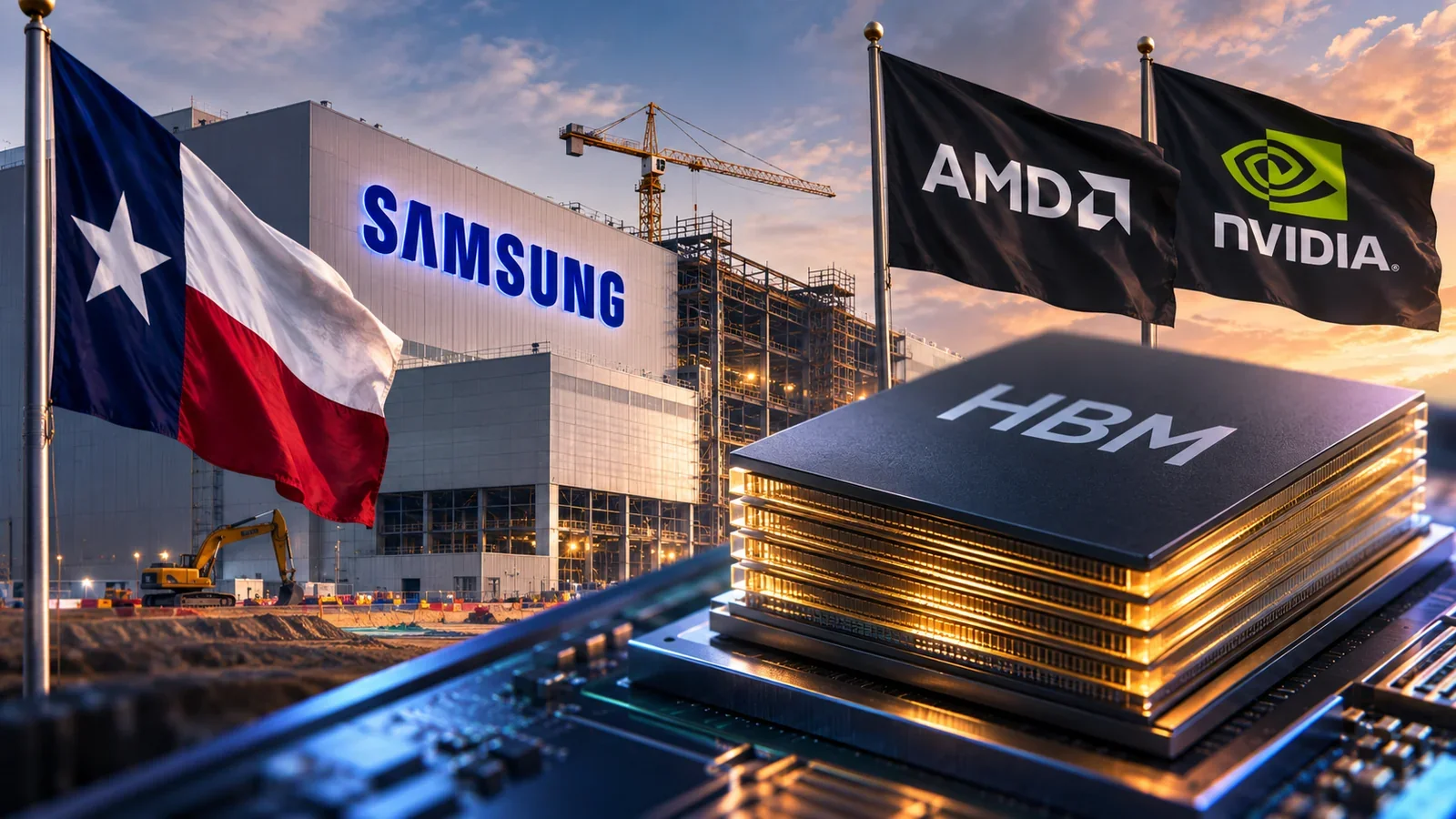
Samsung plans to use its second semiconductor factory in Taylor, Texas, to produce high-bandwidth memory (HBM) components intended for AMD and Nvidia. According to a report published by the South Korean newspaper Maeil Business this Tuesday (3), all of the future facility's production capacity would already be committed, with most of the orders assigned to AMD. The information was reported by Reuters.
The unit will be dedicated to manufacturing base dies, the logic chips that sit at the base of HBM memory structures. These components play important roles in communication between the memory layers and influence their performance and energy efficiency, characteristics relevant to artificial intelligence accelerators.
The new factory will use an advanced 2-nanometer process and will occupy approximately 250,000 square meters, an area about 50% larger than that of Samsung's first facility in Taylor. The latter already has a semiconductor manufacturing contract with Tesla.
Although preliminary site preparation work has begun, main construction is scheduled for November 2026. The schedule released by Maeil Business sets equipment installation from February 2029, followed by the start of mass production in 2030.
The newspaper also reports that Samsung intends to combine the components manufactured in Texas with DRAM chips produced in South Korea to deliver complete HBM memory modules to customers.
Nvidia's requirement for the next generation of HBM involves TSMC
Nvidia's participation in the new factory's plans presents a particularity. On October 18, the South Korean newspaper Seoul Economic Daily reported that the company had asked Samsung, SK Hynix and Micron to use TSMC's 3-nanometer process in manufacturing the base chips for its future custom memory, called NVHBM. The information was also reported by Reuters.
This requirement would aim to standardize the performance of memories supplied by different manufacturers and reduce the complexity of validation processes. Samsung would have accepted the condition, keeping its own manufacturing for conventional HBM models and custom solutions intended for other customers.
According to Maeil Business, the company would also be evaluating the possibility of manufacturing NVHBM components in-house if the capacity available at TSMC is not sufficient to meet demand. The requirement reported for this custom memory does not allow concluding, therefore, that all components intended for Nvidia will be produced at the future unit in Texas.
The original report also points out that Samsung's HBM4 and HBM4E models use base chips manufactured on 4 nanometers, while the new facility was planned to serve later generations with more advanced processes.
Samsung has not publicly confirmed the orders attributed to AMD and Nvidia. Contacted by Reuters, the South Korean manufacturer did not comment on the information about the second factory's customers.