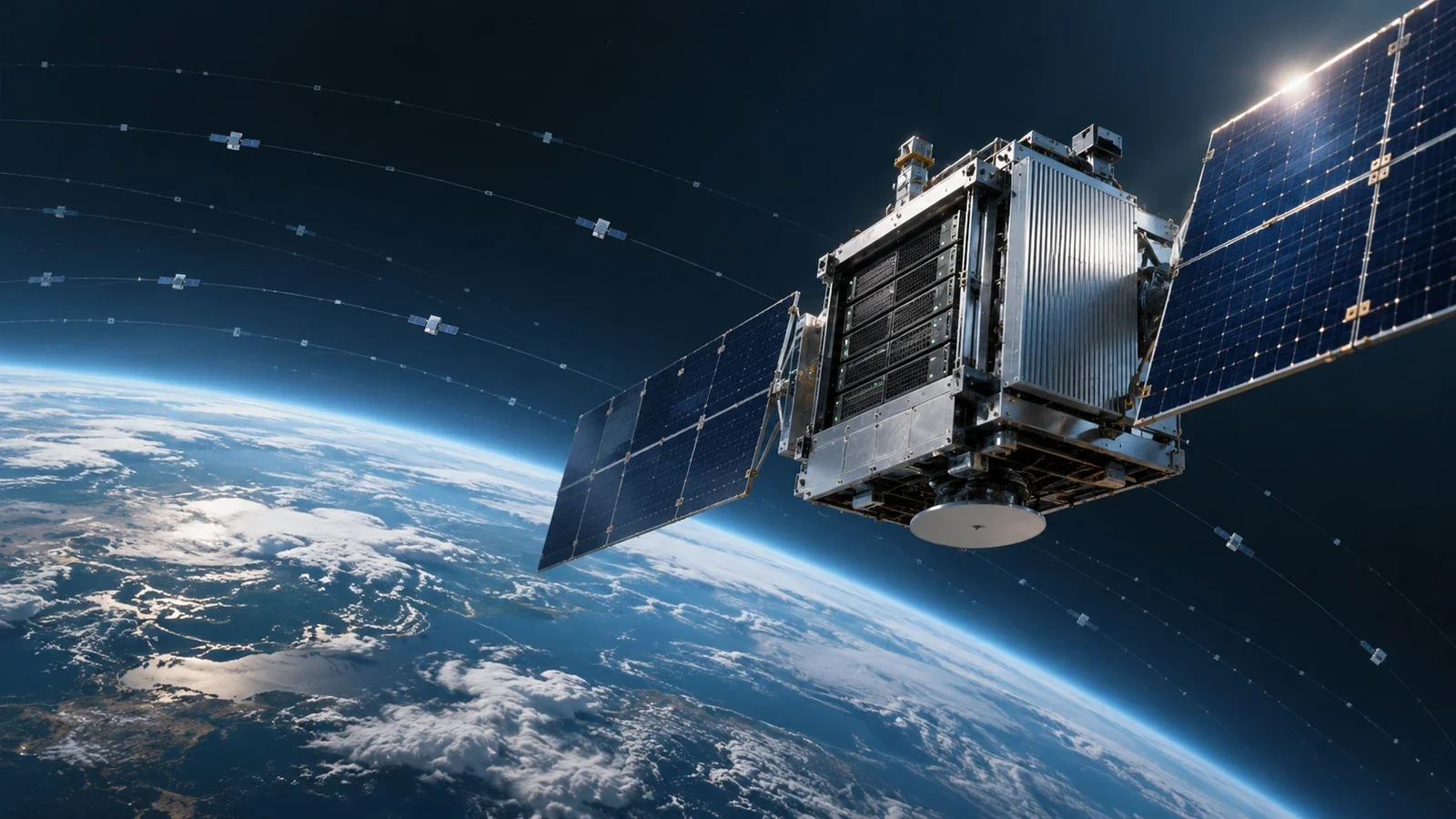
The U.S. Federal Communications Commission (FCC) granted SpaceX partial authorization on Wednesday (25) to deploy a constellation of up to 1 million satellites intended for data processing in space. Named Starmind, the project aims to meet growing demand for computing capacity for artificial intelligence.
This is the first authorization of its kind in U.S. history. The scope of the license, however, is narrower than the scale of the announcement suggests.
Decision DA 26-1273, published by the regulator, specifically authorizes the use of radio frequencies for emergency operations and backup telemetry, tracking, and command of the satellites. Primary communications will occur through optical inter-satellite links integrated with Starlink infrastructure.
The constellation may occupy different altitudes between 500 and 1,002 kilometers. The use of Ka-band frequencies will be conditioned on coordination with federal systems and on ceasing transmissions if they cause harmful interference.
FCC Chairman Brendan Carr advocated the initiative as an opportunity to combine American leadership in the space sector with the development of advanced computing infrastructure.
A regulatory ceiling, not a launch plan
Although it authorizes a constellation of unprecedented dimensions, the FCC did not certify the technical or economic viability of the orbital data centers.
The document establishes four deployment milestones that must be met to preserve the authorization:
- November 25, 2033: first satellite in operation;
- November 25, 2035: 100,000 satellites;
- November 25, 2038: 500,000 satellites;
- November 25, 2040: 1 million satellites.
The license will have a 15-year term, counted from certification of the first satellite's entry into operation.
One issue still pending is the fate of the equipment after its activities end. SpaceX requested permission to transfer satellites operating above 600 kilometers to disposal or heliocentric orbits as an alternative to atmospheric reentry.
The FCC deferred that decision because it considered the information presented insufficient. The company will need to request a modification to the authorization before deploying satellites that use these alternative disposal methods.
FCC waives new environmental assessment
The regulator rejected the opposition requests filed by Amazon, through Kuiper Systems, by Viasat, and by the American Astronomical Society (AAS).
The FCC also decided not to require an additional environmental assessment under the U.S. National Environmental Policy Act (NEPA). The agency cited an October 2026 decision that classifies licensed space operations as extraterritorial activities that do not trigger its environmental obligations under the law.
The decision does not eliminate the responsibility of the Federal Aviation Administration (FAA) for assessing the environmental impacts of rocket launches.
In a statement published after the authorization, the AAS warned that the number and brightness of the satellites could compromise decades of investment in astronomical research infrastructure.
Astrophysicist Adam Becker also warned, in an interview with the Associated Press, about the possibility of a chain reaction of collisions among space debris capable of affecting other systems in low orbit.
The FCC found the commitments presented by SpaceX to mitigate orbital debris to be sufficient, but explicitly left issues related to economic viability, computational efficiency, and thermal management of data centers in space outside the scope of the decision.