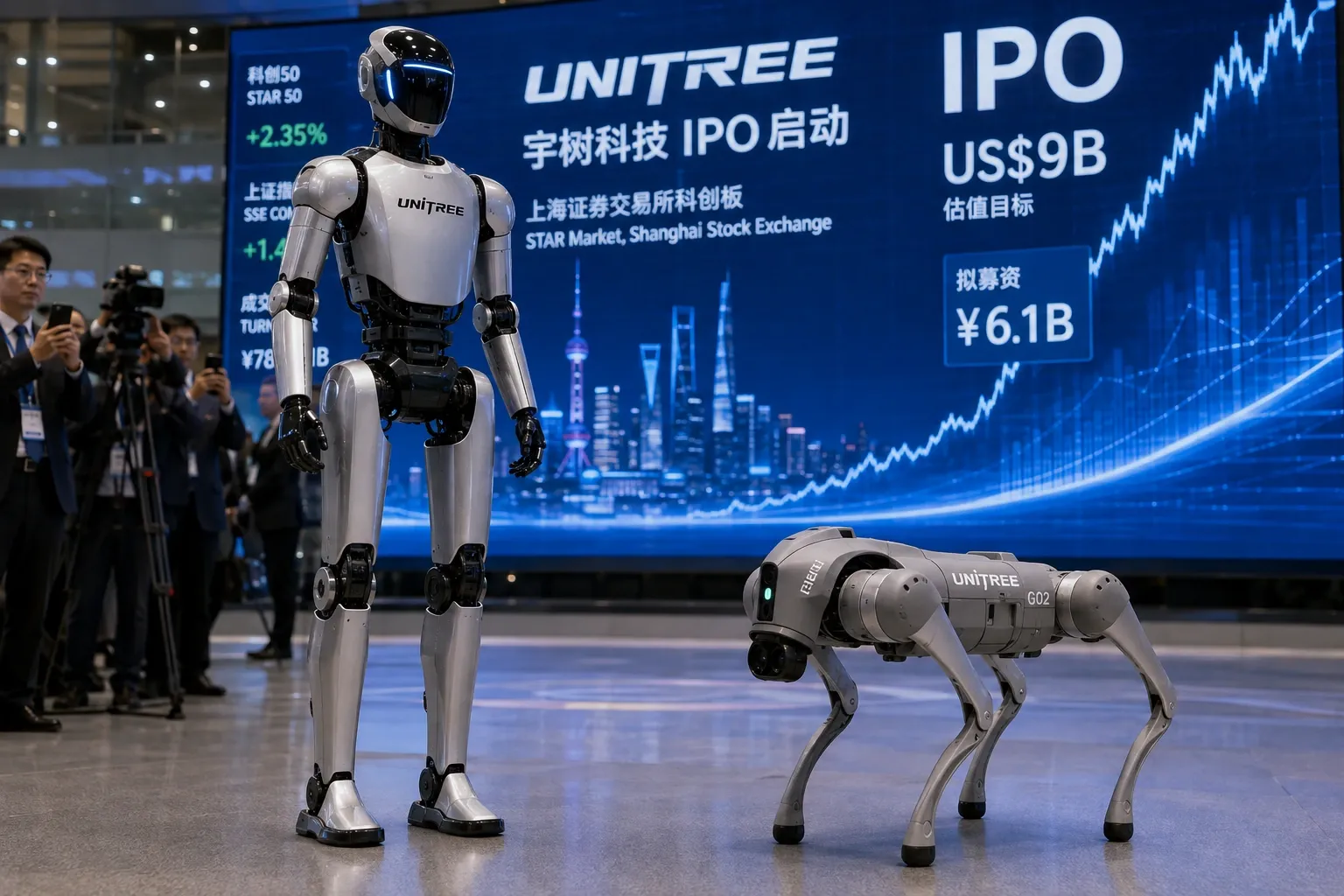
Unitree Robotics priced each share at 150.8 yuan in its initial public offering on the Star Market in Shanghai. The manufacturer said in a document released Thursday (6) that it will sell 40.45 million new shares, a transaction that values the company at 60.99 billion yuan, about US$ 9 billion.
The company expects to raise 6.1 billion yuan with the IPO. That amount exceeds the initial target of 4.2 billion yuan.
DeepSeek and Tencent took part in the strategic placement. The investor list also includes China National Petroleum Corp, China Southern Power Grid, China Telecom, Citic Securities and China's National Council for Social Security Fund.
DeepSeek invested 141 million yuan and will hold the shares for at least three years. The companies also signed an agreement to develop AI models and embodied intelligence technologies.
The partnership establishes reciprocal priority in contracting artificial intelligence model services and acquiring robots.
IPO could set a benchmark for the sector
The offering implies a price-to-earnings ratio of 219.23 times and a price-to-sales multiple of 35.89 times.
On the Hong Kong Stock Exchange, UBTech Robotics and Dobot trade at price-to-sales multiples of 19.37 and 20.12 times, respectively. The two companies have not yet recorded a profit.
Unitree, on the other hand, reported revenue of 1.7 billion yuan and adjusted net income of 591 million yuan in the last year.
Zheng Hualiang, founder of asset manager Leap VC, said the manufacturer's valuation could serve as a benchmark for other Chinese embodied intelligence companies.
Leap VC invested in Unitree in 2022, when the company had a pre-investment valuation close to 1 billion yuan.
Kangyuxiao Li, a Morningstar equity analyst, said the IPO gives the market a public benchmark to evaluate the segment. The analyst noted that differences among companies should produce distinct valuations in a fragmented market.
Startups such as Deep Robotics, Leju Robotics, AgiBot, X Square Robot and LimX Dynamics are also seeking access to the capital markets. Some companies in the sector have already received private valuations above 20 billion yuan.
Investors watch the stock exchange debut
The offering comes after a period of volatility in Chinese technology stocks. The Star 50 index, concentrated in sector companies, ended July down nearly 26%.
Zhang, an employee at a competing manufacturer, said he intends to request Unitree shares. For him, the outcome of the transaction could influence the ability of other robotics companies to raise funds.
Investor Kathy Shi said she requested the shares on expectations of appreciation after the debut. She does not foresee large-scale commercial adoption of embodied intelligence in the short term.
Li believes component suppliers can benefit from industry growth regardless of which manufacturers take the lead.
Zheng said any future appreciation of companies tied to the robotics supply chain will depend on rising sales. The investor noted scale production, lower prices and brand recognition as Unitree's current advantages.