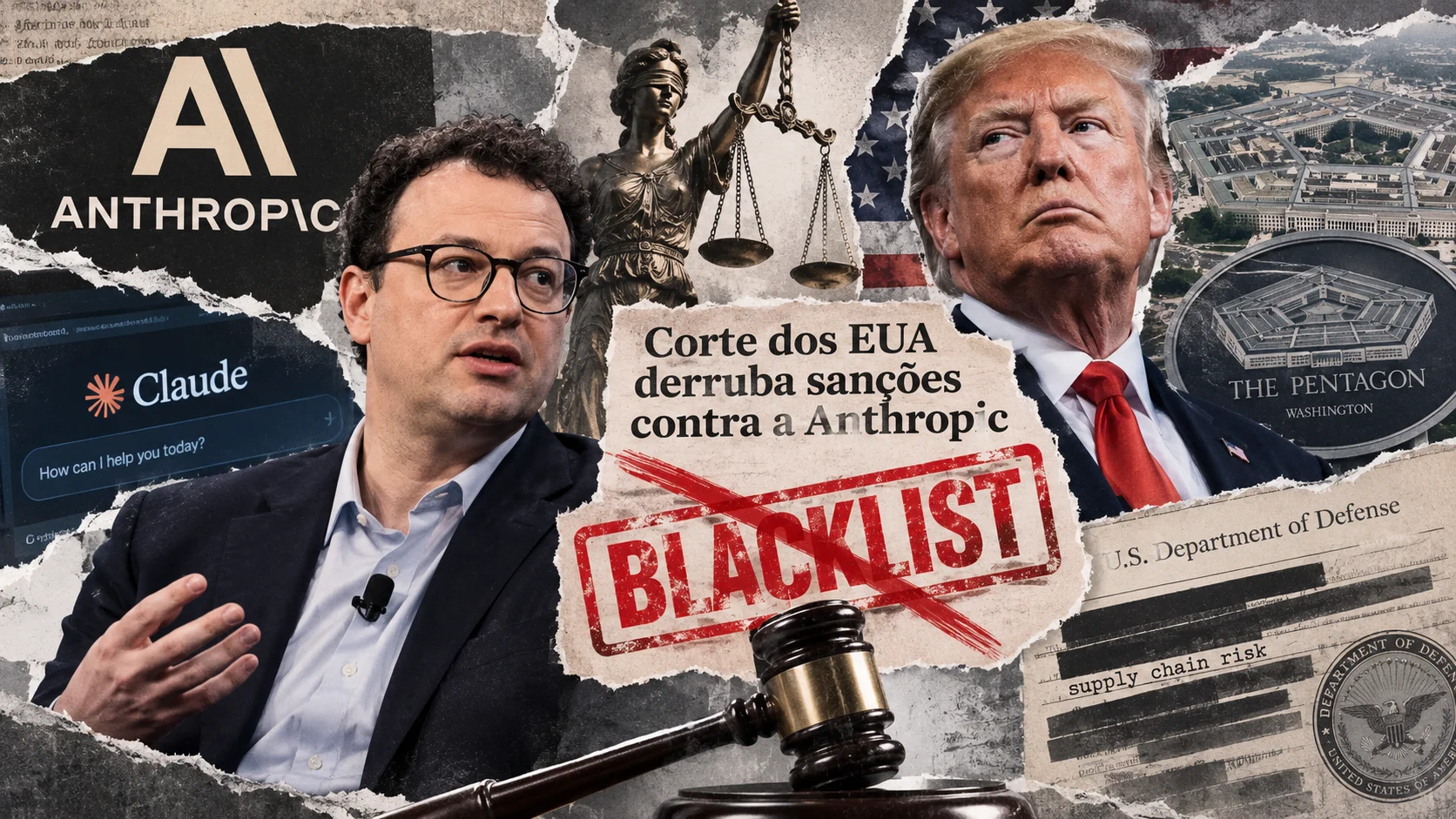
A federal court in California overturned the main measures imposed by Donald Trump's administration against Anthropic and permanently barred their enforcement. In a ruling published on Thursday (27), Judge Rita F. Lin concluded that the company was the target of illegal retaliation for its criticism of Pentagon policy on the military use of artificial intelligence.
The ruling overturns Anthropic's designation as a “supply chain risk,” along with the order that barred suppliers and partners of the US Armed Forces from maintaining business relationships with the company. The court also found violations of the First and Fifth Amendments of the U.S. Constitution.
The lawsuit revealed that a central part of the administrative justification used to support the sanctions was concentrated on a four-page memorandum, drafted after two of the three challenged measures. During the case, the government itself also acknowledged that Anthropic does not have remote access capable of modifying its models after they are deployed in military systems.
National security argument loses strength
One of the main arguments presented by the government was the risk of Anthropic interfering with Claude's operation after its deployment in sensitive environments.
The court concluded, however, that the company does not have that type of access. The government also acknowledged that Anthropic's technology does not, by itself, pose a greater risk to national security than other AI models classified as “black-box” systems.
With that hypothesis weakened, the specific factor used by the Pentagon became the lack of “trust” in the company. Administrative documents cited Anthropic's “increasingly hostile posture through the press” and its criticism of the government's position on the use of AI.
For Lin, the evidence showed that the measures sought to punish the company for its public stance, not to respond to a concrete threat of sabotage.
“The hollow invocation of national security is not a blank check to punish and retaliate against government critics,” the judge wrote.
The judge also classified as “arbitrary and capricious” Defense Secretary Pete Hegseth's decision to consider Anthropic a supply chain risk.
Anthropic already worked with sensitive government areas
The history of the relationship between the company and the U.S. government also weighed against the claim that the company posed a threat.
U.S. intelligence and defense agencies had been using Claude since 2024, while Claude Gov, a version intended for national security operations, had been in use at the Pentagon since March 2025.
Anthropic had also undergone 18 months of review to receive Top Secret security clearance. In June 2025, Claude received approvals for FedRAMP High workloads and Department of Defense impact levels 4 and 5.
A month later, the company received an agreement of up to US$ 200 million for two years to integrate and optimize AI capabilities within the Pentagon.
According to the court record, before the conflict that led to the sanctions, the department had not identified a supply chain risk related to Anthropic.
The court also highlighted another contradiction. A few days before the punishments, Hegseth went so far as to consider using the Defense Production Act to classify the company as essential to national security and compel it to continue providing its services.
Even after the measures against the company began, the Pentagon continued negotiating contracts with Anthropic and discussing possible applications of new models in sensitive areas.
For the judge, that behavior was incompatible with the claim that the company posed a threat capable of justifying such broad measures.
Dispute began over surveillance and autonomous weapons
The conflict escalated during negotiations to include Claude on the GenAI.mil platform. The Pentagon wanted contracts that would allow the models to be used for “all lawful uses”, without additional restrictions imposed by providers.
Anthropic agreed to remove most of its limitations, but kept two: mass surveillance of American citizens and autonomous lethal weapons, in which AI systems could participate in lethal decisions without adequate human supervision.
The company argued that current models would not yet be sufficiently reliable for these applications.
Dario Amodei also said during the negotiations that he would help the Pentagon remove Claude from its systems if the department considered another provider more suitable.
In a meeting on February 24, Hegseth acknowledged that Claude had relevant capabilities and that the concerns raised by Anthropic were understandable.
At the end of the meeting, however, he gave the company until February 27 to accept the new terms.
Otherwise, according to documents filed in the case, Anthropic would be classified as a supply chain risk and face restrictions not only within the Pentagon, but also in relationships with companies and other institutions linked to the federal government.
In the face of the ultimatum, Amodei maintained the company's position. He said Anthropic did not seek to interfere in specific military operations, but believed that in a limited set of situations, AI could “undermine, rather than defend, democratic values.”
Measures hit clients and contracts
On February 27, Trump ordered federal agencies to stop using Anthropic products, providing for a six-month transition period in some cases.
Shortly afterward, Hegseth announced that suppliers, partners and companies that did business with the Armed Forces could not maintain certain commercial relationships with the company.
The effects began even before a court order temporarily suspended the measures in March.
According to documents filed by the company, more than 100 corporate clients contacted Anthropic with questions or concerns about the possible consequences of remaining associated with the company.
A partner with a multi-million-dollar annual contract replaced Claude with a rival model to fulfill a contract with the Food and Drug Administration.
Anthropic estimated to the court that, if the restrictions took full effect, it could lose between 50% and 100% of revenue tied to defense suppliers and Pentagon-related clients, as well as several billion dollars in revenue in 2026.
The figures are projections presented by the company itself during the case.
Court orders removal of sanctions
In the final ruling, Lin permanently barred the agencies involved from implementing or enforcing the measures deemed illegal and ordered the removal of guidance, instructions and communications used to put them into practice.
Anthropic's classification as a supply chain risk was overturned, as were the restrictions affecting its business with military suppliers.
The court also overturned measures adopted by nine federal agencies, including the Pentagon, the State Department, the Treasury, the Department of Homeland Security, the Department of Energy and the General Services Administration.
The ruling, however, does not require the Pentagon to continue using Claude or to contract with Anthropic.
The department remains free to choose other artificial intelligence providers, as long as its decisions respect the law and constitutional guarantees.
After the ruling, Anthropic spokesperson Danielle Ghiglieri said the company welcomed the court's conclusion that the supply chain risk classification was illegal.
According to her, the company intends to continue working with the U.S. government on the use of artificial intelligence for national security.