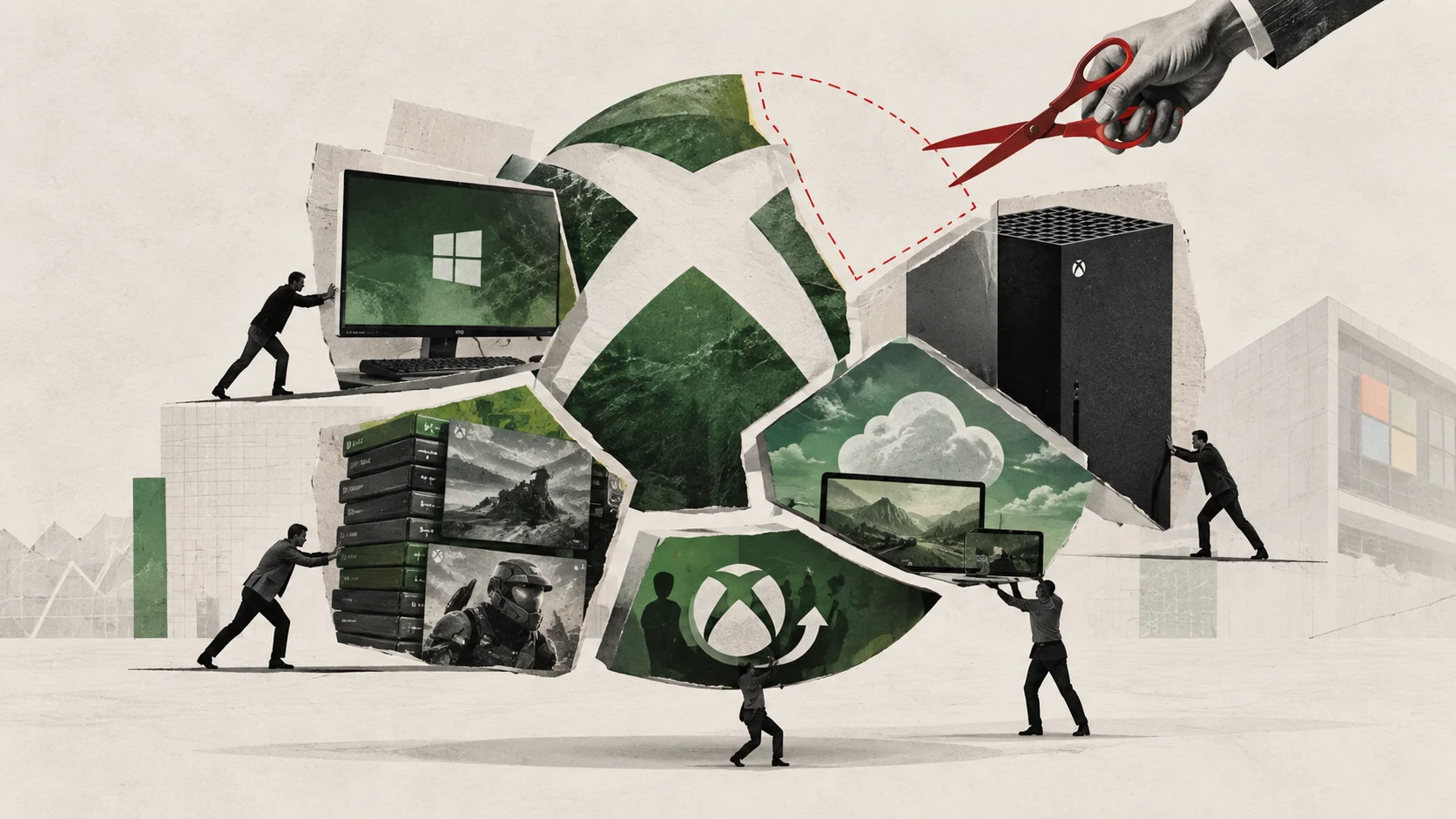
Satya Nadella says Microsoft still needs to invent the “right sustainable business model” for gaming. The remark came days after Xbox eliminated another 268 roles and continued a restructuring that is already reshaping studios, franchises and management.
The important part of Nadella’s comment is not that Xbox is changing strategy again. It is what remains unresolved after years of Game Pass expansion, acquisitions and multiplatform publishing: how Microsoft can combine the economics of a large publisher, a subscription service and its own gaming platform without recreating the cost structure it is now dismantling.
Reach is no longer Xbox’s main problem
Microsoft has already built the scale that its broader strategy was supposed to deliver. Xbox said in June that more than 1 billion people play its games each year across console, PC, mobile and streaming, generating 72 billion hours of play. In fiscal 2025, Microsoft reported gaming revenue above $23 billion and Game Pass revenue of nearly $5 billion, while describing itself as the top publisher on both Xbox and PlayStation.
The problem is that reach did not translate cleanly into the economics Microsoft expected.
Xbox management disclosed in June that the division expected to finish the fiscal year with an approximately 3% “accountability margin,” an internal profitability measure. Excluding Activision Blizzard King, Microsoft said it had spent more than $20 billion over five years on content, platforms and hardware subsidies while annual revenue declined by nearly $500 million.
That makes Nadella’s formulation unusually revealing. Xbox does not primarily need another distribution channel. It needs a model in which the channels it already controls reinforce each other economically.
Game Pass is becoming a more selective tool
The clearest evidence is Game Pass itself.
Microsoft spent years turning day-one access into one of the subscription’s defining propositions. But in April, it cut the U.S. price of Game Pass Ultimate from $29.99 to $22.99 and said future Call of Duty releases would no longer enter the service at launch. Those titles will instead arrive roughly a year later, while other major games can continue launching day one.
That is an important adjustment because Call of Duty is precisely the kind of franchise where Microsoft can choose between maximizing subscription value and preserving premium game sales.
The emerging model therefore looks less like “put everything into Game Pass” and more like using the subscription differently depending on the economics of each title. That gives Microsoft more freedom to protect full-price revenue from its largest franchises while still using Game Pass to drive engagement, discovery and recurring revenue elsewhere.
It also means subscription growth alone is no longer enough to judge whether the strategy works.
Multiplatform publishing solves one problem and creates another
Publishing Xbox games on rival hardware gives Microsoft access to audiences it cannot reach through its own console base. Its strong position as a publisher on PlayStation shows that this is already a meaningful business rather than a theoretical expansion strategy.
Microsoft is continuing down that path. State of Decay 3, for example, is planned for Xbox, PC, cloud and PlayStation 5.
But Nadella simultaneously says Microsoft wants to remain both a publisher and a platform provider across PC and Xbox. That distinction matters. If every major game maximizes distribution independently, Microsoft still needs reasons for players and developers to choose the Xbox ecosystem itself.
The company has not abandoned that side of the equation. Project Helix, its next-generation Xbox hardware, remains in development, while Xbox Mode is extending the Xbox interface and library experience deeper into Windows PCs.
The challenge is therefore not simply deciding between exclusivity and multiplatform publishing. It is determining which assets should maximize distribution and which should strengthen the platform — and whether the combination produces better economics than treating Xbox primarily as either a console business or a conventional publisher.
Microsoft is cutting the cost base before that model is proven
The restructuring is the other half of the equation.
Xbox announced in July that approximately 3,200 positions would be eliminated throughout fiscal 2027, with about 1,600 roles removed immediately. Management said its margins were three to ten times lower than comparable platform and publishing businesses and acknowledged that its expansion into a much larger studio portfolio had not generated the expected returns.
This week’s 268 additional cuts are part of that same reset. Microsoft is also consolidating studios under larger publishing organizations: Activision is taking responsibility for Rare, World’s Edge and development of the next Halo; Obsidian is moving under Bethesda; and Playground and Turn 10 are being combined. Xbox says the restructuring is now roughly three-quarters complete.
The mechanism is straightforward: fewer organizational layers and fewer independent business units can reduce fixed costs and concentrate publishing resources around franchises with greater scale.
But cost reduction alone does not answer Nadella’s question. A smaller Xbox can have better margins without necessarily establishing a durable growth model. Microsoft still has to demonstrate that the remaining combination of premium games, subscriptions, rival platforms, Windows and Xbox hardware produces growth after the restructuring ends.
FY27 will provide the first real test
Recent financial results make that test measurable.
Xbox content and services revenue declined 10% year over year in Microsoft’s fiscal fourth quarter, after falling 5% in the previous quarter. In fiscal Q3, gaming revenue fell 7% and Xbox hardware revenue dropped 33%.
Xbox management has said it expects the business to return to growth in 2027.
That means the next phase can be judged against concrete signals: whether content and services revenue resumes growth, whether Game Pass stabilizes after its pricing and Call of Duty changes, whether the reduced studio structure improves the economics of first-party production, and how Microsoft balances PlayStation releases with games designed to strengthen its own ecosystem.
Nadella’s comment effectively defines the problem Microsoft now has to solve. Xbox has already acquired the studios, expanded beyond the console and built one of the industry’s largest subscription businesses. The unfinished work is proving that those pieces can operate together as a sustainable business rather than as separate strategies competing for the same economics.