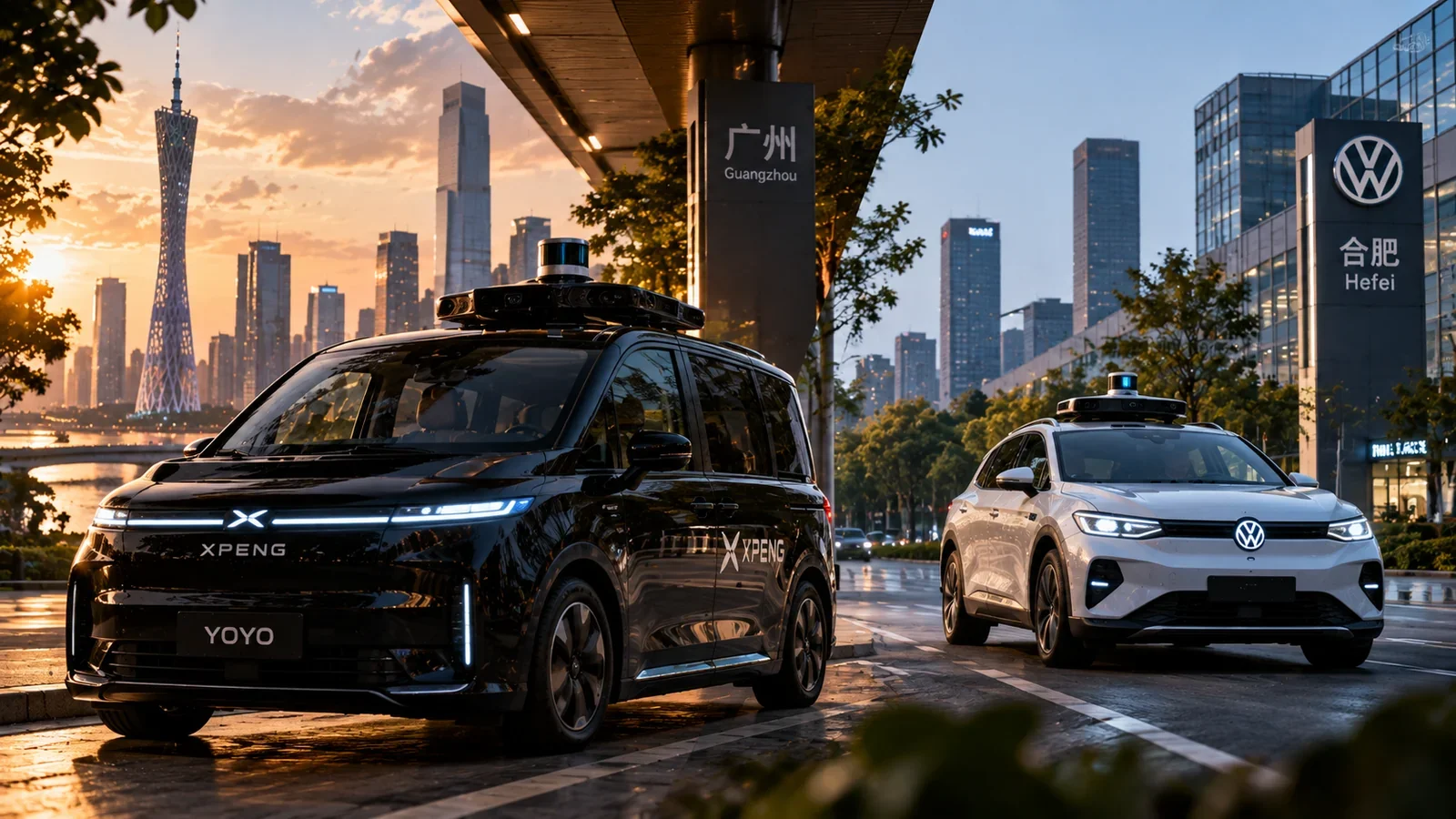
China has granted new authorizations for autonomous vehicles from Xpeng and the Volkswagen group. The Chinese manufacturer will be able to operate its robotaxis at level 4 (L4) in demonstrations with passengers in Guangzhou, while the German automaker received a license to test systems at level 3 (L3) on public roads in Hefei. The companies announced the permits on Monday (26).
Xpeng received authorization to expand the operations of the XPENG Yoyo service, which moves from the technological validation phase to tests of operation and commercial viability. According to the South China Morning Post, the license allows carrying paying passengers, but it does not yet amount to definitive approval for an unrestricted commercial service.
Access will continue to be limited initially to invitation codes, with gradual expansion. The company intends to evaluate not only the vehicles' ability to drive autonomously, but also the handling of requests, fleet distribution, passenger boarding and the response to unexpected situations.
The Yoyo robotaxis use four Turing artificial intelligence chips, developed by Xpeng itself, and the VLA 2.0 autonomous driving model. The manufacturer intends to offer vehicles, software and AI technology to partner transportation platforms, instead of directly operating large fleets.
The company also set a goal of carrying out operations with passengers without safety drivers in 2027.
Volkswagen begins L3 tests and targets technology ready in 2027
In Hefei, in Anhui province, Volkswagen Group China has already begun tests on public roads and data collection with its L3 autonomous driving technology. The authorization allows evaluating the system in real traffic conditions, but it does not represent an approval to sell vehicles with this capability.
The difference between the licenses is important. At level L3, the vehicle takes over driving under specific conditions, but the driver must be available to retake control when requested. L4, in turn, allows the system to perform the driving task without human intervention within its defined operational conditions.
Volkswagen intends to achieve technological readiness for L3 in 2027. The company did not say which models take part in the tests, how many vehicles are involved or which routes were authorized.
The group uses technologies developed in its Chinese operation, including the Hyper Sense 8 assistance system and the GAIA 2.0 artificial intelligence model. According to the manufacturer, the platform runs daily safety simulations equivalent to 5 million kilometers of real driving.
Volkswagen also scheduled for October 28 a technology event in Hefei, at which it will present advances in its solutions developed for the Chinese market.