
An acquisition stack connects media buying to business outcomes.
That sounds obvious, but many advertising operations are still split into isolated systems:
- ad platforms optimize clicks and platform conversions;
- landing pages optimize local conversion rate;
- CRM teams manage leads;
- finance tracks revenue;
- analytics tries to reconcile the differences.
A modern acquisition stack connects these layers so that the business can answer a more useful question:
Which media investments create incremental, economically valuable customers?
The seven layers of an acquisition stack
A practical architecture includes:
- media platforms;
- creative production;
- audience and feed management;
- landing experience;
- conversion measurement;
- CRM and commercial outcomes;
- analysis and budget allocation.
The stack should support the full path from impression to revenue.
Layer 1: media platforms
Typical acquisition channels include:
- paid search;
- paid social;
- video;
- display/programmatic;
- retail media;
- affiliate and partner media;
- marketplaces;
- sponsorships.
The goal is not to be present everywhere.
Each channel should have a job.
Examples:
Paid search Captures existing intent.
Paid social Creates or intercepts demand based on audience and creative.
Retail media Reaches shoppers close to commerce environments.
Affiliate Uses performance-based external distribution.
Video Builds demand, explains products and expands audience reach.
Channel selection should follow audience behavior and economics.
Layer 2: creative operations
Automated bidding has increased the strategic importance of creative.
The stack should support:
- creative briefs;
- asset library;
- variant tracking;
- approval;
- localization;
- format adaptation;
- performance tagging;
- fatigue monitoring.
Every asset should have an ID.
That enables analysis across:
- concept;
- hook;
- visual;
- offer;
- creator;
- format;
- audience.
Without creative taxonomy, the organization knows which ad won but not why.
Layer 3: audience, product and feed data
Some acquisition systems depend heavily on structured feeds.
Examples:
- ecommerce product catalogs;
- travel inventory;
- property listings;
- app events;
- customer audiences.
The quality of feed data can affect delivery.
A strong stack monitors:
- missing fields;
- rejected items;
- price mismatches;
- inventory status;
- category mapping;
- destination URLs.
Audience data also needs governance.
First-party audiences can include:
- customers;
- high-value customers;
- leads;
- product users;
- cart abandoners;
- churned customers.
Suppression is often as important as targeting.
Do not waste acquisition budget advertising acquisition offers to ineligible customers.
Layer 4: landing experience
The landing page is part of the advertising system.
It should preserve:
- message continuity;
- offer;
- audience relevance;
- measurement parameters;
- page speed;
- mobile usability.
A high CTR with weak landing conversion may indicate message mismatch.
A strong landing experience should answer:
- What is this?
- Who is it for?
- Why is it better?
- What proof exists?
- What should the visitor do next?
The acquisition team should own the feedback loop between creative and landing behavior.
Layer 5: conversion measurement
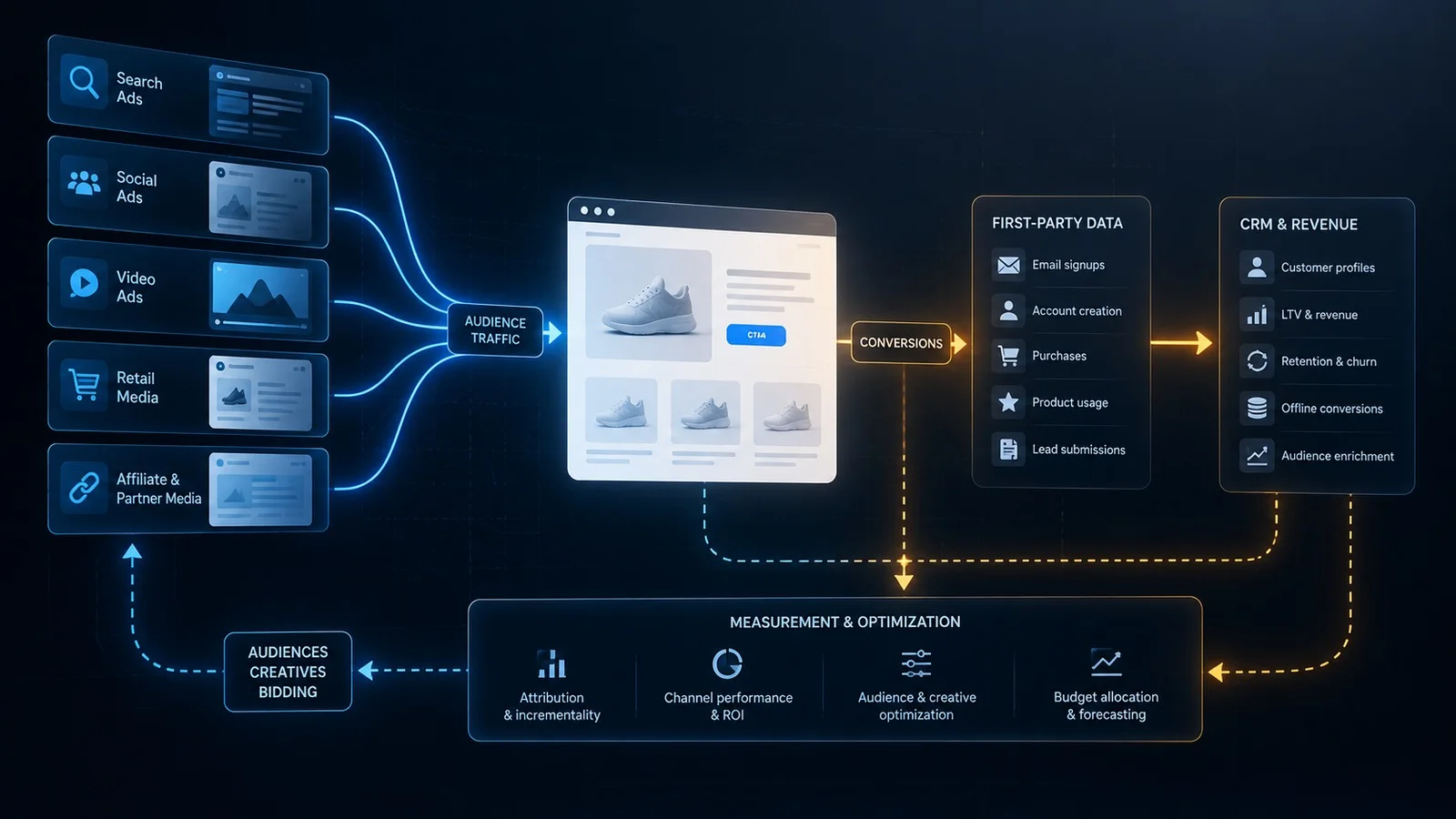
Advertising platforms require high-quality conversion signals.
At minimum, define:
- primary conversion;
- secondary conversion;
- value;
- deduplication;
- attribution window;
- first-party identifier availability.
Google Ads supports enhanced conversions, which use hashed first-party customer data to supplement conversion measurement.
Google changed this area in 2026. Enhanced conversions for web and leads were unified under a single setting, and Google began accepting user-provided data from website tags, Data Manager and API connections at the same time. Google also moved offline conversion and enhanced-conversion-for-leads uploads toward the Data Manager API.
This is operationally important.
Paid media teams can no longer treat conversion architecture as a one-time tag installed on the thank-you page.
Conversion data increasingly moves through:
- browser tags;
- server-side endpoints;
- CRM;
- APIs;
- data-manager products.
Someone must own the architecture.
Server-side measurement is not a magic fix
Server-side tagging can improve control over data routing and reduce some client-side processing.
Google Tag Manager supports server-side containers that receive requests and route data to downstream products.
Use server-side infrastructure when it solves a real problem:
- central routing;
- first-party endpoints;
- conversion reliability;
- data governance;
- performance.
Do not implement it simply because it is fashionable.
It creates infrastructure that must be:
- monitored;
- secured;
- scaled;
- updated;
- paid for.
Layer 6: CRM and offline outcomes
For B2B and high-consideration purchases, the browser conversion may be only the beginning.
Example:
ad click → form lead → qualified lead → opportunity → customer
If the ad platform optimizes only for form submissions, it may learn to find people who submit forms rather than people who buy.
The stack should return downstream signals where appropriate.
Useful commercial outcomes include:
- qualified lead;
- opportunity;
- closed-won;
- revenue;
- margin;
- first purchase;
- subscription activation.
This creates a stronger optimization signal.
Optimize for the right event
Automated bidding will generally optimize toward the signal it receives.
If the signal is weak, the optimization can be weak.
Bad primary conversion:
- newsletter signup when the campaign goal is enterprise pipeline.
Better:
- qualified demo.
Best available:
- downstream opportunity or revenue signal when volume and latency support it.
The conversion event must balance:
- business relevance;
- sufficient volume;
- acceptable delay;
- data quality.
A very high-quality event that occurs twice per month may be too sparse for some optimization systems.
Layer 7: attribution and incrementality
Platform attribution answers:
Which touchpoints receive credit?
Incrementality asks:
Which conversions happened because of the media investment?
These are not the same.
A complete measurement stack can combine:
- platform attribution;
- analytics attribution;
- CRM source data;
- experiments;
- geo tests;
- holdouts;
- marginal spend analysis.
Do not expect one attribution model to produce truth.
Use multiple forms of evidence for large budget decisions.
Measure marginal economics
Average ROAS can hide deterioration.
Suppose:
- first $20,000 of spend produces excellent returns;
- next $20,000 is acceptable;
- next $20,000 reaches lower-intent audiences.
The blended result may still look healthy while the next dollar has weak economics.
Track:
- marginal CAC;
- marginal ROAS;
- conversion quality;
- frequency;
- audience expansion;
- contribution margin.
Budget allocation should consider the return from incremental spend.
Build a campaign naming system
A disciplined naming convention makes analysis easier.
A campaign record might include:
- market;
- channel;
- objective;
- audience;
- product;
- creative concept;
- offer;
- date.
Do not overload campaign names until they become unreadable.
The more important requirement is a stable campaign ID that can be joined across:
- ad platform;
- analytics;
- CRM;
- warehouse.
Use automated rules carefully
Automation can help with:
- pacing;
- anomaly alerts;
- creative fatigue flags;
- budget thresholds;
- feed errors.
Avoid automated rules that make irreversible large changes without guardrails.
The more consequential the action, the more valuable review becomes.
A practical acquisition stack
- Media — Search, social, video, retail, partner
- Creative — Production, taxonomy, approvals
- Audience/feed — First-party audiences, product feeds
- Experience — Landing pages and conversion flow
- Measurement — Tags, APIs, server-side signals
- CRM — Lead and opportunity outcomes
- Revenue — Orders, billing, margin
- Analysis — Attribution, incrementality, marginal economics
- Automation — Pacing, alerts, QA
The right stack is not necessarily enterprise software.
A smaller business can build an excellent system using native platform tools plus reliable analytics and CRM.
Acquisition stack checklist
Verify:
- Is every channel assigned a role?
- Are creative assets tagged consistently?
- Are product feeds monitored?
- Are customer suppressions working?
- Does landing-page messaging match the ad?
- Is the primary conversion economically meaningful?
- Are conversions deduplicated?
- Are first-party identifiers handled correctly?
- Can offline revenue connect back to acquisition?
- Are platform conversions reconciled?
- Is marginal efficiency visible?
- Are automated actions guarded?
- Does someone own measurement infrastructure?
The strongest paid-media stack does not optimize for platform activity.
It builds a reliable feedback loop:
media → customer action → business outcome → better allocation.
Adapt the stack to the business model
Acquisition architecture should reflect how the business actually converts.
Ecommerce
Prioritize:
- product-feed quality;
- checkout events;
- purchase value;
- margin;
- repeat purchase;
- returns;
- customer suppression.
The ad click and the order often happen relatively close together, so commerce data can become a strong optimization signal.
B2B
Prioritize:
- lead identity;
- CRM integration;
- qualified-stage definitions;
- opportunity value;
- long sales cycles;
- offline conversion feedback.
A form submission is rarely the final business outcome. The stack needs to follow the account into sales.
Subscription and SaaS
Prioritize:
- signup;
- activation;
- trial conversion;
- retention;
- recurring revenue;
- payback.
A channel that produces cheap trials but weak retention can look attractive in the acquisition dashboard and expensive in the business model.
Publisher or media
Prioritize:
- qualified audience;
- newsletter growth;
- return frequency;
- subscription;
- affiliate actions;
- advertising yield.
The most valuable acquisition event may be a retained reader rather than an immediate transaction.
This is why acquisition stacks should not be copied from another company. The architecture must follow the economics of the business.