
Conversion rate optimization becomes much more useful when it stops being a collection of landing-page tweaks and becomes an experimentation system.
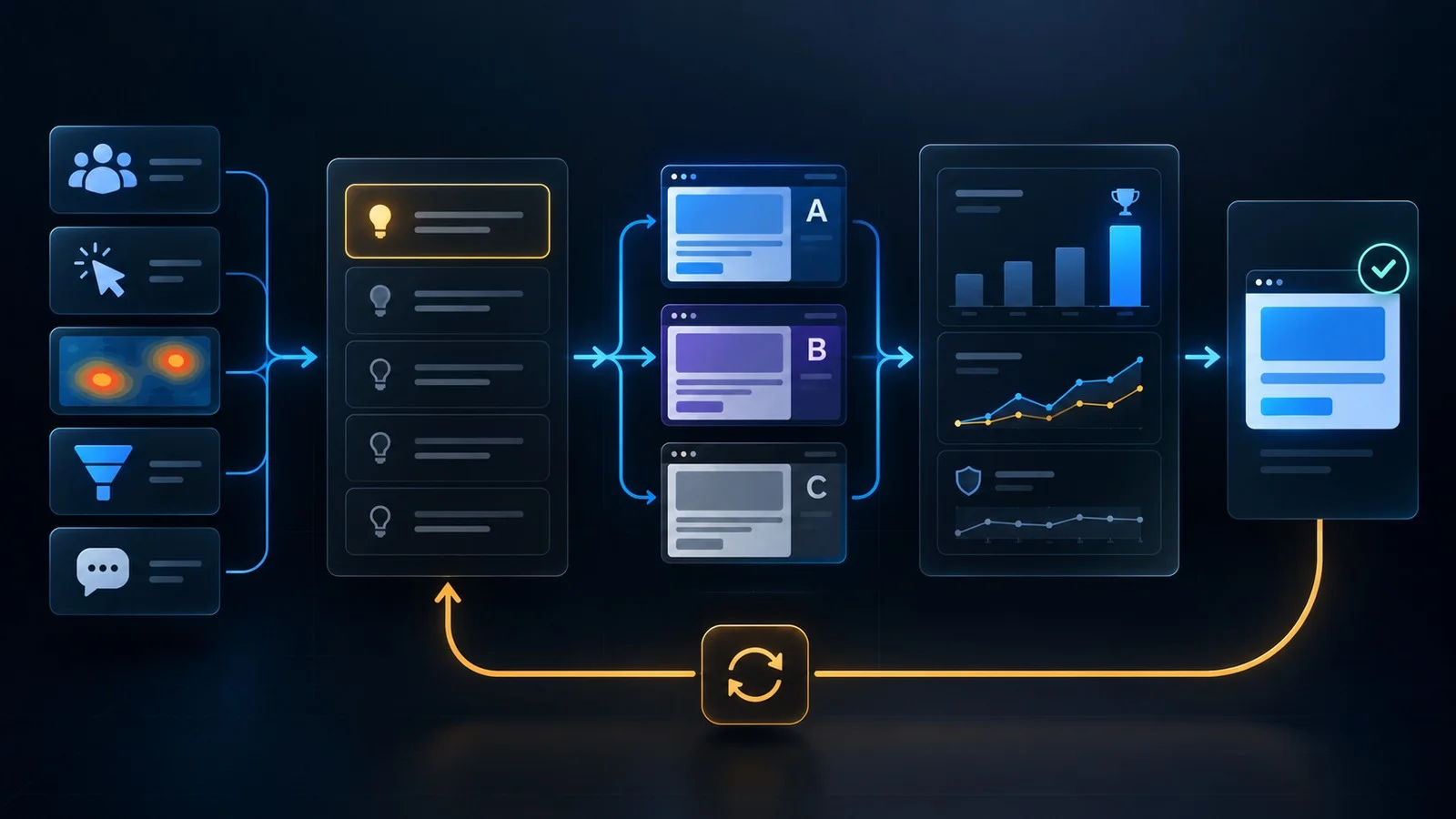
A mature experimentation stack connects four things:
- evidence about user behavior;
- a prioritized hypothesis backlog;
- controlled delivery of variants;
- reliable measurement of outcomes and guardrails.
The software can range from simple visual testing tools to feature-flag platforms integrated directly into application code.
The operating model matters more than the vendor.
Layer 1: behavioral evidence
Experiments should begin with a reason.
Useful evidence sources include:
- web analytics;
- product analytics;
- funnel analysis;
- search queries;
- CRM data;
- session replay;
- heatmaps;
- surveys;
- support tickets;
- sales objections;
- usability tests.
The objective is to identify friction or uncertainty.
Examples:
- mobile visitors abandon pricing more often than desktop visitors;
- activated users retain but most new users never activate;
- prospects repeatedly ask the same implementation question;
- visitors engage with comparison content but do not reach product pages.
This evidence generates hypotheses.
Layer 2: the hypothesis backlog
A hypothesis should explain:
- which segment is affected;
- what change is proposed;
- why it should work;
- which metric should move;
- what could be harmed.
Example:
For first-time mobile visitors on the pricing page, replacing the plan matrix with a guided recommendation should increase checkout starts because the current comparison requires too much scanning, without increasing refund rate.
That is testable.
“Improve pricing page” is not.
The backlog should record:
- hypothesis;
- evidence;
- owner;
- expected impact;
- confidence;
- effort;
- target metric;
- guardrails;
- status.
Prioritize by learning value
A test can be valuable even when it does not win.
High-value experiments answer important questions.
Examples:
- Does this audience understand the value proposition?
- Is price or complexity the larger constraint?
- Does social proof affect enterprise buyers?
- Does a shorter onboarding path improve activation?
- Does requiring a card increase paid conversion quality?
Prioritize experiments where the answer changes a meaningful decision.
Do not fill the calendar with low-risk cosmetic tests while strategic uncertainty remains untouched.
Layer 3: experiment delivery
There are several ways to deliver variants.
Client-side visual testing
Useful for:
- copy;
- layout;
- simple landing-page changes.
Advantages:
- fast setup;
- marketer-friendly.
Limitations can include:
- performance impact;
- flicker;
- restricted application logic.
Server-side experimentation
Variants are assigned in backend logic.
Useful for:
- pricing logic;
- checkout behavior;
- recommendation algorithms;
- complex experiences.
Feature-flag experimentation
Experiments run through feature flags.
Optimizely Feature Experimentation, for example, supports experiments on top of feature flags, while Statsig uses SDKs and experiment configuration to assign variants and measure metrics.
This model is useful because rollout and experimentation share the same delivery infrastructure.
A winning variant can often be expanded gradually rather than rebuilt after the test.
Choose the randomization unit
The experiment needs a stable assignment unit.
Possibilities include:
- user;
- account;
- device;
- session;
- geography.
User-level assignment works when a stable user identifier exists.
Account-level randomization may be better in B2B where multiple users belong to one company.
Device-level assignment can be useful for anonymous visitors.
The unit should match the risk of contamination.
If users from the same enterprise account receive different pricing experiences, account-level assignment may be more appropriate.
Define a scorecard before launch
Statsig's current experiment workflow requires a hypothesis and a scorecard with at least one primary metric.
That reflects a good operating principle.
Before launching, define:
Primary metric
The main outcome.
Examples:
- purchase conversion;
- activated account rate;
- qualified demo conversion.
Secondary metrics
Help explain the mechanism.
Examples:
- click-through;
- time to activation;
- form completion.
Guardrail metrics
Protect against harm.
Examples:
- refund rate;
- churn;
- support contact;
- page performance;
- gross margin.
Do not add twenty “primary” metrics.
Use feature flags for safe rollout, not only tests
An experimentation stack can also improve delivery safety.
Feature flags can support:
- internal preview;
- percentage rollout;
- geography rollout;
- account allowlists;
- rapid rollback.
This separates deployment from exposure.
A feature can exist in production code without being visible to every user.
That reduces the operational risk of large launches.
Layer 4: statistical analysis
The platform should help answer:
- Is there evidence of a difference?
- How large is the effect?
- How uncertain is the estimate?
- Did guardrail metrics move?
- Are important segments different?
Avoid reducing the decision to “green means winner.”
The business should consider:
- effect size;
- uncertainty;
- implementation cost;
- downstream behavior;
- strategic fit.
A statistically detectable result can still be economically irrelevant.
Prevent peeking-driven decisions
One common problem is stopping an experiment as soon as the preferred variant appears ahead.
That increases the risk of acting on noise.
Use the platform's statistical methodology and pre-defined decision rules.
Document before launch:
- expected duration;
- traffic allocation;
- minimum practical effect;
- primary metric;
- guardrails;
- stopping conditions.
Do not rewrite success criteria after seeing the data.
Segment after the primary result carefully
Segment analysis can reveal useful differences.
Examples:
- mobile vs. desktop;
- new vs. returning;
- geography;
- plan;
- acquisition channel.
But slicing results repeatedly can produce false patterns.
Treat unexpected subgroup findings as new hypotheses unless the segment was pre-specified.
Connect CRO to revenue
A CRO team should not optimize only page conversion.
A landing-page test can increase form submissions while reducing lead quality.
A checkout test can increase purchase rate while increasing refunds.
An onboarding test can increase activation while harming long-term retention.
Connect experiment metrics to downstream systems when possible.
Examples:
- CRM qualification;
- revenue;
- margin;
- retention;
- lifetime value.
The longer the decision horizon, the more valuable downstream validation becomes.
Add qualitative research to the stack
Not every problem should be A/B tested.
If the team does not understand why users fail, research may be more valuable.
Use:
- interviews;
- usability sessions;
- survey responses;
- sales recordings;
- support data.
Then test the intervention created from that insight.
Experimentation is one method inside a broader optimization practice.
Experiment library
Every completed test should be stored.
Include:
- hypothesis;
- evidence;
- audience;
- variant details;
- screenshots;
- dates;
- metrics;
- result;
- decision;
- follow-up.
Tag by:
- funnel stage;
- audience;
- page;
- problem;
- message;
- product area.
The library prevents repeated tests and builds institutional knowledge.
A practical CRO stack
- Analytics — Funnels, cohorts, segments
- Behavior — Replay, heatmaps, qualitative evidence
- Research — Surveys, interviews, feedback
- Backlog — Hypotheses, priority, ownership
- Experimentation — A/B and multivariate tests
- Feature delivery — Flags, targeting, rollout
- Measurement — Primary, secondary, guardrails
- Warehouse/CRM — Downstream quality and revenue
- Knowledge — Experiment archive
A company does not need a dedicated vendor in every category.
Choose the smallest system that supports the experimentation maturity of the team.
When not to run an experiment
Avoid testing when:
- traffic is far too low;
- the change is legally required;
- the current experience is obviously broken;
- the cost of running the test exceeds the decision value;
- qualitative research is needed first.
Sometimes the correct action is simply to fix the problem.
Experimentation stack checklist
Confirm:
- Is there evidence behind the hypothesis?
- Is the target segment defined?
- Is assignment stable?
- Is the primary metric specified?
- Are guardrails defined?
- Is the tracking validated before launch?
- Is the stopping rule documented?
- Can the change be rolled back?
- Will downstream effects be checked?
- Will the result be stored?
- Does the next action depend on the result?
The best CRO stack does not produce the highest number of experiments.
It creates a disciplined loop:
observe → hypothesize → test → measure → learn → roll out → observe again.
That loop is the real optimization system.
Match the stack to experimentation maturity
The right experimentation stack changes as the organization matures.
Early stage
A small team may need only:
- reliable analytics;
- qualitative research;
- a hypothesis tracker;
- simple landing-page experiments.
The biggest opportunity is usually learning discipline, not infrastructure.
Growing program
As experiment volume increases, add:
- centralized experiment records;
- stable assignment;
- reusable metrics;
- automated QA;
- guardrail reporting;
- feature flags where product tests require them.
At this stage, governance becomes more important because multiple teams can interfere with one another.
Mature program
A mature experimentation organization may need:
- shared metric definitions;
- experimentation SDKs;
- warehouse integration;
- account or device-level randomization;
- automated exposure logging;
- experiment interaction detection;
- portfolio-level learning.
The stack should evolve only when operational complexity justifies it.
A common mistake is buying enterprise experimentation infrastructure before the organization has a repeatable hypothesis process. The platform then becomes an expensive place to run low-value tests.
Build process maturity and technical maturity together.