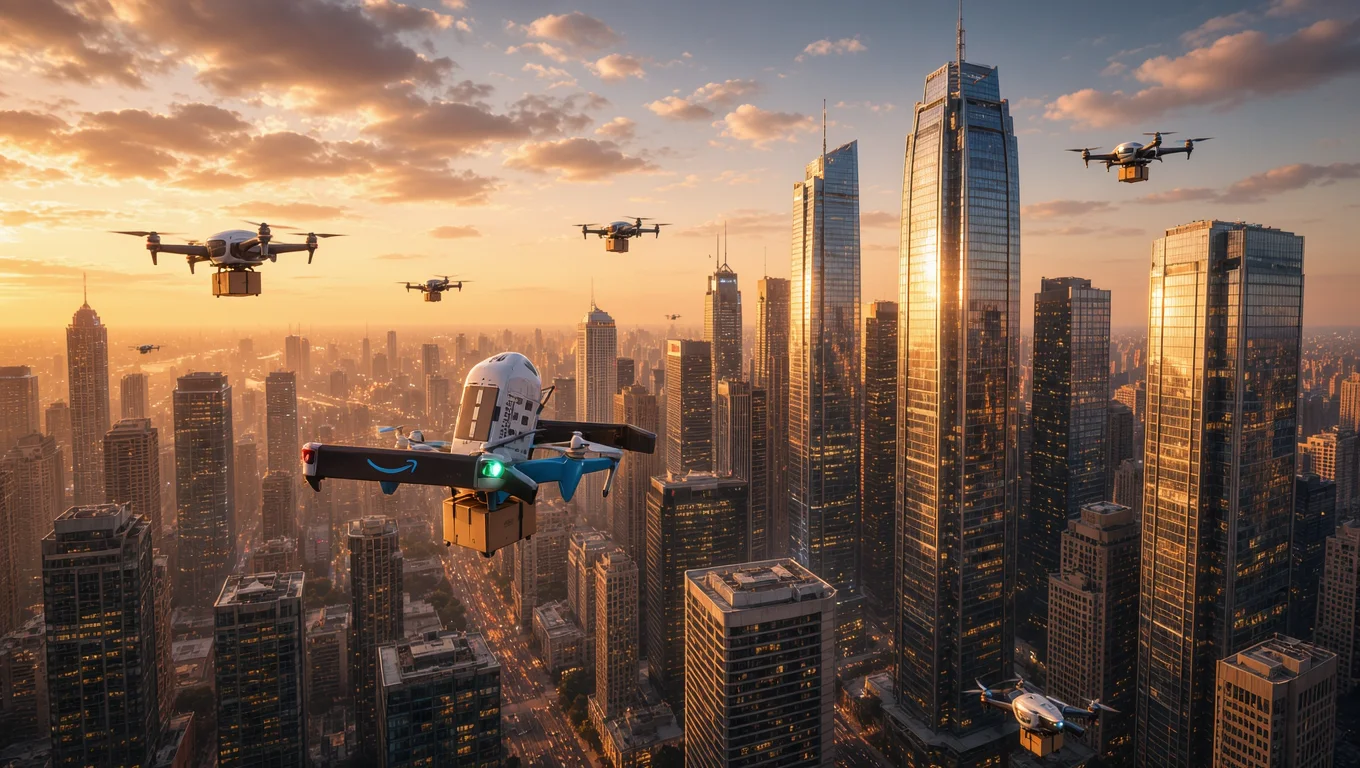
Amazon announced on Wednesday, August 19, 2026, the expansion of the Prime Air drone delivery service to five new metropolitan areas in the United States: Chicago, Syracuse, Cleveland, Atlanta, and Boise. The company said in a statement that the service should start "soon" in these regions, with more communities by the end of the year.
The expansion is part of the company's plan to reach nearly 500 U.S. cities and municipalities by the end of 2026, a reach six times larger than the current one. Prime Air currently operates in ten metropolitan areas: Baton Rouge, Dallas, Detroit, Houston, Kansas City, Omaha, Phoenix, San Antonio, Tampa, and Waco. The company said the service has already delivered "hundreds of thousands of packages" this year and that its locations make thousands of daily deliveries.
How Prime Air works
The drones take off from bases that serve an area of approximately 175 square miles. Orders can arrive in up to 30 minutes, but most take about 60 minutes, according to Amazon.
In the covered regions, customers can choose from "millions" of products, such as food, cosmetics, medicines, and electronics. To qualify, items must weigh up to 5 pounds (about 2.27 kg) and fit in a large shoebox. The company says this covers more than 60% of the most purchased products.
On orders of at least US$50, Prime members pay no fee. Smaller orders have a fee of US$2.99 for Prime members and US$4.99 for non-members.
History and setbacks
The program has faced challenges from the start. Commercial deliveries in the U.S. only began in late 2022, after founder Jeff Bezos predicted in 2013 that the service could arrive in four or five years. In January 2025, the company paused deliveries for two months after flight data indicated that dust could interfere with the MK30 drone's altitude sensor. In October 2025, two MK30 drones collided with a crane near the base in Tolleson, Arizona, leading to investigations by the FAA and the NTSB.
By the end of 2026, Amazon expects to serve communities with 30 million customers, CEO Andy Jassy said in a letter to shareholders in April. The long-term goal is to deliver 500 million packages per year by drone by the end of the decade.
Competition
Meanwhile, competitors are advancing with their own networks. In May, Walmart announced that its drone service, operated with partners such as Wing and Zipline, surpassed 1 million deliveries. Walmart and Wing plan to build more than 270 drone delivery locations by 2027. On August 17, Zipline announced a strategic partnership with Uber to expand deliveries in the U.S., with the first Uber Eats deliveries expected this year. In July, DoorDash announced DoorDash Air, its own drone program with commercial deliveries expected in fall 2026.