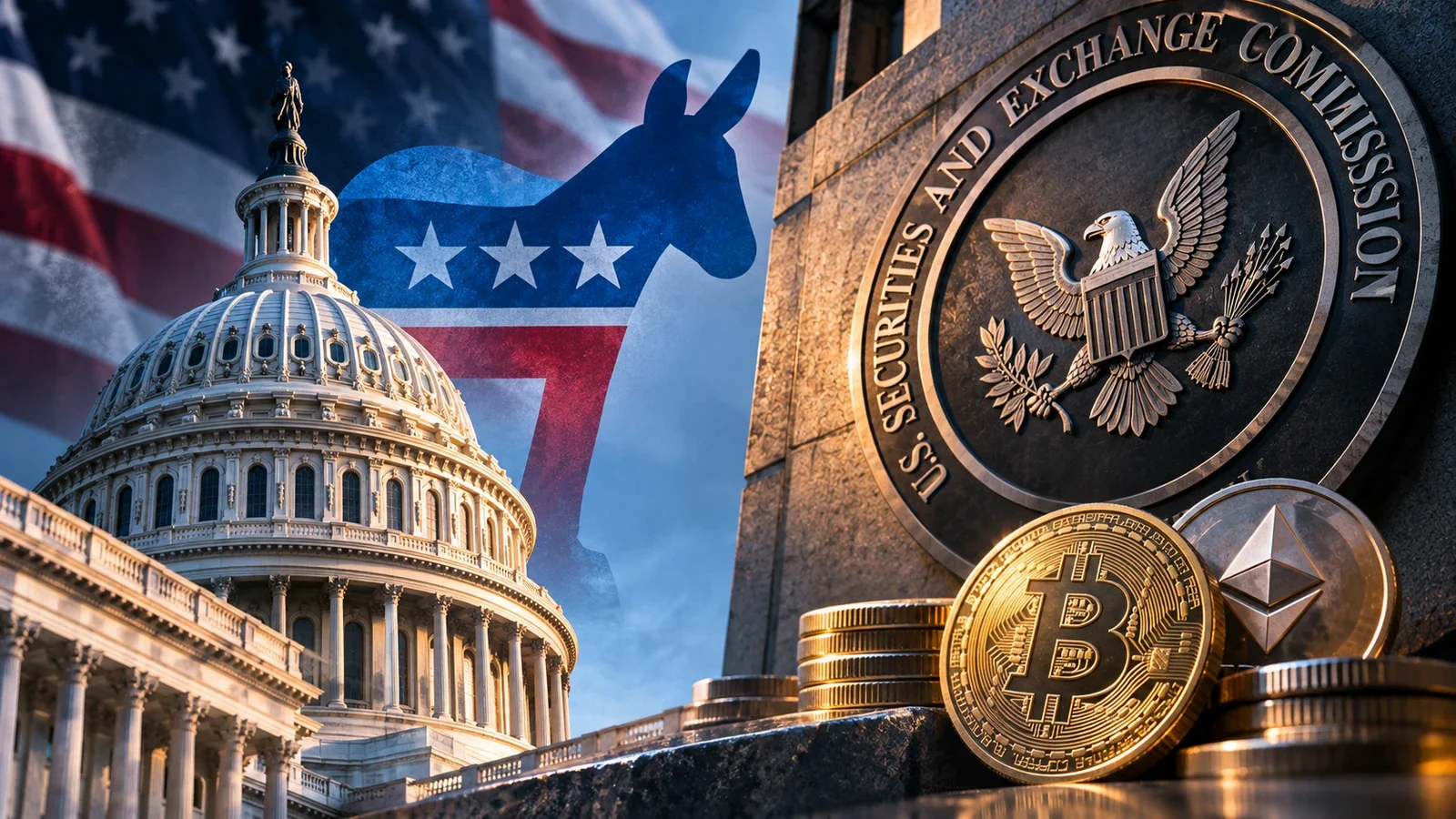
Democrats won control of the US House of Representatives and Senate in Tuesday's (3) midterm elections and are already discussing a new proposal to regulate the cryptocurrency market. The initiative could expand the powers of the Securities and Exchange Commission (SEC) and reduce the authority envisioned for the Commodity Futures Trading Commission (CFTC) in overseeing digital assets.
The talks were revealed on Wednesday (4) by journalist Eleanor Terrett, based on information from three industry sources who had contact with Democratic aides in Congress. The plan would be developed for the next legislative session, which begins in January 2027.
The proposal does not yet have published legislative text or an official date for introduction. Among the possibilities discussed is the revival of investor protection measures championed by Democratic Representative Maxine Waters during the passage of the CLARITY Act, in 2025.
Proposal could restore protections rejected in 2025
The starting point for the discussions would be the Crypto Investor and Consumer Bill of Rights, a set of measures presented by Waters as an amendment to the CLARITY Act.
The document provided for 24-hour customer service, withdrawals within 24 hours, mechanisms to protect assets in the event of platform bankruptcy and monthly proof of reserves accompanied by auditor attestation. It also established obligations related to order execution and the prevention of trades carried out with an unfair advantage over clients.
The proposal did not advance. In July 2025, the House Rules Committee rejected, by 8 votes to 4, the authorization for the amendment to be considered on the House floor.
According to Terrett, Democrats are studying combining part of these measures with provisions negotiated with Republicans in the Senate before the failure of the procedural vote on the CLARITY Act, in September 2026. The talks would also include ethics restrictions on President Donald Trump's and other federal officials' participation in businesses involving cryptocurrencies.
The main regulatory difference would be in the division of responsibilities between the federal agencies. The CLARITY Act, approved by the House in July 2025 by 294 votes to 134, would assign the CFTC a central role in overseeing spot markets for digital commodities, while preserving the SEC's authority over securities.
The bill failed to overcome a procedural vote in the Senate in September, when it received 49 votes in favor and 50 against, below the 60 needed to advance.
With Democrats taking control of both chambers in January, legislation could take a different direction from the one advocated by Republicans. However, there is no confirmation of which provisions will be included in a possible new proposal, nor that it will secure enough support to become law.