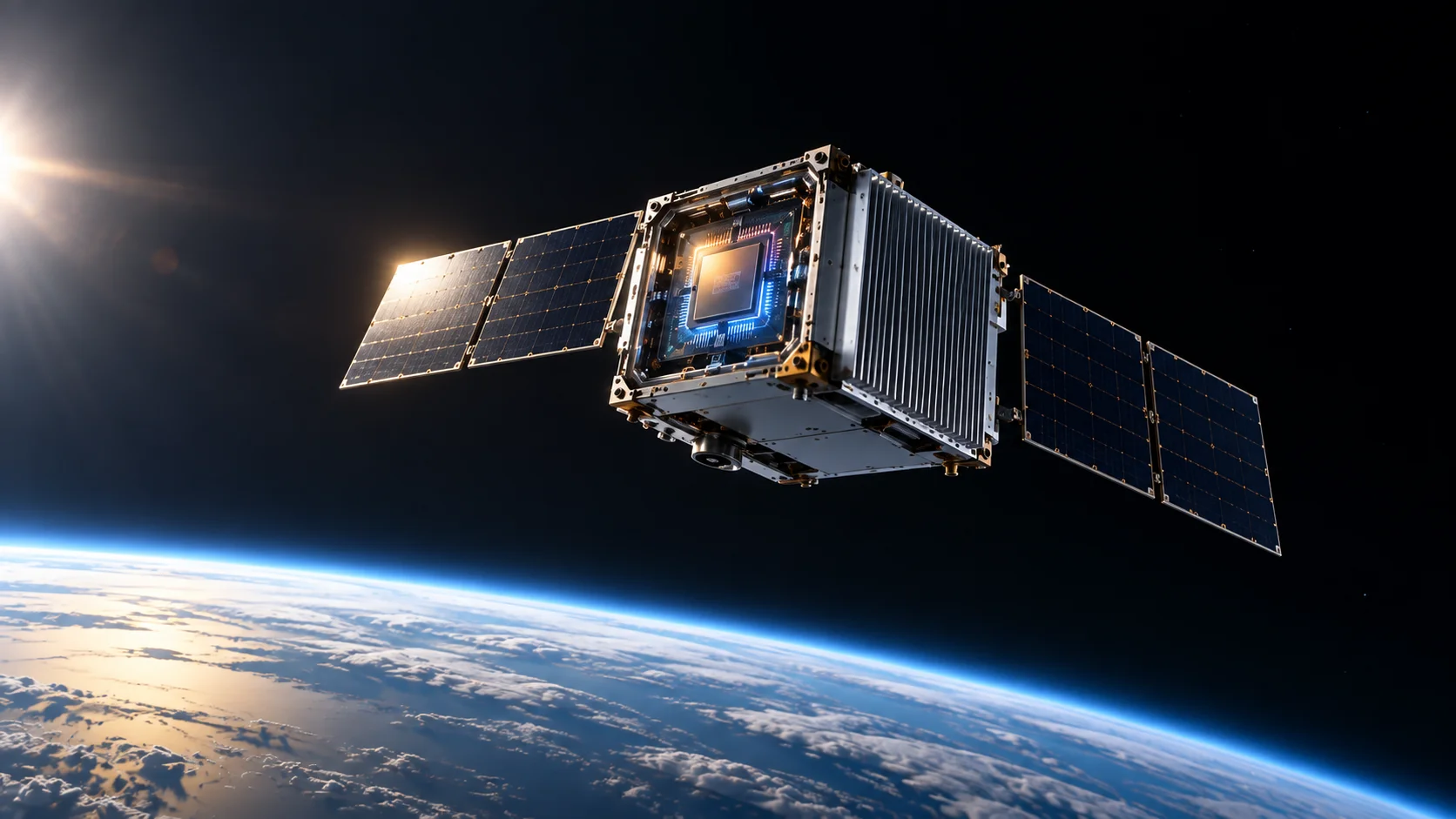
Google placed into orbit the first prototype of Project Suncatcher, an initiative that investigates whether computing infrastructure for artificial intelligence could operate in space. The satellite, developed in partnership with Planet, was launched on Thursday (1st) on SpaceX's Transporter 18 mission, and the company confirmed that it established contact with the equipment and that it is working as expected.
The launch marks the project's transition from predominantly ground-based tests to experiments in real orbital conditions. In the coming weeks, Google intends to measure how its TPUs handle vibration, radiation, and thermal extremes, factors that must be mastered before the idea of running large AI workloads in space can advance.
The equipment launched is still far from representing a complete orbital data center. It is a prototype aimed at validating components and engineering solutions that could, in the future, integrate satellite constellations with distributed processing capacity.
Before the launch, Google subjected Trillium TPUs to tests with proton beams at the Crocker Nuclear Laboratory at the University of California, Davis. According to the company, the chips withstood a total radiation dose higher than that estimated for a five-year space mission. The in-orbit operation will make it possible to verify how this behavior is reproduced outside the laboratory.
Cooling is one of the main obstacles
Heat dissipation is among the project's central problems. Conventional data centers rely on systems based on air or liquid circulation, while in the vacuum of space heat must be transferred and then radiated into the environment.
Google developed a combination of heat pipes and radiators and has already tested the system in a thermal vacuum chamber. The prototype in orbit will make it possible to observe its performance under real conditions, where thermal variations and solar exposure are different from those found in ground facilities.
Energy is precisely one of the reasons to explore this model. According to the project's research, solar panels positioned in certain orbits can produce up to eight times more energy than equivalent systems on Earth and operate with almost continuous exposure to the Sun.
Another challenge is communication. The architecture imagined by Google envisions groups of satellites with dozens of TPUs connected by high-speed optical links. To function as an integrated computing infrastructure, these devices would need to exchange large volumes of data while moving in orbit.
The next stage planned for 2027 involves placing two satellites in orbit to test this laser communication. Until then, data collected by the current prototype will be used to identify failures and guide new projects for hardware, cooling, and orbital systems.