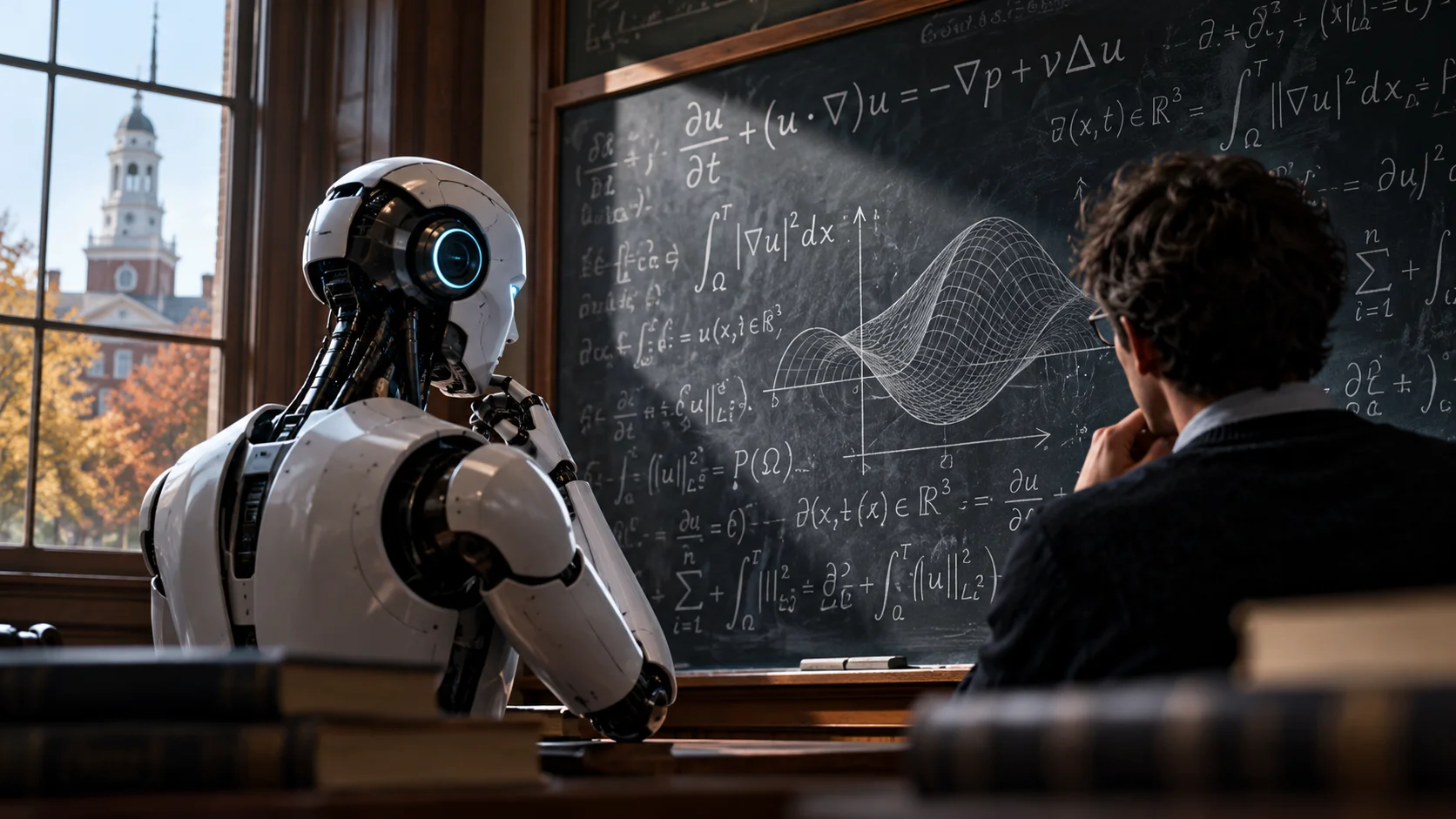
Artificial intelligence can already produce proofs of complex mathematical problems, but Harvard researchers disagree about what makes these results truly valuable. A report published by The Harvard Crimson on October 21 brought together 12 professors and researchers with differing opinions about the role of the technology in research and teaching.
The discussion gained momentum after OpenAI announced, in September, a possible solution to the Navier-Stokes existence and smoothness problem, one of the seven Millennium Problems, which offer prizes of US$ 1 million. The proof presented by the company still depends on evaluation and academic recognition.
For Ahsan Khan, a researcher at the Harvard Center of Mathematical Sciences and Applications, the validity of a result matters more than its origin. He argues that a mathematical discovery does not lose value because it was produced by a machine.
Professor Melanie Matchett Wood raises a different concern. For her, AI should expand human capacity to understand mathematics, not replace that understanding or concentrate knowledge in systems that the researchers themselves cannot explain.
Wood is also part of an independent group created in September to advise artificial intelligence companies on the responsible disclosure of mathematical results.
Tests show that correct answers still do not guarantee clear explanations
The debate finds support in an evaluation published on October 14 by the First Proof project, which submitted five AI systems to ten advanced mathematics problems.
The systems were able, together, to correctly solve all ten problems. The most efficient configuration, called ProofCouncil, got nine right, while OpenAI's GPT-6 Astra solved seven.
However, the quality of the explanations and the bibliographic references lagged behind the ability to find solutions. Among the ten answers produced by GPT-6 Astra, only four had citations considered adequate by the evaluators. In ProofCouncil, there were seven.
The results were examined by 30 specialists, who considered mathematical correctness, clarity of the proof and acknowledgment of previous work.
These limitations help explain the cautious stance of some researchers. Professor Tomer Schlank told The Harvard Crimson that he considers AI more useful, for now, for bibliographic research and programming. Other academics expressed concern about the use of scientific papers in training models without the authors' control.
The disagreement has also reached classrooms. This semester, some introductory mathematics courses at Harvard have begun adopting activities without technology, seeking to preserve the development of students' skills.
In September, a meeting held at the university with 24 mathematicians also recommended expanding in-person, written and oral assessments, without abandoning students' training to use AI tools in research.