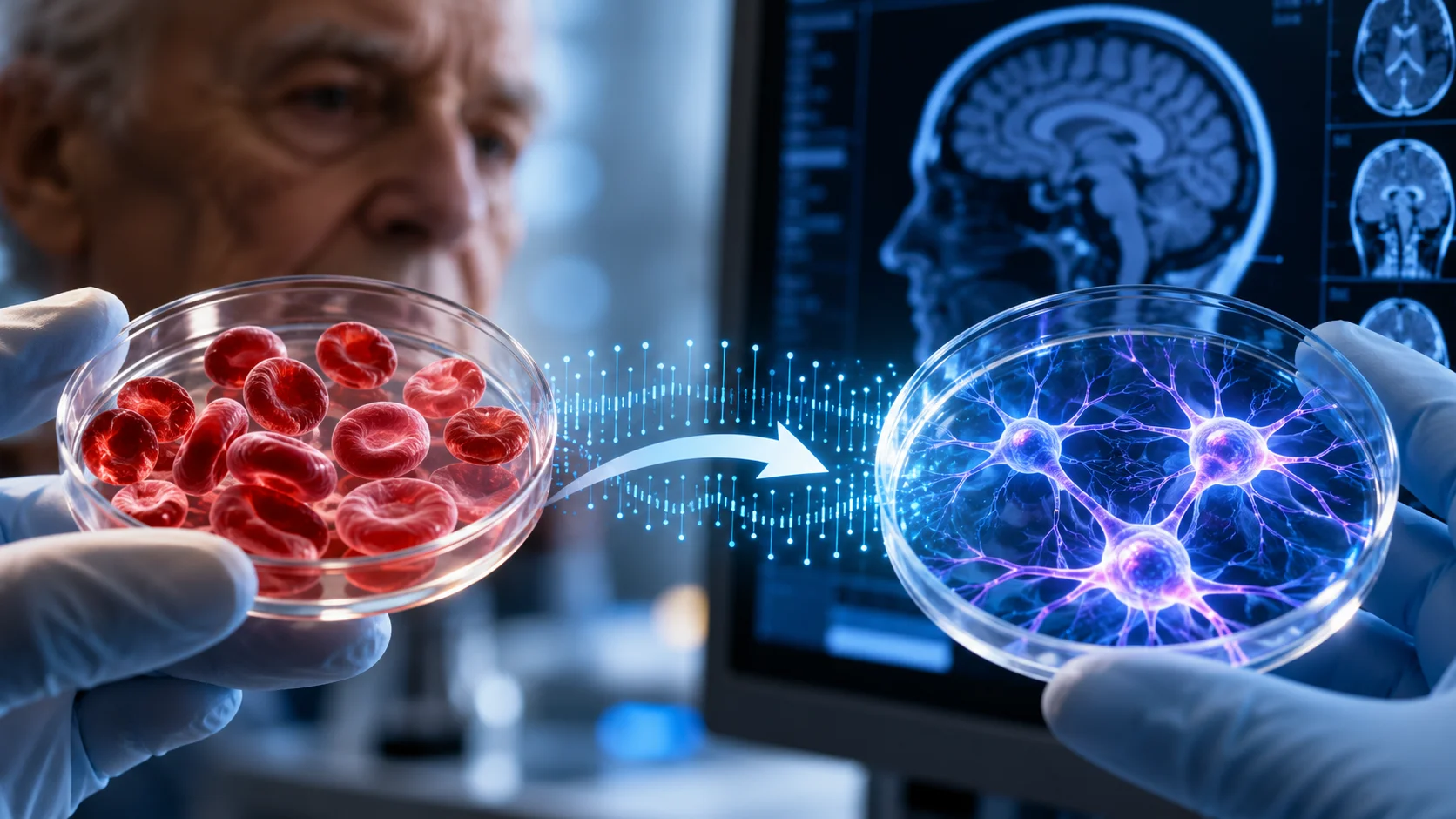
Researchers at the University of Bonn in Germany managed to transform blood cells from a person aged 80 years into neural stem cells with a molecular age under 20 years. The result was obtained in the laboratory and described in a study published on October 3 in the scientific journal Aging Cell.
The team used the transcription factors SOX2 and cMYC to reprogram red blood cell precursors, converting them directly into stem cells capable of giving rise to neurons and other types of cells in the nervous system.
During the transformation, the researchers observed a reduction of more than 60 years in epigenetic markers of aging. These markers are chemical changes in DNA used by algorithms known as epigenetic clocks to estimate the biological age of cells.
The process does not modify the genetic sequence. Instead, it alters mechanisms that control how the information present in DNA is used.
Rejuvenation continued even with reduced cell division
The study analyzed cells from 15 donors, with ages ranging from birth to 101 years. Although signs of neural identity appeared in approximately 12 days, the reduction in aging markers occurred gradually, especially during the first seven weeks, and could be tracked for more than 100 days.
This slow progression is one of the most relevant characteristics of the research. Conventional methods that go through a pluripotency stage, in which cells acquire the ability to give rise to different tissues, can reset epigenetic markers in approximately 20 days.
The team also identified an important result: epigenetic rejuvenation continued even when cell multiplication was experimentally reduced. The effect also persisted during differentiation into neurons, indicating that it does not necessarily depend on continuous cell division.
According to Oliver Brüstle, director of the Institute of Reconstructive Neurobiology at the University Hospital of Bonn, tracking this process for several weeks makes it possible to investigate which factors and substances can accelerate or slow the reduction in aging markers.
The researchers also observed that neural cells produced from older donors lost cellular characteristics normally associated with aging, including certain signs of senescence and changes in mitochondrial function.
The results do not yet represent a technique for human rejuvenation. The experiments took place in cell cultures, and epigenetic age does not correspond to a complete measure of biological aging.
The main immediate application is in scientific research. The model can help investigate cellular mechanisms related to aging and their connection to neurodegenerative diseases, including Alzheimer's, without this constituting a proven therapy.