Hong Kong announced an issuance of approximately HK$ 20 billion in digital green bonds, incorporating tokenized bank deposits into the settlement process. The operation, considered by the government to be the world's largest digital bond issuance, broadens a question for the financial market: which form of money will be used to settle tokenized assets at scale?
The answer is beginning to appear in the structure of the issuance itself. Instead of completely replacing existing systems, Hong Kong is combining traditional banking infrastructure, central bank money and tokenized deposits.
Tokenization advances from issuance to settlement infrastructure
The government's fourth digital issuance was distributed in Hong Kong dollars, yuan, US dollars and euros. The volume nearly doubled compared with the HK$ 10 billion operation carried out in November 2025.
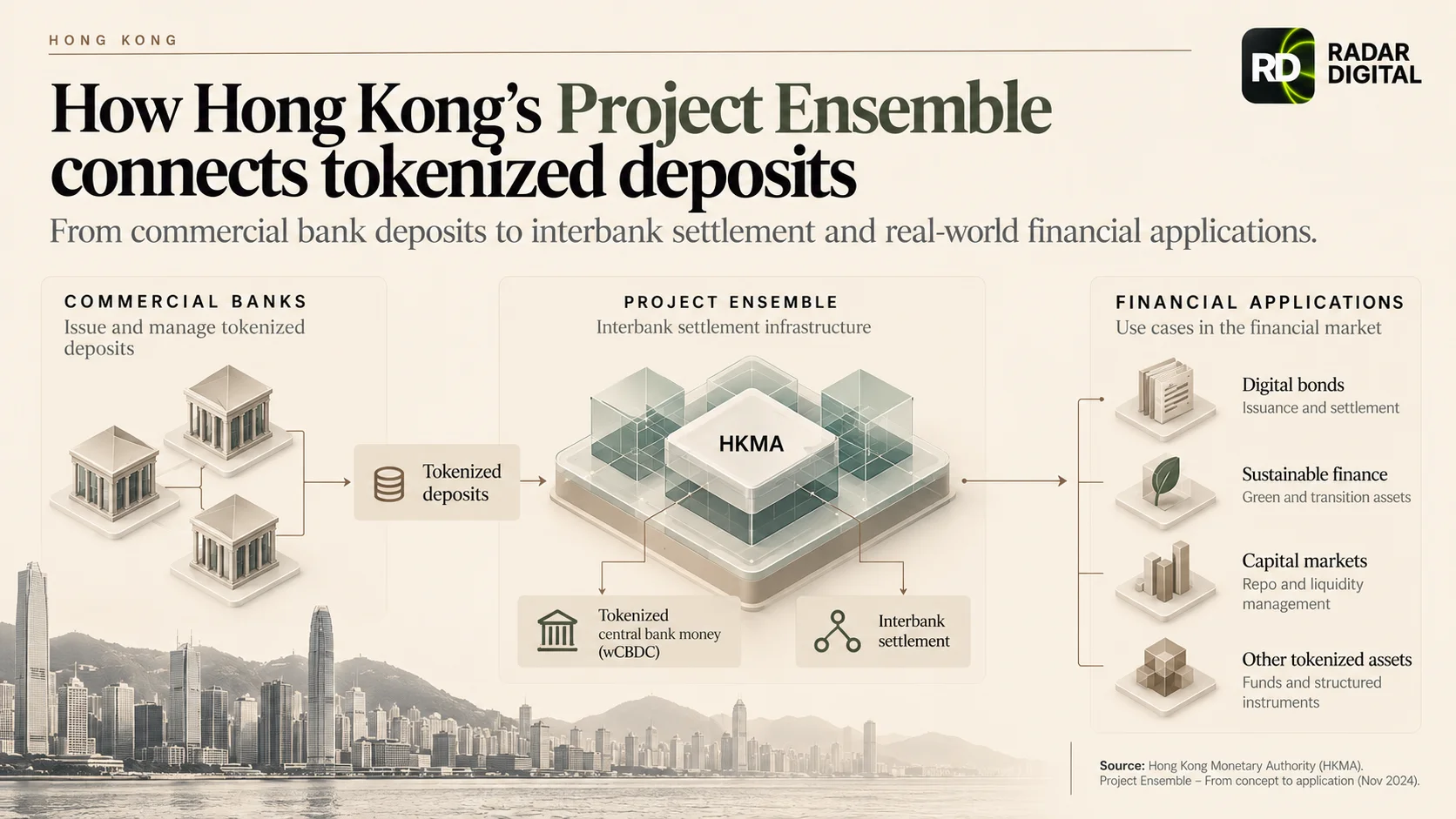
The main novelty, however, is in the HK$ 5.5 billion tranche denominated in local currency. For the first time, a government digital bond issuance incorporated tokenized Hong Kong dollar deposits into the primary settlement infrastructure.
These deposits are digital representations of funds held at commercial banks. Unlike simply registering a bond on blockchain, their use makes it possible to integrate the financial asset and the payment instrument into a programmable infrastructure.
The operation uses EnsembleTX, an initiative of the Hong Kong Monetary Authority (HKMA), which advanced to real-value transactions in November 2025. The project connects banks and market participants to develop financial operations involving tokenized deposits and assets.
The progress is concrete, but it requires a distinction: the HK$ 20 billion represents the total value of the issuance, not the amount actually settled with tokenized deposits. The documentation released confirms the incorporation of this modality into the operation, but does not state what volume was settled through it.
Stablecoins, tokenized deposits and CBDCs compete for different functions
The operation shows that the tokenization of financial markets does not necessarily depend on stablecoins.
The three main digital settlement instruments have distinct characteristics.
Stablecoins make it possible to transfer digital representations of currencies over blockchain networks. Depending on the issuer, regulation and infrastructure used, they can facilitate transactions between participants on different platforms, but they require their own mechanisms for reserves, redemption and risk management.
Tokenized deposits preserve the legal relationship between the customer and their commercial bank. Their main institutional advantage lies in the possibility of adapting existing bank deposits to programmable operations while maintaining integration with traditional financial services.
Meanwhile, central bank digital currencies intended for the institutional market, known as wholesale CBDCs, can function as settlement assets between financial institutions, reducing exposure to commercial bank credit risk at this stage.
These differences also appear in the strategy of the Bank for International Settlements (BIS), which advocates the integration of central bank reserves, commercial deposits and tokenized financial assets as a possible architecture for capital markets.
Hong Kong is putting part of this architecture into practice. The issuance maintains traditional settlement channels, offers the tokenized central bank money modality introduced in 2025 and adds tokenized bank deposits to the tranche denominated in Hong Kong dollars.
The absence of stablecoins in this structure does not determine which instrument will prevail in the market. It shows, however, that there is a tokenization path in which commercial banks and monetary authorities preserve central functions, without depending on private stablecoin issuers.
Traditional banks continue to control essential parts of the operation
The issuance infrastructure helps explain why tokenization does not automatically eliminate financial intermediaries.
The bonds use the HSBC Orion platform and are cleared and settled through the Central Moneymarkets Unit (CMU), operated by the monetary authority. The CMU maintains connections with Euroclear and Clearstream, allowing investors to use already established international structures.
HSBC also participates as trustee and principal paying agent. Other international banks perform distribution, coordination and organization functions for the offering.
This configuration preserves essential mechanisms of custody, institutional access and legal certainty. Settlements carried out by the CMU have legal finality protection in Hong Kong.
Interoperability, however, remains a challenge.
EnsembleTX was launched with interbank settlement initially supported by Hong Kong's traditional real-time payment system. The evolution toward continuous settlement using tokenized central bank money is part of the project's planned development.
Therefore, integrating tokenized deposits into a bond issuance does not mean that all stages of the operation already function independently, continuously and entirely within a blockchain.
Another relevant change is in standardization. The issuance adopted version 2.0 of the Bond Data Taxonomy, developed by the International Capital Market Association (ICMA). The standard establishes a structured representation of bond data, facilitating its use by different institutions and systems.
This standardization is necessary to reduce fragmentation between platforms, especially when different banks, depositories and markets need to share information over the life of a bond.
The size of the issuance still does not prove operational efficiency
Hong Kong's evolution shows that digital issuance of public debt has already surpassed small-scale experiments.
The government carried out its first tokenized issuance in 2023, worth HK$ 800 million. In November 2025, it reached HK$ 10 billion. The current operation raises this level to approximately HK$ 20 billion.
Even so, the increase in volume does not, in isolation, prove a reduction in issuance costs or an improvement in the liquidity of the bonds.
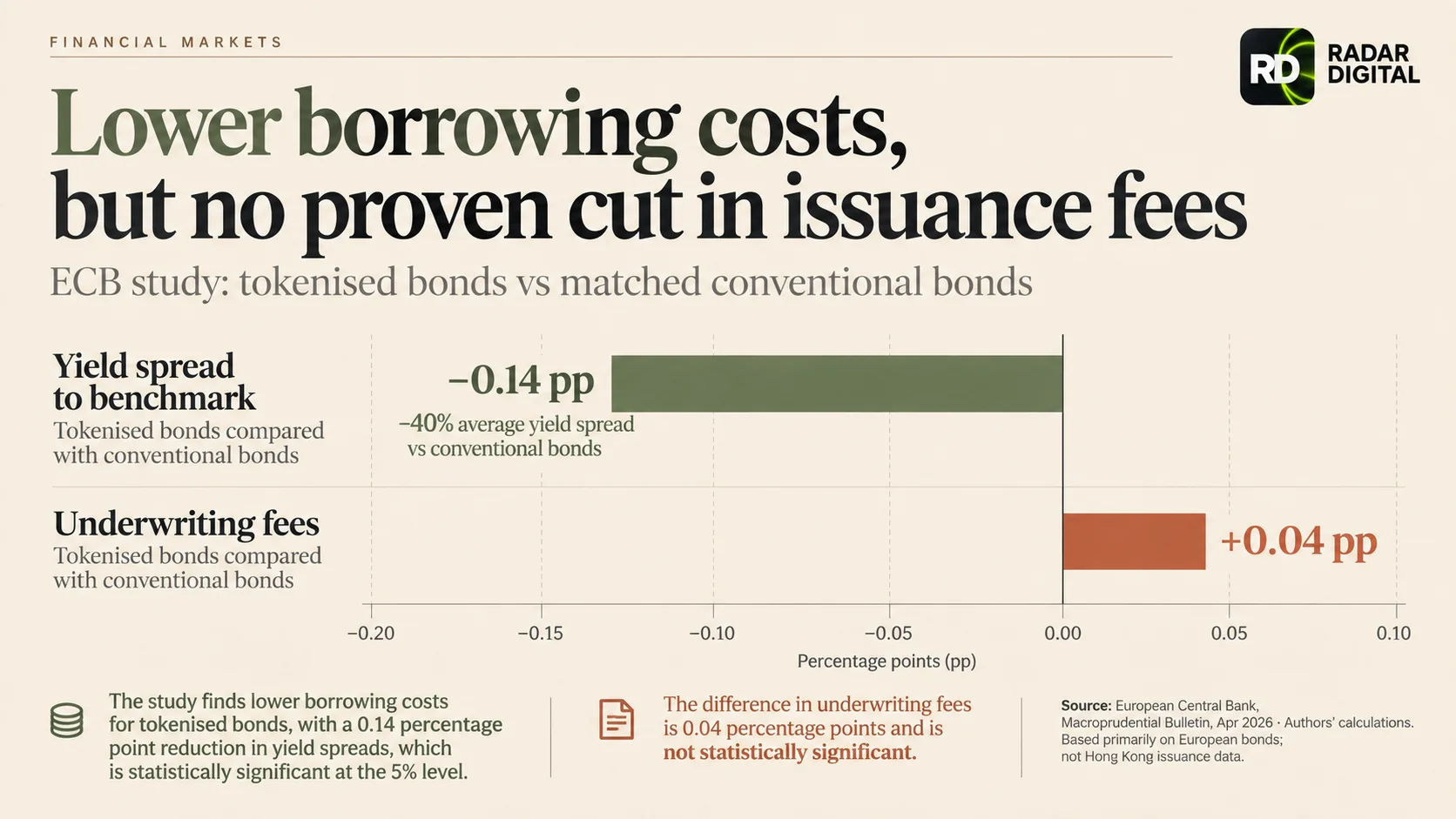
The current operation maintains a one-business-day settlement cycle, known as T+1. Nor has sufficient data been released to compare the costs of the different payment instruments or determine how much of investor demand can be attributed specifically to the technology used.
This information is important for assessing whether tokenization offers economic advantages capable of sustaining its adoption outside government programs.
The next test will be in the recurring use of the infrastructure. The effective participation of tokenized deposits in settlements, the trading of the bonds on the secondary market and the ability to connect different platforms will be more revealing indicators than the announced volume.
Hong Kong has already demonstrated that digital bonds can achieve a relevant scale within the institutional market. The next step will be to prove that the same infrastructure can process recurring operations with efficiency, interoperability and competitive costs.