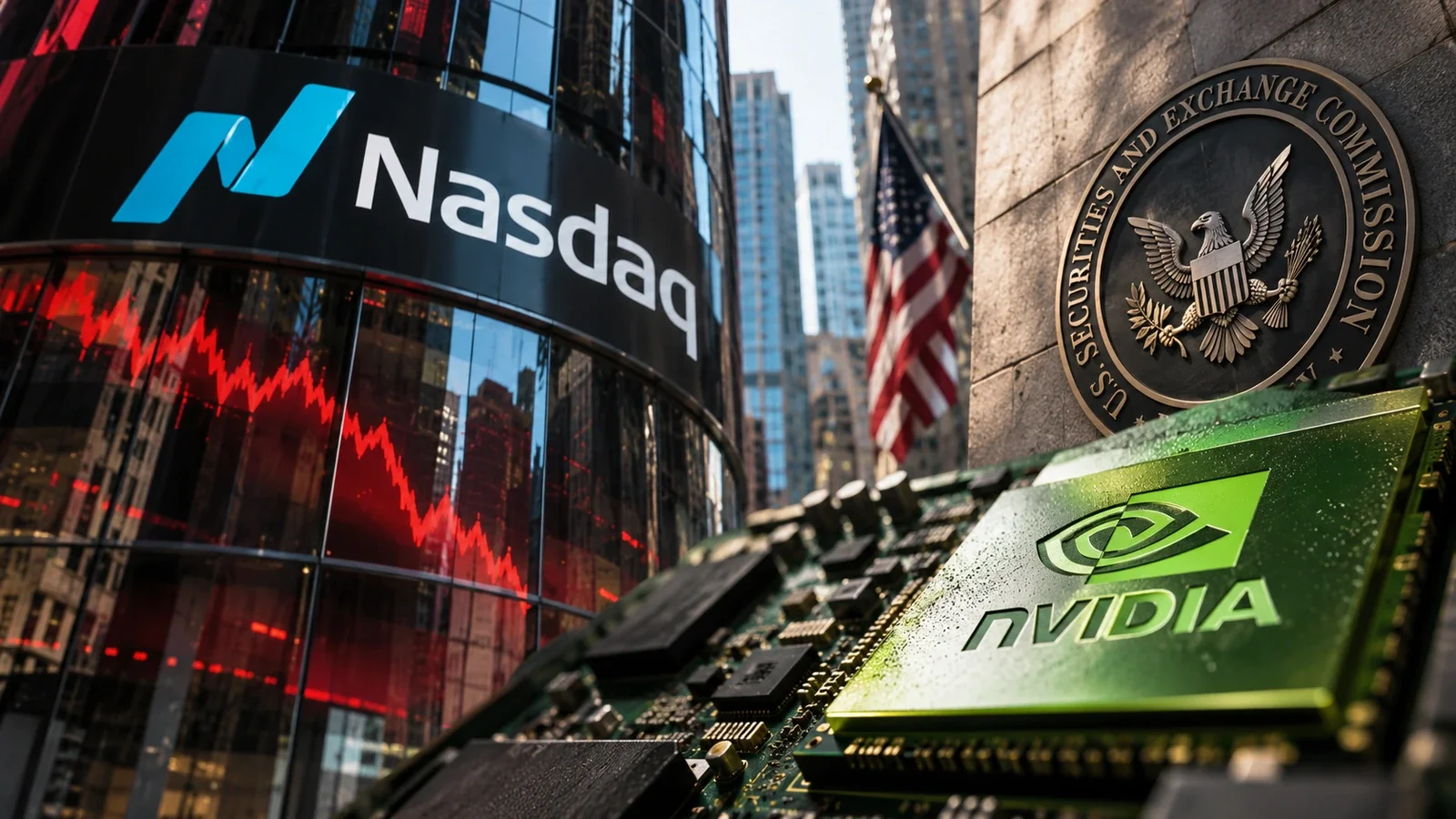
The Nasdaq Composite fell 5.3% on Friday (20), closing the session in New York at 22,617.73 points, while the S&P 500 dropped 3.7%, to 6,910.39 points, entering correction territory. Nvidia lost 14.01%, closing at US$ 125.53, after Reuters reported that the U.S. Securities and Exchange Commission (SEC) is examining possible accounting issues at the chipmaker.
The decline marked yet another losing session for the S&P 500, which accumulated an 8.6% drop for the week and ended more than 10% below its October record. The Dow Jones fell 1.9%, to 48,147.33 points, also in correction, while the Nasdaq moved into losses for 2026.
Nvidia completed its 7th consecutive week of decline, the longest streak since the 2008 financial crisis. The company has lost approximately US$ 2.5 trillion in market value since its October peak, amid deteriorating investor confidence in artificial intelligence-related companies.
Why Nvidia fell even with record revenue
The chipmaker had reported on Tuesday (17) a record quarterly revenue of US$ 115.8 billion, growth of 103% compared with the same period a year earlier. The data center division accounted for US$ 107.6 billion, up 110%, while net income reached US$ 65.3 billion.
The results, however, did not prevent the intensification of stock selling after Reuters reported, based on two anonymous sources familiar with the matter, that members of the SEC's enforcement area are examining possible accounting problems at the company.
The regulatory agency declined to comment, and Nvidia did not immediately respond to Reuters' requests. The report could not determine which specific practices are under review or when the investigation began. There is no public conclusion of wrongdoing, and the existence of an investigation is not proof of fraud.
Another point of attention is the quarterly 10-Q report. Although it disclosed its financial results, Nvidia said, in a document filed with the SEC, that it will submit the complete form “in the coming weeks”. The decision goes against its recent practice of delivering the document alongside results, but remains within the regulatory deadline of 40 days after the end of the quarter.
The discussion also involves an earlier change in the presentation of revenue by region. In the 3rd quarter of fiscal year 2026, Nvidia began classifying revenue by the location of customers' headquarters instead of billing address. The change, acknowledged in official documents, removed Singapore from individual geographic disclosure.
According to the Financial Times, corporate filings show that Nvidia's Singapore subsidiary recorded approximately US$ 104 billion in external revenue in 2025, a value close to half of the chipmaker's global sales in that period. The figure does not mean that the chips were delivered or used in the country. Nor is there confirmation that this specific change is the subject of the SEC investigation.
Decline hits Asian markets and broadens doubts about AI financing
The pressure on semiconductor companies had already reached Asian markets on Friday (20), before the close in New York. Japan's Nikkei 225 fell 5.06%, while South Korea's Kospi dropped 5.21%. In Taiwan, the main index lost 6.2%.
Concern also extends to the financing of artificial intelligence infrastructure. In its quarterly documentation, Nvidia detailed potential commitments of up to US$ 32 billion related to specialized cloud providers, conditioned on obtaining financing and deploying the infrastructure.
For Richard Saperstein, chief investment officer at Treasury Partners, speaking to Reuters, the market is going through a reassessment of AI companies given prospects of a slowdown in data center construction and a reduction in funding sources for new projects.
The next relevant documentary information will be the filing of the 10-Q, which could bring additional details about Nvidia's finances and commitments. So far, the record results and the change in the geographic disclosure criterion are documented, while the scope of the accounting investigation reported by Reuters remains without public confirmation from the SEC.